Active Recall Techniques: The Complete Guide to Studying Smarter
If you’ve ever reread a chapter three times and still blanked on the exam, active recall techniques are the fix you’ve been missing. Active recall means testing yourself on information instead of simply reviewing it, and it consistently produces stronger memory than rereading or highlighting ever will. This guide walks through the science behind it, the specific techniques that work best, and exactly how to build them into a study routine that actually holds up under exam pressure.
What Is Active Recall?
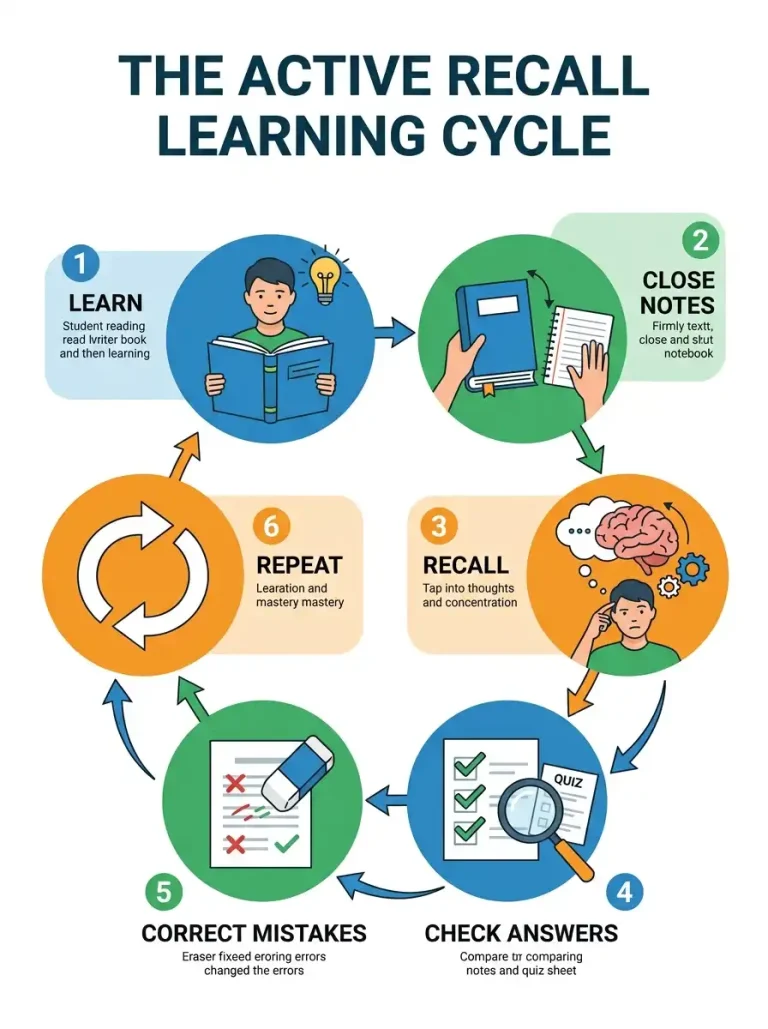
Active recall is a learning method built around retrieving information from memory rather than looking at it again. Instead of scanning your notes for the tenth time, you close them and try to answer a question, explain a concept, or list everything you remember. This retrieval attempt, often called retrieval practice, is what separates active recall from every passive study habit.
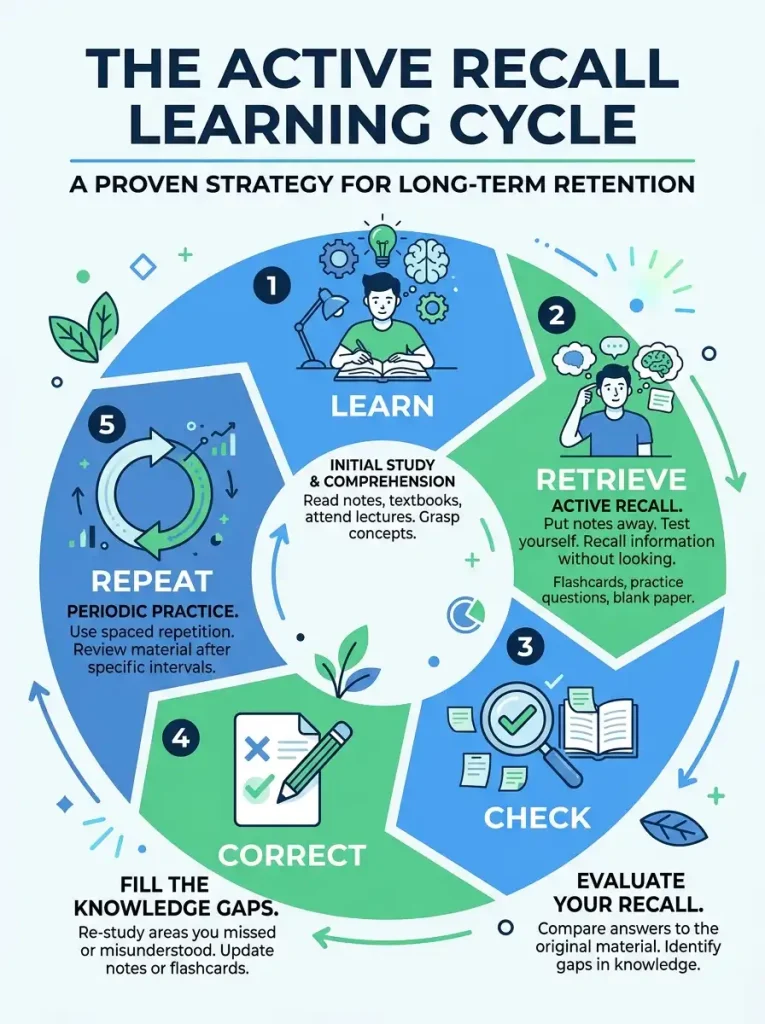
The difference sounds small at first, but it changes everything about how your brain handles information. Recognizing a fact on a page feels easy because your brain only needs to match it against something familiar. Producing that same fact from nothing requires a completely different kind of mental work, and that extra effort is exactly what strengthens memory.
Think about the last time you tried to recall a phone number without looking at your contacts. That mental reach, that brief moment of searching, is retrieval in action. Active recall techniques simply recreate that same process on purpose, using structured tools instead of leaving it to chance.
Why Active Recall Works
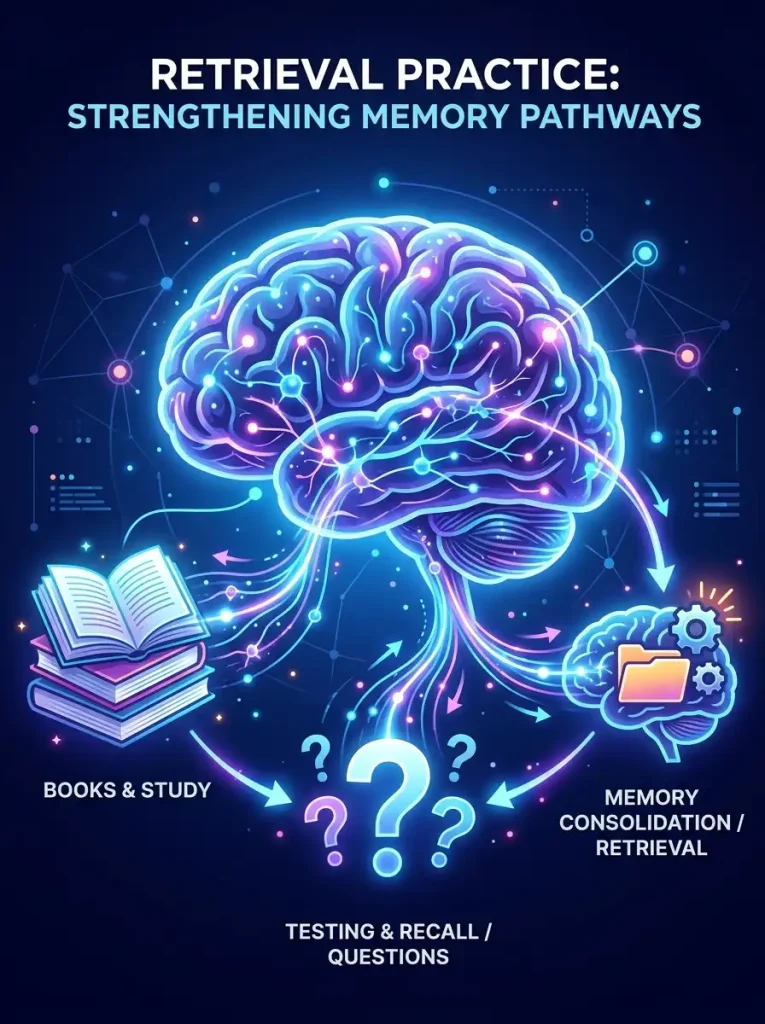
Every time you retrieve a memory, you reinforce the neural connections tied to it. Cognitive psychologists refer to this as the testing effect, and decades of memory research support it consistently. Simply put, retrieving information makes it easier to retrieve again later, while rereading mostly just builds a false sense of familiarity.
There’s a concept in learning science called desirable difficulty. It describes how a bit of struggle during learning, as long as you eventually succeed, actually improves retention more than an easy, frictionless review session. Active recall creates exactly that kind of manageable struggle, which is why it feels harder than rereading even though it works better.
Long-term memory depends heavily on this retrieval effort rather than exposure time. You could spend an hour rereading a page and retain very little, or spend fifteen minutes testing yourself and retain far more. The quality of the mental effort matters more than the number of minutes you log.
The Science Behind Memory Retrieval
Memory formation involves encoding, storage, and retrieval, and most students only focus on the first stage. Encoding happens when you first learn something, storage is how your brain holds onto it, and retrieval is how you pull it back out when needed. Active recall strengthens all three stages by repeatedly forcing retrieval, which in turn reinforces storage and even improves how future information gets encoded.
Researchers studying memory retrieval have found that forgetting isn’t necessarily a sign of failure. In fact, a small amount of forgetting between study sessions can make the next retrieval attempt more effective, since your brain has to work slightly harder to bring the memory back. This is part of why spacing out your review sessions, rather than cramming them together, produces better long-term results.
Active Recall vs Passive Review
Passive review includes habits like rereading textbooks, highlighting sentences, and watching lecture recordings without pausing to test yourself. These methods feel productive because they’re comfortable, but comfort doesn’t predict exam performance. Highlighting, in particular, often creates an illusion of learning since the information looks familiar without ever being tested.
Active recall flips that comfort on its head. It asks you to sit with uncertainty for a moment, produce an answer, and then check it. That small discomfort is uncomfortable precisely because your brain is working harder, and that harder work is what builds durable memory.
Here’s a simple comparison of the two approaches:
| Passive Review | Active Recall |
|---|---|
| Rereading notes repeatedly | Testing yourself without notes |
| Highlighting key phrases | Writing answers from memory |
| Watching lectures again | Explaining concepts out loud |
| Feels comfortable and familiar | Feels effortful but productive |
| Builds recognition, not recall | Builds true long-term recall |
Evidence From Cognitive Psychology
Cognitive psychology has studied retrieval practice for decades, and the consistent finding is that testing yourself improves retention more than equivalent time spent rereading. This pattern holds across many subjects, from vocabulary lists to complex scientific concepts, suggesting the effect isn’t limited to simple memorization tasks.
What makes this especially useful for students is that the benefit shows up even when initial recall attempts fail. Trying to remember something, even unsuccessfully, and then seeing the correct answer still strengthens memory more than never attempting recall at all. This means there’s very little downside to testing yourself early, even before you feel fully ready.
Different Active Recall Techniques
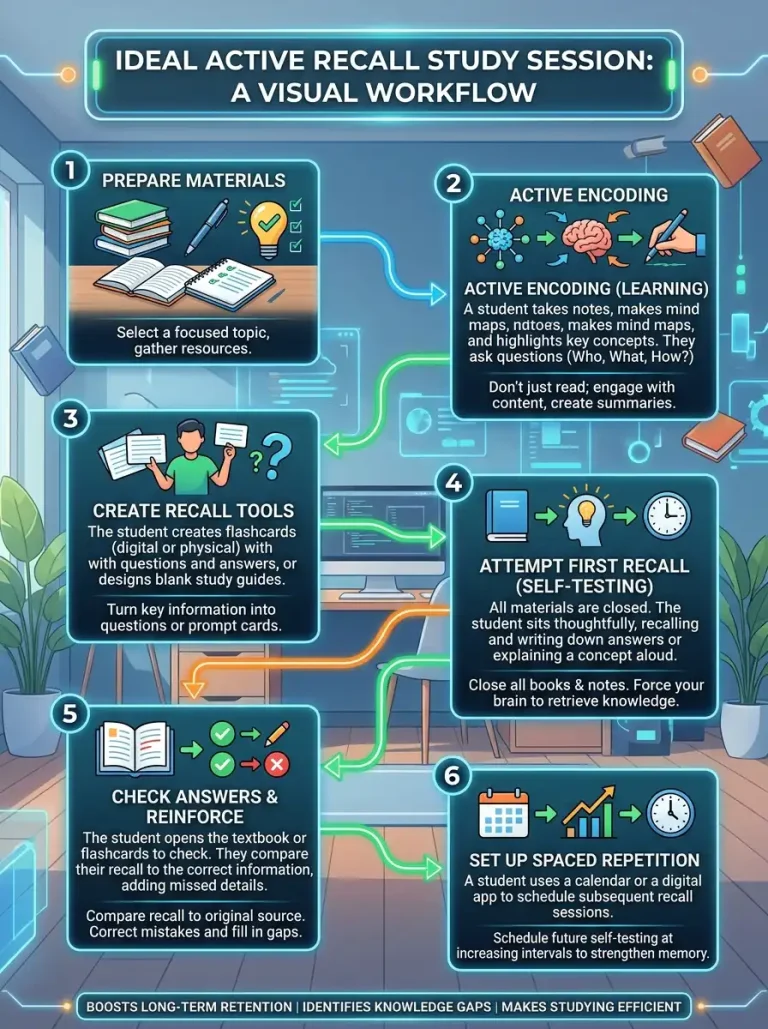
Active recall isn’t one single method. It’s a family of techniques that all share the same core principle: retrieve first, check second. Choosing the right technique often depends on the subject, the format of your exam, and how much time you have before test day.
Flashcards
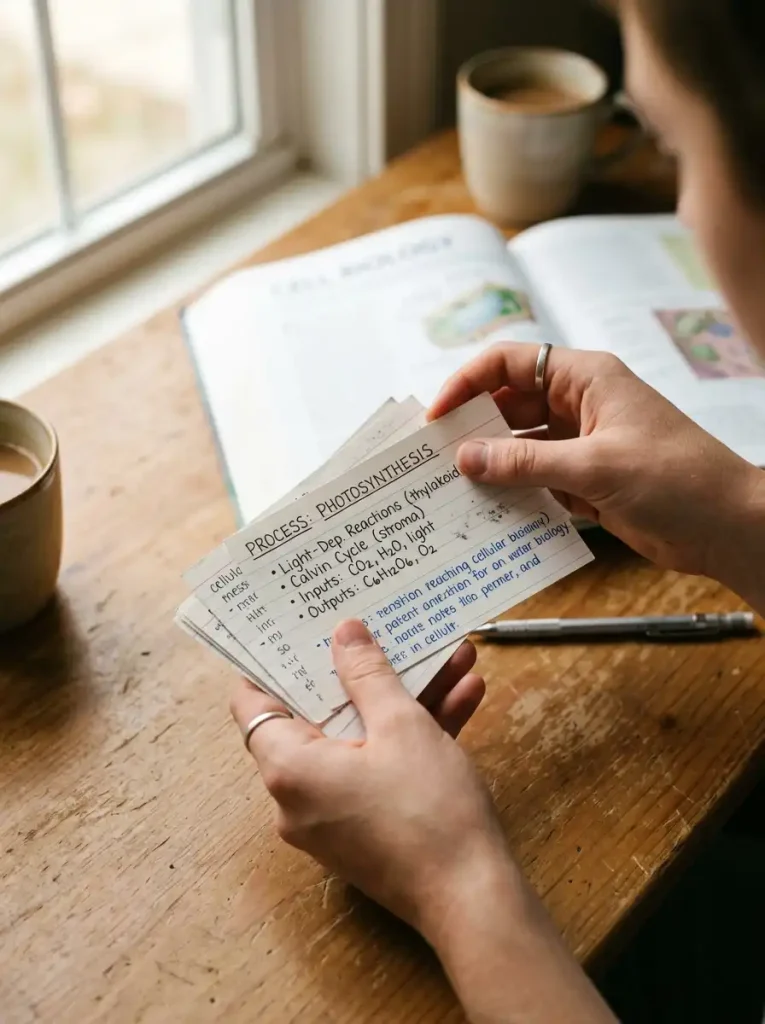
Flashcards remain one of the most familiar active recall tools, and for good reason. Each card presents a question or term on one side and the answer on the other, forcing a quick retrieval attempt before you flip it over.
They work particularly well for vocabulary, definitions, formulas, and discrete facts. Language learners, medical students memorizing terminology, and anyone studying isolated pieces of information tend to benefit most from this format.
A quick example: a nursing student might write “signs of hypoglycemia” on the front of a card and list symptoms like shakiness, confusion, and sweating on the back. Flipping through a stack daily builds fast, reliable recall for exam-day recognition and clinical situations alike.
Self-Testing
Self-testing broadens the flashcard idea into full practice questions, short quizzes, or verbal self-quizzing without any cards at all. Instead of single facts, you test broader understanding, like explaining a process or solving a problem from scratch.
This technique suits subjects with more complexity than a flashcard can capture, such as history essays, scientific processes, or multi-step math problems. It also works well as a quick check at the end of a study session, before moving to the next topic.
Blurting Method
The blurting method asks you to write down absolutely everything you remember about a topic on a blank page, without looking at notes first. Once you’ve exhausted your memory, you compare your page against the original material and mark what you missed.
This technique exposes gaps that structured questions sometimes hide, since there’s nowhere to hide behind a multiple-choice format. It works especially well for subjects with lots of interconnected ideas, like biology, sociology, or economics, where understanding relationships between concepts matters as much as memorizing facts.
Retrieval Practice
Retrieval practice is really the umbrella term underneath all of these techniques, since every method above depends on pulling information from memory rather than reviewing it passively. Structuring dedicated retrieval sessions, separate from your initial learning, keeps this practice consistent rather than accidental.
A simple approach: after reading a chapter, wait ten minutes, then try to summarize the main points without looking back. This short delay adds a small retrieval challenge that strengthens the memory more than testing yourself immediately.
Practice Exams
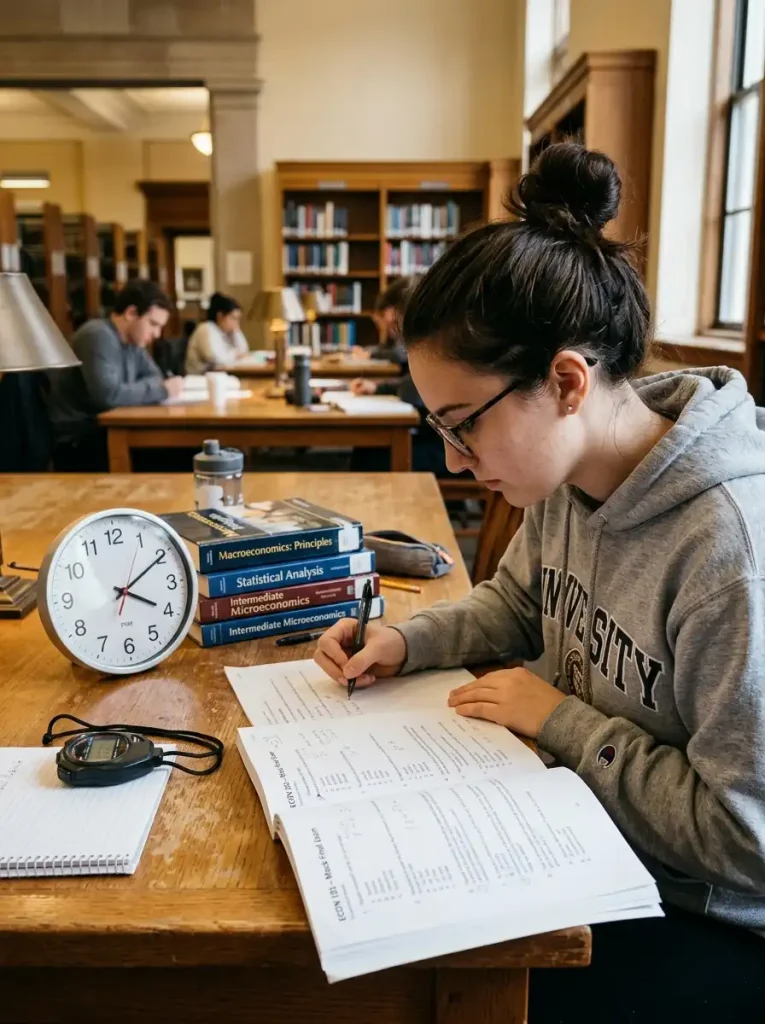
Practice exams simulate real test conditions by using timed, closed-note questions that match your actual exam format. This technique combines content recall with the added pressure of time constraints, which mirrors what you’ll face on the real day.
Running through a few past papers or practice tests in the final weeks before an exam builds both content mastery and pacing skills. Many students discover they know the material but run out of time, and practice exams catch that problem before it costs marks on the real test.
Question Generation
Question generation asks you to write your own test questions instead of relying only on pre-made materials. Creating a good question requires understanding a topic well enough to know what’s worth asking, which itself deepens comprehension.
Try writing three to five questions after each study session, covering the most important points from what you just learned. Trade questions with classmates for an easy way to expand your question bank without doubling your own workload.
Teaching Others (The Feynman Technique)
The Feynman Technique asks you to explain a concept in plain language, as though teaching someone with no background in the subject. Wherever your explanation gets stuck or overly vague, that’s exactly where your understanding has a gap.
This method works particularly well for concept-heavy subjects like physics, economics, or philosophy, where explaining “why” matters more than reciting a definition. Try explaining a tricky topic out loud to a friend, a study partner, or even an empty room, and notice where you stumble.
Spaced Repetition Combined With Active Recall
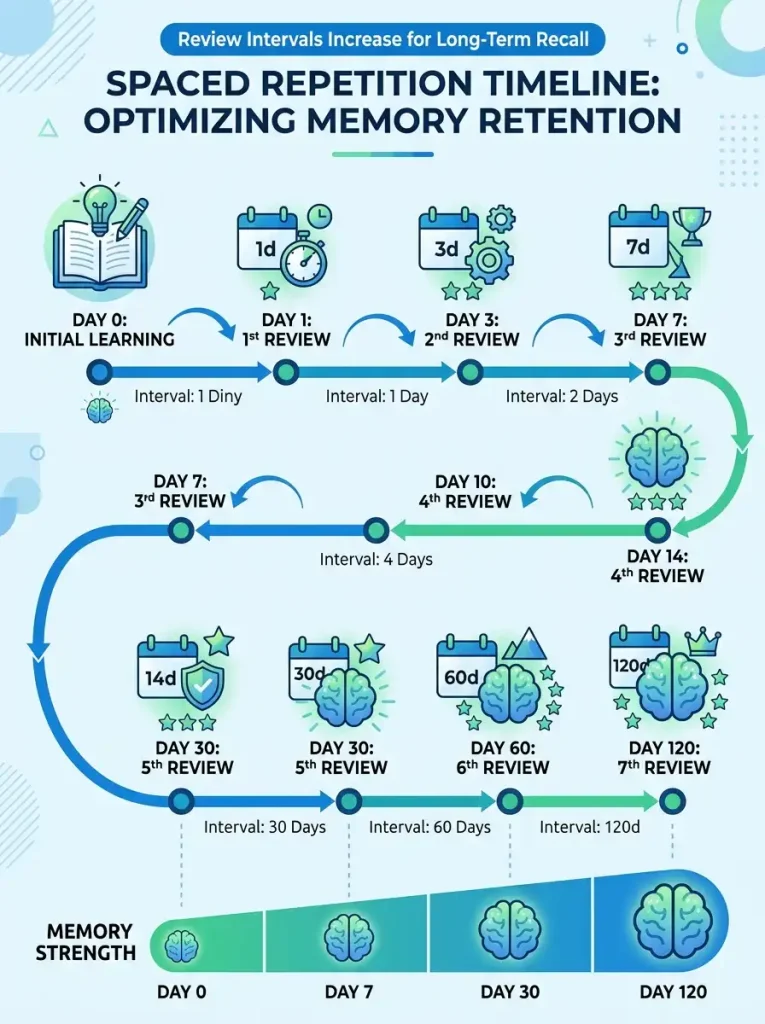
Spaced repetition determines when you review material, while active recall determines how you review it. Combined, they create a system where you retrieve information at increasing intervals, building memory that lasts well beyond a single exam.
A typical spacing pattern might look like this:
- Review one day after first learning the material.
- Review again three days later.
- Review a week after that.
- Review once more after two to three weeks.
Each retrieval attempt at a longer interval strengthens the memory more than reviewing the same day repeatedly. This is part of why cramming, despite feeling productive in the moment, rarely produces retention that lasts past the exam itself.
Cornell Notes Integration
Cornell Notes divide a page into a note-taking column, a narrower cue column, and a summary section at the bottom. The cue column, filled in after your notes are complete, works naturally as a set of retrieval prompts for later review.
To use this system for active recall, cover the notes column entirely and try answering each cue from memory. Only after attempting recall should you uncover your notes to check accuracy. This turns an ordinary note-taking format into a built-in self-testing tool without requiring separate flashcards or worksheets.
Mind Maps and Recall
Mind maps organize information visually, using branches and connections between related ideas. While often used for brainstorming, they also support active recall when built from memory rather than copied from a textbook.
Try drawing a mind map on a blank page using only what you remember about a topic, then compare it against your notes afterward. Gaps in your branches point directly to concepts that need more review. This approach works particularly well for subjects built around relationships between ideas, like biology systems or historical cause-and-effect chains.
Digital Tools and Apps
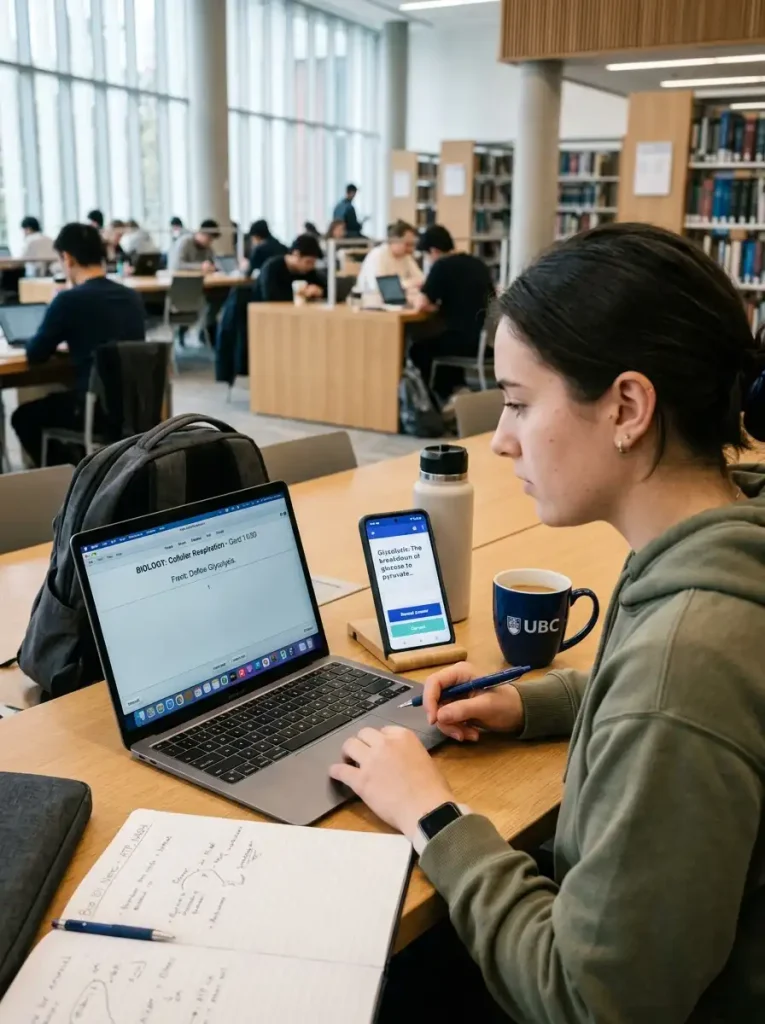
Digital flashcard apps have become popular largely because they automate spaced repetition scheduling, showing you cards right when you’re likely to forget them. This removes the guesswork of manually planning review intervals, which many students find genuinely useful.
That said, digital tools work best as a supplement rather than a total replacement for paper-based methods. Typing an answer engages less motor memory than handwriting one, and app notifications can sometimes introduce the very distractions active recall is meant to avoid.
Paper-Based Methods
Paper-based active recall techniques, like handwritten flashcards, blurting sheets, and printed practice questions, offer a few distinct advantages over screens. Handwriting engages motor memory alongside verbal memory, and physical paper removes the temptation to switch tabs or check notifications mid-session.
Paper also makes review sessions easier to plan visually. A stack of completed worksheets or flashcards gives you a tangible sense of progress that a digital app’s statistics screen doesn’t always replicate in the same way.
Mistakes to Avoid
Even strong techniques lose effectiveness when applied incorrectly. Here are the mistakes that show up most often, along with simple fixes.
- Rereading instead of retrieving: Close your notes completely before attempting any recall exercise, rather than glancing back mid-question.
- Checking answers too soon: Sit with uncertainty a little longer before looking anything up, since that discomfort is where memory strengthening happens.
- Skipping spaced reviews: Schedule follow-up sessions in advance rather than relying on memory to remind you when a topic needs revisiting.
- Overloading single sessions: Mixing too many new topics into one sitting reduces focus, so limit each session to a manageable amount of material.
- Ignoring wrong answers: A missed question points directly to a specific gap, so review it immediately rather than moving on without correction.
Best Study Schedule for Active Recall
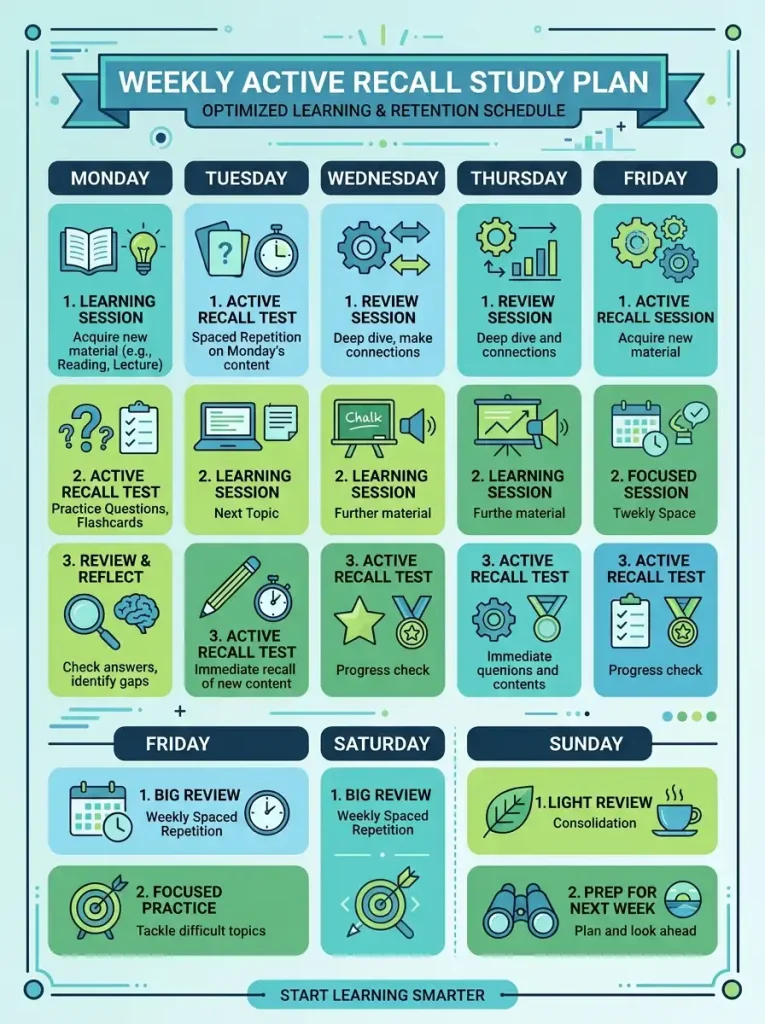
A workable weekly schedule balances new learning, initial recall, and spaced review without overwhelming any single day. Here’s a simple structure many students find sustainable:
- Monday and Tuesday: Learn new material through lectures, textbooks, or reading.
- Wednesday: Run a blurting session or self-test on Monday’s content.
- Thursday: Create flashcards or Cornell Notes cues for Tuesday’s material.
- Friday: Complete a short practice quiz mixing this week’s topics together.
- Weekend: Review anything flagged as weak, then plan next week’s spacing intervals.
Adjust the exact days to fit your own schedule, but keep the underlying pattern: learn, then test, then space out your reviews.
Active Recall for Exams
Exam preparation benefits enormously from practice exams and timed self-testing in the final stretch before test day. Once you’ve built a solid foundation using flashcards, blurting, and spaced review, shift toward full practice tests that mimic real exam conditions as closely as possible.
Pay attention to timing during these practice sessions, not just accuracy. Many students know the material well but lose marks simply because they run out of time, and practice exams are the only way to catch that problem before it costs you on test day.
Active Recall for University Students
University coursework often spans multiple subjects with very different demands, from essay-based humanities courses to formula-heavy science classes. Active recall adapts well to both, though the specific technique should match the subject.
For essay-based subjects, question generation and the Feynman Technique tend to work best, since they train you to construct arguments rather than just recite facts. For formula-heavy subjects, practice exams and flashcards covering key equations tend to produce faster, more reliable results.
Active Recall for Professional Certifications
Professional certification exams, whether in finance, healthcare, project management, or technology fields, often cover large volumes of material within a fixed timeframe. Active recall becomes essential here simply because there’s too much content to rely on rereading alone.
Building a spaced repetition schedule months in advance, combined with regular practice exams closer to the test date, gives working professionals a realistic path through dense material without needing to set aside entire days for studying.
Active Recall for Language Learning
Language learning depends heavily on recalling vocabulary, grammar rules, and sentence structures under real conversational pressure, not just recognizing them on a page. Flashcards remain a staple here, but self-testing through speaking practice adds an important layer that pure vocabulary drills miss.
Try describing your day out loud in the language you’re learning, without translating from your native language first. This forces genuine retrieval rather than translation, which better matches how you’ll actually need to use the language in conversation.
Daily Active Recall Routine
Consistency matters more than intensity when it comes to building long-term retention. A short daily routine, even fifteen to twenty minutes, tends to outperform occasional long study marathons.
A simple daily checklist might include:
- [ ] Review yesterday’s flashcards before starting anything new.
- [ ] Complete one blurting session on a recent topic.
- [ ] Write two or three practice questions based on today’s material.
- [ ] Note tomorrow’s scheduled review topics based on spacing intervals.
Sticking to a routine like this, even loosely, builds the kind of steady retention that cramming simply can’t replicate.
Common Myths About Active Recall
A few misconceptions keep students from using active recall effectively, so it’s worth addressing them directly.
Myth: Active recall means memorizing without understanding. In reality, active recall works best alongside genuine comprehension, since retrieval practice strengthens memory for concepts you already understand rather than replacing the need to understand them.
Myth: Rereading and highlighting are just as effective if you do them enough times. Repeated passive review mostly builds familiarity, not retrievable memory, which is why students who highlight extensively often still struggle on exams that require producing answers from scratch.
Myth: Active recall only works for simple facts. Techniques like the Feynman Technique and question generation apply just as well to complex concepts and multi-step reasoning as they do to vocabulary lists.
Myth: More study hours always mean better results. The quality of retrieval effort during those hours matters far more than total time spent, which is why a focused twenty-minute recall session often beats an unfocused two-hour rereading marathon.
Frequently Asked Questions
How long does it take to see results from active recall? Many students notice improved retention within one to two weeks of consistent practice, especially when combining recall sessions with spaced review. Results tend to compound over a full study term as gaps get identified and corrected early.
Is active recall better than spaced repetition? They aren’t competing methods. Active recall determines how you study, while spaced repetition determines when you review, and combining both produces stronger results than using either alone.
Can active recall work for subjects that require deep understanding, not just memorization? Yes, particularly through techniques like the Feynman Technique and question generation, which test your ability to explain and apply concepts rather than simply recite them.
What’s the fastest active recall technique for last-minute exam prep? Practice exams and timed self-testing tend to give the most exam-relevant feedback quickly, since they mimic real test conditions directly rather than testing isolated facts.
Do flashcard apps work as well as handwritten flashcards? Both have value, though handwriting engages motor memory in a way that typing doesn’t. Apps offer convenient spaced repetition scheduling, so many students benefit from combining both formats.
How many topics should I cover in one active recall session? Limiting a single session to one or two related topics usually works better than spreading attention across many subjects at once, since focus improves retrieval quality.
Does active recall reduce exam anxiety? Consistent self-testing builds an accurate, evidence-based sense of what you actually know, which tends to replace vague uncertainty with genuine confidence heading into an exam.
Can I use active recall for open-book exams? Yes, though the focus shifts slightly toward recalling where information is located and how concepts connect, rather than memorizing every detail outright.
What if I keep forgetting the same material despite active recall practice? Shorten the spacing interval for that specific topic and consider switching techniques, since a persistent gap sometimes signals a need for the Feynman Technique to check for a deeper misunderstanding rather than just a memory lapse.
Is it better to study alone or in a group when using active recall? Both work well depending on the technique. Solo practice suits flashcards and blurting, while group settings work particularly well for question generation and teaching concepts to each other.
Final Actionable Summary
Active recall works because it asks your brain to produce answers rather than simply recognize them, and that extra effort is what builds memory that survives exam pressure. Start with one technique that fits your current subject, whether that’s flashcards for vocabulary or the Feynman Technique for complex concepts, and build a consistent routine around it.
Layer in spaced repetition to schedule your reviews, track your weak spots honestly, and shift toward timed practice exams as test day approaches. Small, consistent recall sessions beat long, unfocused study marathons every time, and that consistency is the real secret behind students who walk into exams feeling ready instead of anxious.