Active Recall Study Method: The Science-Backed Way to Learn Faster and Remember More
You have probably experienced this before. You spend hours reading a textbook chapter, carefully highlighting key passages and rereading difficult sections. The next day, you can barely remember what you read.
It is frustrating. It is demoralizing. And it is incredibly common.
Most students study exactly this way. They read, reread, and highlight until their eyes grow tired. They assume that repeated exposure will somehow force information into their brains. But the research tells a very different story.
The active recall study method flips this approach completely. Instead of passively reviewing material, you actively pull information out of your memory. You force your brain to retrieve what you have learned. And this single shift transforms how effectively you study.
This guide walks through everything you need to know about active recall. You will learn what it is, why it works, and exactly how to use it. You will discover techniques that actually improve memory retention. And you will understand why this evidence-based learning strategy consistently outperforms traditional study methods.
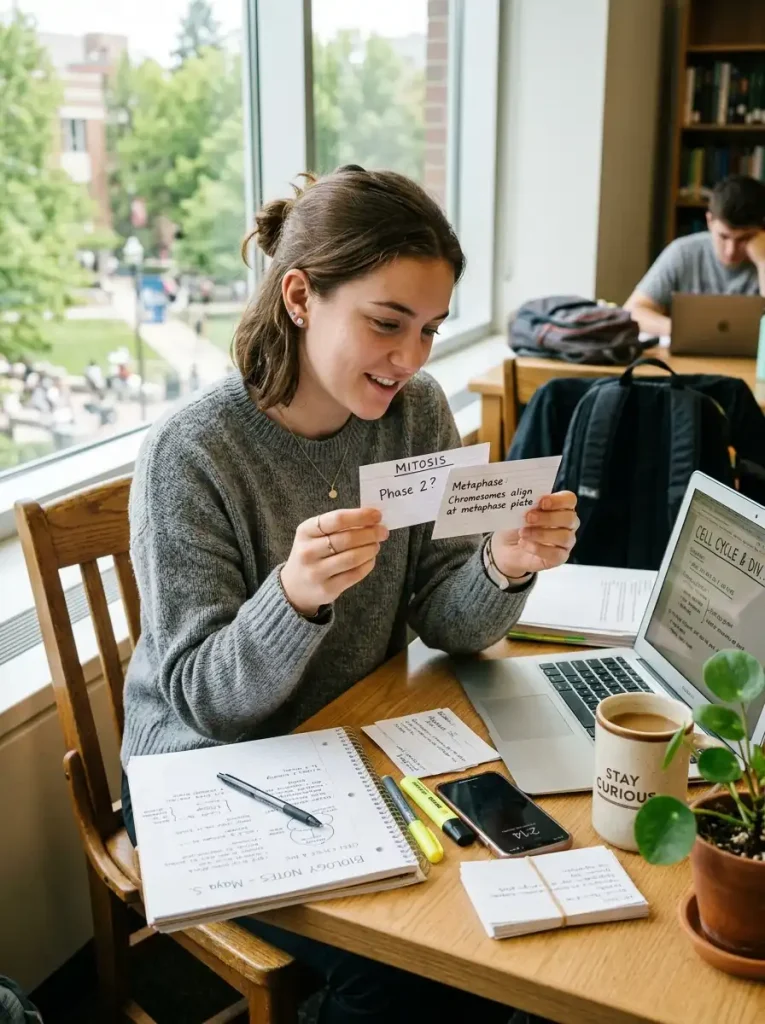
What Is the Active Recall Study Method?
Active recall is a study technique where you actively stimulate your memory to retrieve information. Instead of reviewing material passively, you test yourself repeatedly. You force your brain to recall facts, concepts, and details from memory.
Think of it like going to the gym. Passive studying is like reading about exercise. Active recall is like actually doing the workout. One informs you. The other builds real strength.
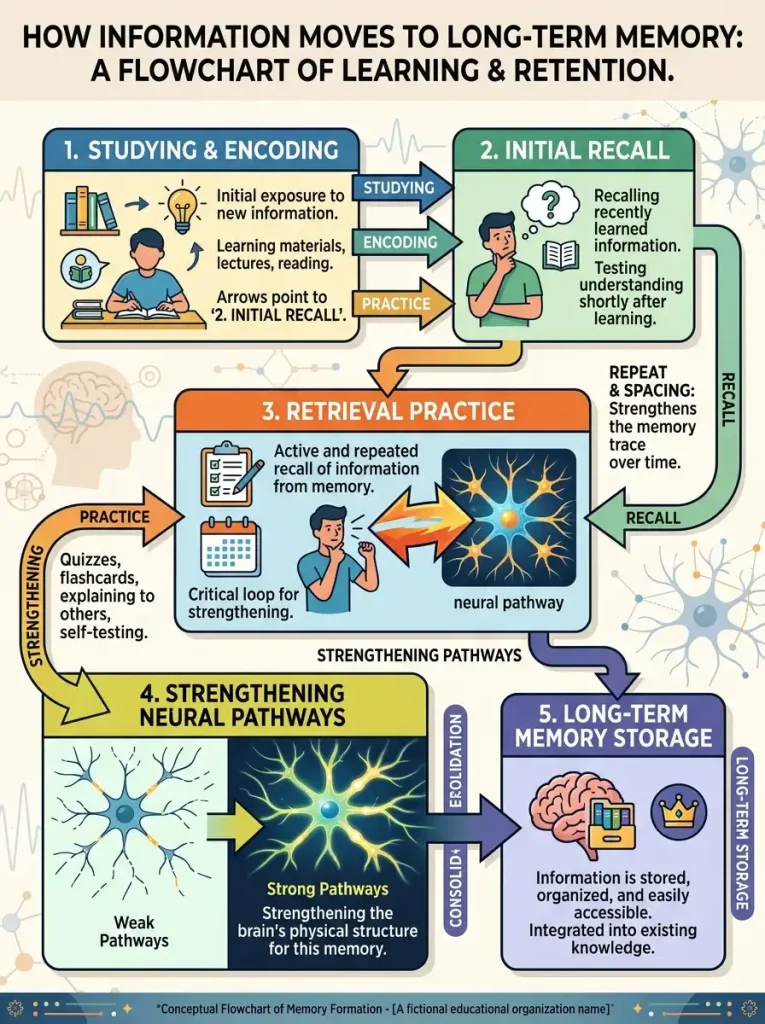
The active recall study method works because retrieval practice strengthens neural pathways. Every time you successfully recall something, you reinforce the connection. Your brain treats that information as important. It becomes easier to access later.
This is not a new idea. Educators and cognitive psychologists have studied retrieval practice for decades. But recent research has confirmed what many teachers suspected all along. Self-testing is one of the most powerful learning strategies available.
How Active Recall Works
Active recall works by engaging your brain’s natural retrieval processes. When you learn something new, your brain stores it as a memory trace. But that trace is fragile at first. Without reinforcement, it fades quickly.
Retrieval practice strengthens that memory trace. Each time you successfully recall information, you reinforce the neural pathway. Your brain essentially says, “This information is useful. I should keep it accessible.”
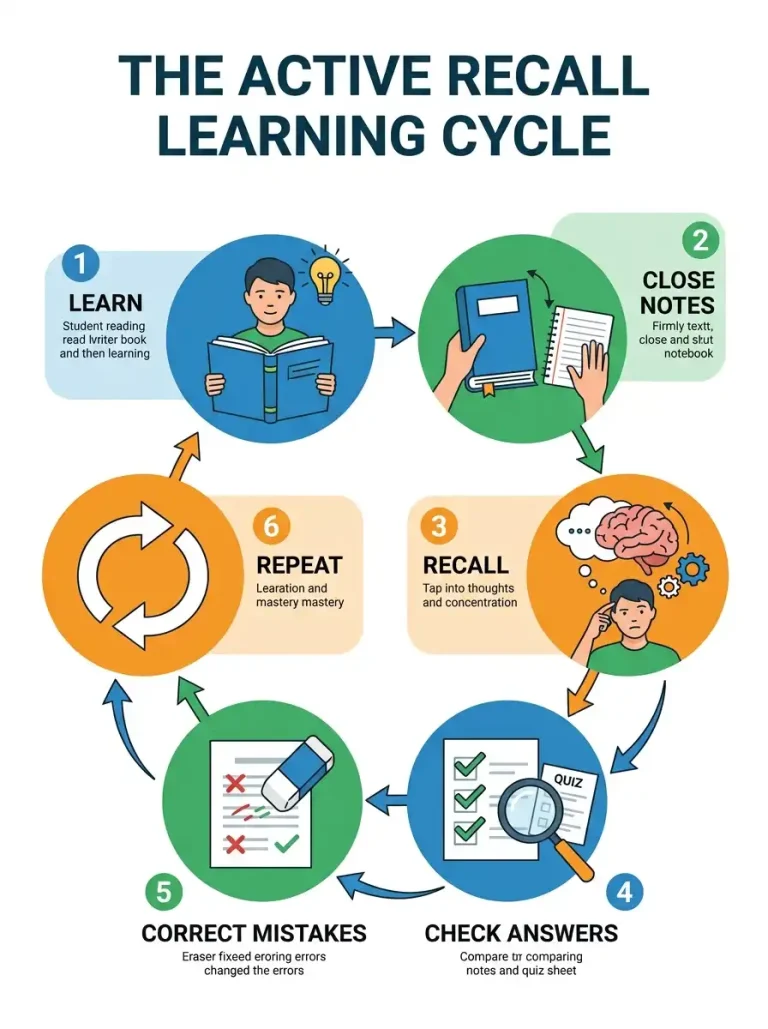
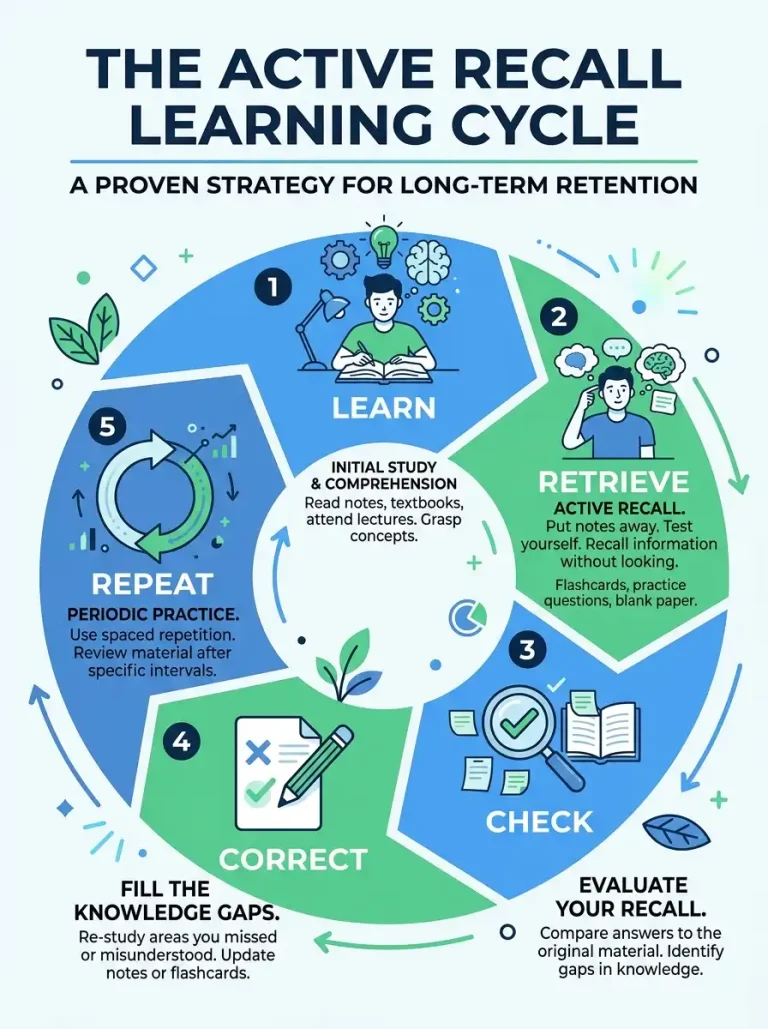
The process looks surprisingly simple. You study some material. You close your book or notes. You write down or say everything you remember. Then you check what you missed. You repeat this process until you can recall everything accurately.
This approach directly counters the forgetting curve. Hermann Ebbinghaus discovered that we forget most new information within hours unless we actively review it. Active recall interrupts this forgetting process. Each retrieval attempt resets the clock.
The Science Behind Active Recall
The science behind active recall is well-established. Cognitive psychologists have conducted hundreds of studies confirming its effectiveness. The research consistently shows that retrieval practice produces better long-term retention than passive review.
One landmark study demonstrated that students who used active recall remembered significantly more information than those who only studied passively. Even when the active recall group spent less total time studying, they performed better on tests.
This works because retrieval practice creates what researchers call “desirable difficulties.” It makes learning harder in the moment. But that difficulty signals your brain to strengthen the memory. It is the difference between remembering something for a day and remembering it for months.
The process also improves your ability to apply knowledge in new contexts. When you practice retrieving information, you are not just memorizing facts. You are building mental frameworks that help you use that information flexibly.
Why Active Recall Is Better Than Passive Studying
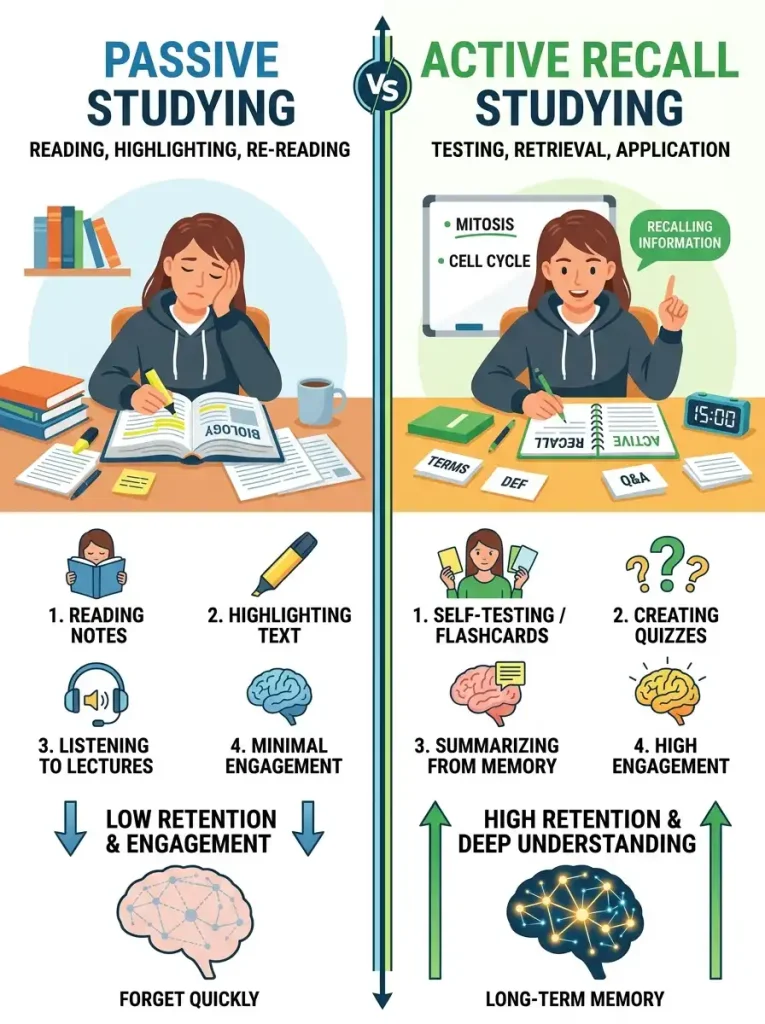
Passive studying feels productive. Reading, highlighting, and rereading give you a sense of familiarity. You recognize the material. You feel like you have learned it.
But recognition is not recall. Recognizing information when you see it is very different from being able to produce it from memory. This is why students often feel confident before an exam and then draw a blank.
Active recall closes this gap. It trains your brain to produce information on demand. You are practicing exactly what you will need to do during an exam or real-world application.
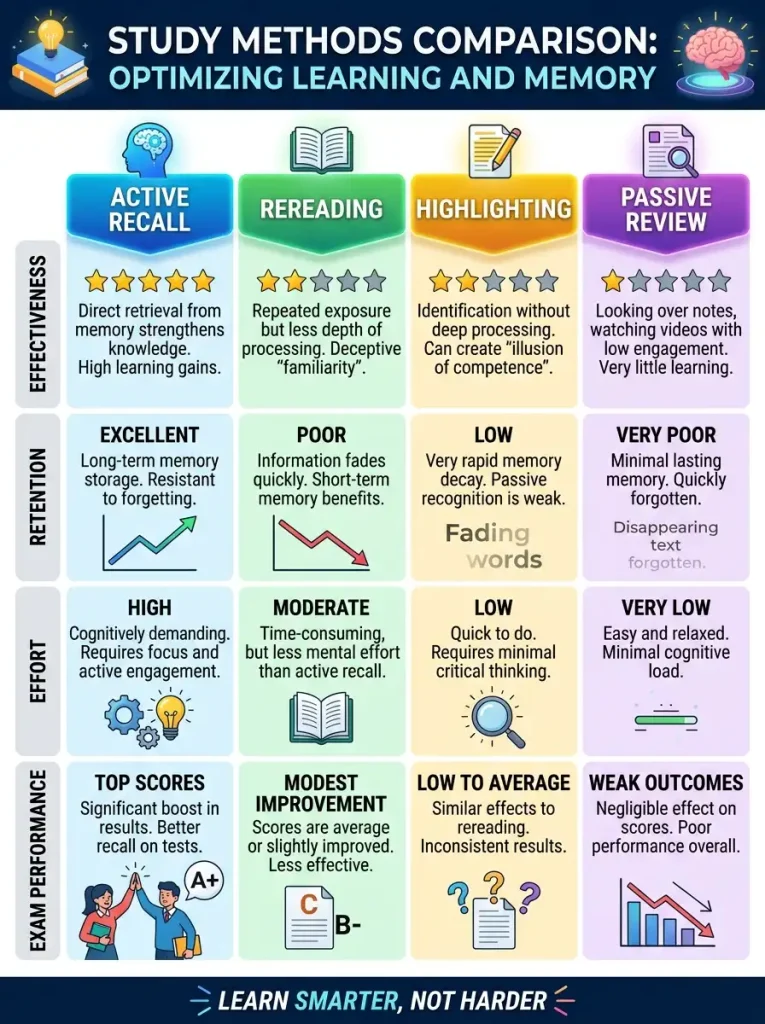
The evidence is compelling. Studies consistently show that active recall improves exam performance by one to two letter grades compared to passive review. It also reduces study time overall because you are learning more efficiently.
Active Recall vs Rereading
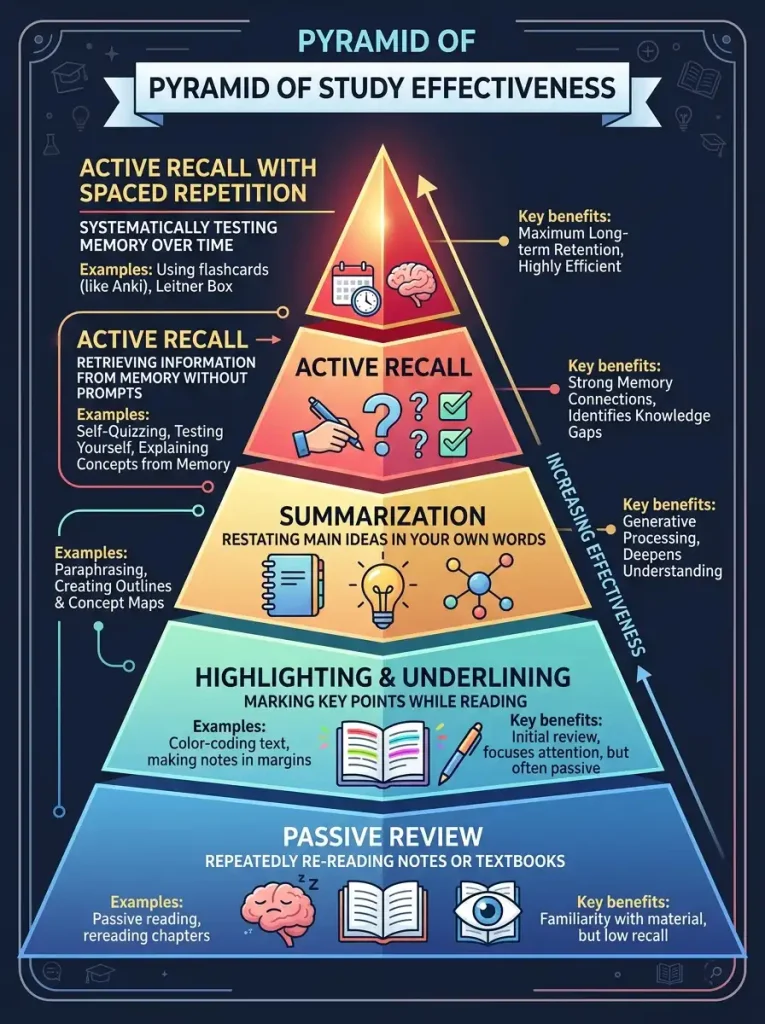
Rereading is one of the most common study habits. It also happens to be one of the least effective. Students often reread chapters multiple times, believing that repeated exposure will help them remember.
The problem is that rereading provides a false sense of mastery. Each time you read something again, it feels familiar. But feeling familiar is not the same as knowing it well enough to explain or use it.
Active recall blows rereading out of the water. In study after study, students who used retrieval practice remembered significantly more than those who spent the same time rereading material. This holds true across all subjects and grade levels.
The difference is even more pronounced over time. Rereading produces rapid forgetting. Active recall creates lasting retention. A student who uses active recall can often remember the same material months later with minimal additional practice.
Active Recall vs Highlighting
Highlighting is another popular but limited study strategy. Students love to mark up textbooks and notes with colorful markers. It feels productive. It creates the illusion of learning.
But highlighting is passive. You are identifying information. You are not actually processing it deeply. Highlighted passages often go unread a second time, making the effort largely wasted.
Active recall demands more from your brain. Instead of identifying what is important, you have to retrieve and reproduce it. This deeper processing creates stronger, more durable memories.
Researchers have found that highlighting has minimal benefit for learning. In some cases, it can actually hurt performance because it gives you a false sense of knowledge. Active recall, by contrast, consistently produces better outcomes.
Active Recall vs Summarization
Summarization sits somewhere between passive and active studying. It requires you to condense and rephrase information. This is more engaging than rereading or highlighting.
But summarization has a key limitation. You can create a summary while still looking at the source material. You are not actually retrieving information from memory. You are reorganizing what is in front of you.
True active recall requires you to close the book first. You have to produce the summary entirely from memory. This retrieval effort is what drives lasting learning.
Summarization is still useful. It can help you organize thoughts and identify key concepts. But it works best when used as a preparation step for active recall, not as a replacement for it.
Active Recall vs Spaced Repetition
These two terms are often confused. They are related but distinct. Active recall is about how you practice retrieving information. Spaced repetition is about when you schedule that practice.
Active recall is the process of self-testing. Spaced repetition is the scheduling system that spreads those tests over increasing intervals of time. They work beautifully together.
You can use active recall without spaced repetition. Many students do. You test yourself repeatedly until you master the material. But spaced repetition makes active recall even more effective.
Spaced repetition ensures that you review information just as you are about to forget it. This timing strengthens memory more efficiently than cramming. When combined with active recall, it creates a powerful learning system.
See also: 14 Welcome Bulletin Board Ideas for School
How Active Recall and Spaced Repetition Work Together
These two strategies complement each other perfectly. Active recall provides the retrieval practice that strengthens memory. Spaced repetition schedules that practice for maximum effectiveness.
Think of it like physical training. Active recall is the exercise itself. Spaced repetition is the rest and recovery schedule that helps you build strength safely.
When you combine them, you study new material with active recall sessions. Then you space those sessions over days and weeks. Each session reinforces the memory. Each interval forces your brain to work a little harder to retrieve the information.
This combination produces exceptional results. Students who use both active recall and spaced repetition consistently outperform those who use either strategy alone. It is arguably the most effective evidence-based learning approach available.
Benefits of Active Recall
The active recall study method offers a wide range of benefits for learners of all ages and levels.
Improved memory retention is the most obvious benefit. Retrieval practice strengthens neural pathways, making information easier to access later. This is true for both short-term review and long-term retention.
Better exam performance follows naturally. When you practice retrieving information under study conditions, you are better prepared for test conditions. The retrieval process itself builds test-taking confidence.
Reduced study time is another major advantage. Active recall is more efficient than passive review. You need fewer total study sessions to achieve the same or better results.
Deeper understanding develops because retrieval practice forces you to connect ideas. You cannot just memorize isolated facts. You have to understand how pieces fit together.
Improved focus and concentration come from the active engagement. Passive studying allows your mind to wander. Active recall demands your full attention.
Long-term retention is perhaps the most valuable benefit. Material learned through active recall lasts much longer than material learned passively. This is crucial for cumulative subjects and professional development.
Greater confidence builds as you experience success. Each successful retrieval reinforces your belief in your ability to learn and remember.
Transferable skills develop as you practice retrieval across different contexts. You become better at learning in general, not just for specific subjects.
See also: 10 Science Bulletin Board Ideas That Turn Classroom Walls Into Learning Tools
Who Should Use Active Recall
Active recall works for nearly everyone. It is not limited to a specific age group, subject, or learning style. Anyone who needs to remember information can benefit.
Students are the most obvious users. Middle school, high school, college, and graduate students can all improve their studying with active recall. It works for everything from vocabulary to complex scientific concepts.
Professionals benefit as well. Doctors, lawyers, engineers, and business leaders all need to retain specialized knowledge. Active recall helps them maintain and refresh their expertise.
Lifelong learners can use active recall to acquire new skills and knowledge. Whether you are learning a language, preparing for a certification, or exploring a personal interest, retrieval practice accelerates your progress.
Exam candidates preparing for standardized tests, professional exams, and licensing exams will find active recall particularly valuable. The technique directly mirrors the retrieval demands of testing situations.

Best Subjects for Active Recall
Active recall is versatile enough for almost any subject, but certain topics benefit particularly strongly.
Languages are an ideal fit. Vocabulary, grammar rules, and idiomatic expressions all respond well to retrieval practice. Flashcards and self-testing are standard tools in language learning for good reason.
Science subjects like biology, chemistry, and physics require both factual knowledge and conceptual understanding. Active recall helps with both. You can test yourself on definitions, formulas, and mechanisms.
History and social sciences involve a great deal of factual information. Dates, names, events, and cause-effect relationships are all perfect for retrieval practice.
Medical and health sciences are memorization-heavy fields. Active recall is widely used in medical education because it handles such large volumes of information effectively.
Mathematics benefits when you test yourself on formulas, problem-solving steps, and solution strategies. Retrieval practice helps you recognize which approach to use for different problems.
Professional certifications often require remembering detailed regulations, procedures, and case law. Active recall is an efficient way to master this material.
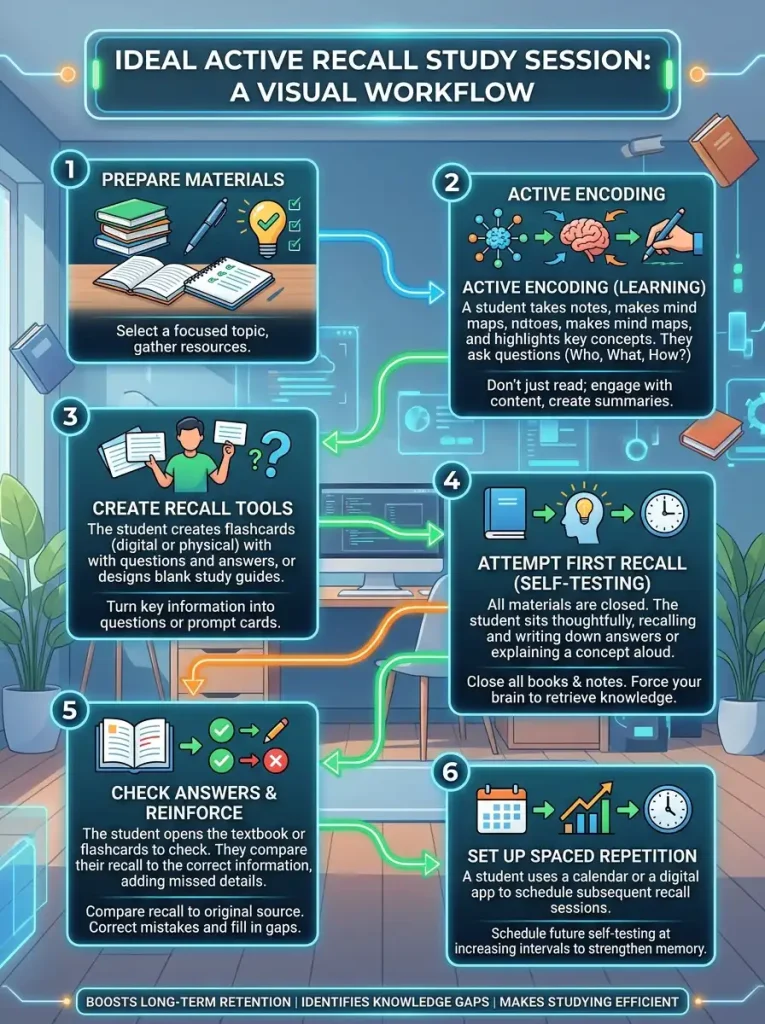
Step-by-Step Guide to Using Active Recall
Using the active recall study method is straightforward. Follow these steps to get started.
Step 1: Learn the material first. Active recall is not a replacement for initial learning. You need to encounter the material first. Read, watch, or listen to your source material. Take initial notes if that helps you.
Step 2: Close your materials. This is a critical step. Put away your book, notes, and any other source material. The retrieval effort is what builds memory. You cannot retrieve if the information is still in front of you.
Step 3: Write or say everything you remember. Start with what you know. Write it down or say it out loud. Do not worry about perfect accuracy at first. Just get the information out.
Step 4: Check your work. Open your materials and compare. What did you miss? What did you get wrong? Mark these areas for extra attention.
Step 5: Review and repeat. Go back over the areas you missed. Then close your materials again and test yourself once more. Repeat this process until you can recall everything accurately.
Step 6: Schedule future sessions. Active recall works best with spaced repetition. Plan to revisit the material in a day, then a few days later, then a week later.
Examples of Active Recall
Concrete examples help illustrate how active recall works in practice.
A biology student studying the cell cycle reads the relevant chapter and takes notes. Instead of rereading, they close the book and write down everything they remember about each phase of the cycle. They then check their work, note what they missed, and review those areas.
A language learner memorizes twenty new vocabulary words. They cover the translation side of their flashcards and try to recall each word’s meaning. They set aside words they struggle with and test themselves again.
A law student preparing for the bar exam reads a case summary. They then close the case file and explain the holding, reasoning, and key facts from memory. They compare their explanation to the original and note any gaps.
A medical student studying physiology tests themselves repeatedly on the steps of the cardiac cycle. They draw diagrams from memory and label each component. They review until they can reproduce the entire sequence without errors.
Active Recall Techniques
Multiple techniques can help you implement active recall effectively. Each has different strengths. Experiment to find what works best for you.
Using Flashcards
Flashcards are the classic active recall tool. They present a question or prompt on one side and the answer on the other. The physical act of flipping the card reinforces the retrieval effort.
Digital flashcards add extra features like spaced repetition algorithms. Apps like Anki and Quizlet track your performance and schedule reviews automatically. They make implementation much easier.
The key to effective flashcards is active engagement. Read the question, think of the answer, and only then check the response. Do not just flip the card immediately.
Blurting Method
The blurting method involves writing down everything you know about a topic without looking at your notes. You literally “blurt” it all onto paper. This is an excellent way to assess your current knowledge level.
After you have written everything you remember, check your notes. Identify gaps and errors. Then repeat the process. Each iteration builds stronger recall.
Question-Based Learning
Convert your study materials into questions. Instead of reading “The mitochondria is the powerhouse of the cell,” ask yourself “What is the function of the mitochondria?”
This technique transforms passive content into active retrieval opportunities. It also encourages deeper processing because you have to formulate accurate answers.
Practice Testing
Practice tests are a form of active recall. They simulate exam conditions and force retrieval under pressure. The act of taking a practice test is itself a powerful learning experience.
Use past exams, textbook questions, or self-created tests. Focus on answering without looking at materials. Then check your answers carefully.
Teaching Someone Else
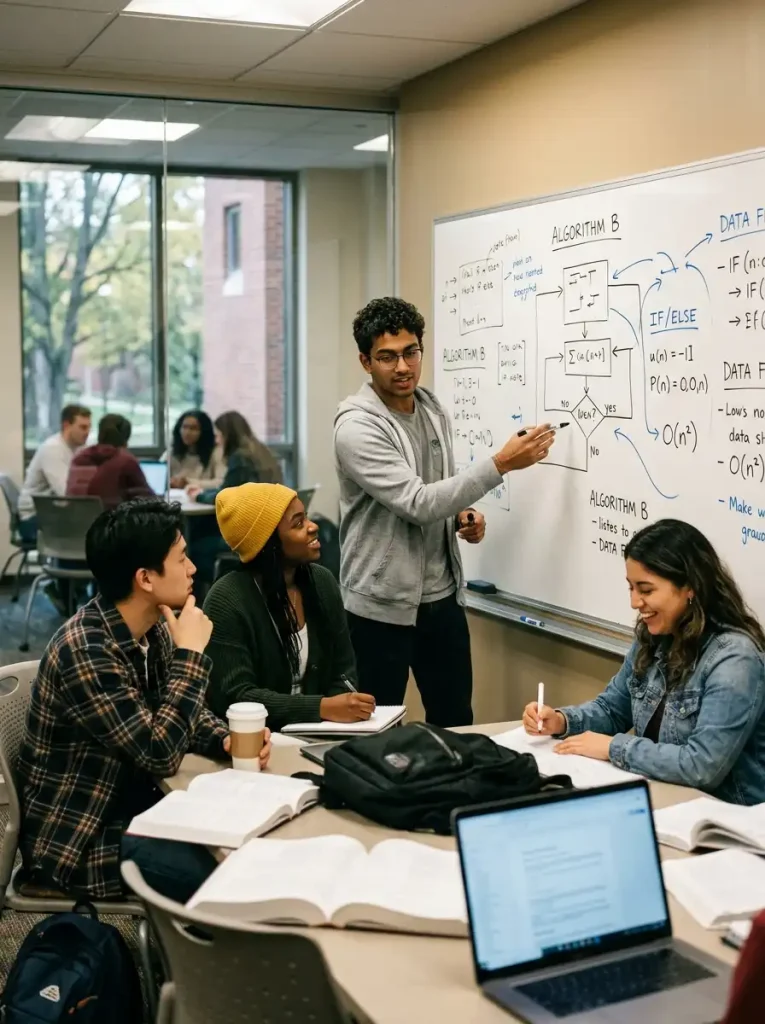
Teaching is one of the most effective forms of active recall. Explaining something to another person forces you to organize your thoughts and retrieve information clearly.
You do not need an actual student. You can teach to a willing friend, a study group, or even a stuffed animal. The retrieval process is what matters.
Brain Dumps
Brain dumps are similar to blurting but more structured. You write down everything you know about a topic in an organized way. This helps you identify gaps and connections you may have missed.
Start with a blank sheet of paper. Write the topic at the top. Then list everything you know, grouping related information together. Use mind maps or outlines if that helps.
Past Questions
Past exam questions are an ideal form of active recall. They require you to retrieve and apply knowledge in the specific way you will need for your assessment.
Try to answer past questions under timed conditions. Then review your responses against marking schemes or model answers. This approach identifies your weaknesses with precision.
Mistakes to Avoid
Active recall is powerful but easy to misuse. Watch for these common pitfalls.
Testing yourself too early. Active recall works best after you have at least some initial familiarity with the material. Trying to retrieve before learning anything will be frustrating and unproductive.
Giving up too quickly. Retrieval feels hard at first. That difficulty is actually the learning process. Push through the initial discomfort. Your brain is working exactly as it should.
Using flashcards passively. Flipping cards without pausing to think is not active recall. Always attempt retrieval before checking the answer. This is where the learning happens.
Cramming with active recall. Active recall works even in cramming sessions. But it works much better with spaced repetition. Spreading retrieval practice over time produces stronger memories.
Skipping error review. Mistakes are valuable. They tell you what needs more attention. Review your errors carefully before the next retrieval session.
Testing only the easy parts. It is natural to focus on what you already know. This is a mistake. Spend extra time on material you find difficult. That is where you need the most practice.
Neglecting understanding. Active recall is not just memorization. Focus on understanding concepts and relationships. This will serve you better than isolated fact recall.
Daily Active Recall Study Routine
A consistent routine makes active recall easier to sustain. Here is a sample daily study structure.
Start with a brief warm-up. Spend five minutes reviewing yesterday’s material with quick retrieval practice. This reinforces previous learning and sets the stage for new information.
Move to new material. Study the content for fifteen to twenty minutes. Take notes or highlight as needed. But keep this initial exposure brief.
Close your materials and begin active recall. Spend fifteen minutes retrieving what you just learned. Write down or say everything you remember. Check your work carefully.
Spend ten minutes on difficult areas. Focus on what you missed or got wrong. Review the material and test yourself again.
End with a quick review. Test yourself once more on the key points. This final retrieval strengthens the memory before you step away.
Weekly Revision Plan
Active recall should be part of a broader weekly study schedule. This plan integrates retrieval practice with spaced repetition.
On Monday, learn new material and practice active recall for the day. Focus on building initial familiarity.
On Tuesday, review Monday’s material with active recall before learning anything new. Then add new content with its own retrieval practice.
On Wednesday, review Monday and Tuesday’s material. Then add new content.
On Thursday, review the entire week’s material. This is a larger retrieval challenge that forces you to distinguish between different topics.
On Friday, review any remaining difficult areas. Test yourself comprehensively on the week’s content.
On Saturday, take a break or do light review. On Sunday, do a full weekly review with active recall of everything you learned.
This schedule uses spaced repetition effectively. It also prevents last-minute cramming by distributing practice throughout the week.
Digital Tools for Active Recall
Several digital tools can support your active recall practice.
Anki is the most popular spaced repetition app. It uses an algorithm to schedule flashcard reviews at optimal intervals. The app is free for desktop and mobile use.
Quizlet offers a more user-friendly approach. You can create flashcard sets and use various study modes. It also includes games and collaborative features.
Brainscape uses a confidence-based repeating system. It asks you to rate your confidence after each answer and adjusts review frequency accordingly.
Notion allows you to build custom active recall systems. You can create databases of questions and answers with built-in review features.
Obsidian is a note-taking app with powerful linking features. You can create question-answer notes and review them using community plugins.
Paper-Based Methods
Digital tools are convenient but not necessary. Paper-based active recall works just as well.
Question cards are simple and effective. Write questions on one side of a card and answers on the other. Review them regularly.
Spiral notebooks work well for blurting and brain dumps. Fill a page with everything you remember. Check against your notes. Then repeat.
Index card boxes offer physical flashcard storage. Organize cards by topic or review date. This creates a tangible analog to spaced repetition.
Color-coded notes help you track what you know. Use green for mastered material, yellow for partial knowledge, and red for areas needing attention.
Blank paper and pen are all you really need. Write, check, review, and rewrite. This simple approach is remarkably effective.
How Long Should You Use Active Recall?
The duration of an active recall session depends on several factors. Your goals, material difficulty, and available time all matter.
Shorter sessions are generally better. Fifteen to thirty minutes of active recall is often more productive than an hour of passive review. The focused retrieval effort is mentally demanding.
Aim for regular active recall practice rather than marathon sessions. Daily practice of twenty to thirty minutes often produces better results than a single weekly session lasting several hours.
Increase session length for difficult material or major exams. But always build in breaks. Active recall requires concentration. Your brain needs rest to function optimally.
The total duration of active recall use can be indefinite. Retrieval practice is a lifelong learning habit. You can use it to maintain knowledge long after initial learning.
Common Myths
Several myths about active recall persist. It is worth addressing them directly.
Myth: Active recall is just memorization. Active recall involves understanding, not just memorization. Effective retrieval practice requires you to understand concepts and relationships. You cannot recall what you do not understand.
Myth: Active recall is only for exams. Retrieval practice helps with any learning goal. It works for professional development, personal interests, and skill acquisition. The benefits extend far beyond test performance.
Myth: Active recall takes too much time. Active recall is actually more efficient than passive study. You need fewer total hours to achieve better results. The time investment pays off quickly.
Myth: Active recall is too hard. The challenge is the point. Retrieval difficulty signals your brain to strengthen the memory. Embrace the effort. It is working.
Myth: Flashcards are required. Flashcards are one tool among many. Other techniques like blurting, teaching, and question-based learning work just as well. Use what fits your style.
Myth: Active recall works for everyone the same way. Effectiveness varies with individual learning styles and subjects. Experiment to find your best approach. But the research consistently supports active recall across diverse populations.
Frequently Asked Questions
What is the active recall study method?
Active recall is a study technique where you actively retrieve information from memory instead of passively reviewing it. You test yourself repeatedly, forcing your brain to recall facts, concepts, and details. This retrieval process strengthens neural pathways and improves long-term retention.
Is active recall better than spaced repetition?
They serve different purposes and work best together. Active recall is the retrieval practice itself. Spaced repetition schedules that practice over time. Neither is “better.” They are complementary strategies that reinforce each other.
Does active recall work for everyone?
Research shows active recall benefits most learners. It works across age groups, subjects, and learning styles. Some people may adapt the techniques to their preferences. But the basic principle of retrieval practice applies broadly.
How often should I use active recall?
Daily practice is ideal. Even fifteen minutes a day produces significant benefits. Consistency matters more than session length. Regular retrieval practice creates stronger, more durable memories.
Can I use active recall for math?
Absolutely. Test yourself on formulas, problem-solving steps, and solution strategies. Practice recognizing when to apply specific approaches. This is often more effective than solving problems with the solution manual in front of you.
What is the blurting method?
The blurting method involves writing down everything you remember about a topic without looking at your notes. It is a form of active recall that identifies knowledge gaps. You then review what you missed and repeat the process.
Is active recall passive or active?
Active recall is fully active. You are actively retrieving information from memory. This is the opposite of passive studying like rereading or highlighting. The active engagement is what makes it effective.
How long should active recall sessions be?
Fifteen to thirty minutes per session is typical. Shorter, focused sessions produce better results than longer, unfocused ones. The retrieval effort is mentally demanding. Work in concentrated bursts.
What subjects work best with active recall?
Most subjects benefit from active recall. Languages, science, history, medicine, and law all respond well. Even subjects like mathematics and philosophy can benefit from retrieval practice when applied thoughtfully.
Can I do active recall without flashcards?
Yes. You can use blurting, teaching, practice testing, brain dumps, or question-based learning. Choose techniques that work for your subjects and study preferences. Variety often helps maintain engagement.
Does active recall work for long-term retention?
It works exceptionally well for long-term retention. Material learned through active recall stays in memory much longer than material learned passively. With periodic spaced review, retention can last indefinitely.
What is the best active recall technique for beginners?
Start with the blurting method or simple question cards. Both are easy to implement and require minimal materials. Begin with one topic at a time. Gradually increase complexity as you become comfortable.
Final Thoughts
The active recall study method is not a gimmick. It is not a quick fix or a trendy technique that will disappear in a few years. It is a well-researched, evidence-based approach supported by decades of cognitive psychology.
The evidence is overwhelming. Active recall consistently outperforms passive studying. It produces better retention, deeper understanding, and improved exam performance. It works across subjects, age groups, and learning contexts.
Making the switch is simple. Stop rereading. Stop highlighting without purpose. Start testing yourself. Start retrieving information from memory. Start building stronger neural pathways through deliberate practice.
The first few sessions may feel harder than your usual studying. That is a good sign. That difficulty is the learning process in action. Embrace it. Trust the research. Trust your brain to respond to the challenge.
You already know that studying smarter matters more than studying longer. Active recall is the smartest study habit you can develop. Add it to your routine today. Your future self will thank you when you remember what you learned long after your peers have forgotten.
Start now. Choose one technique from this guide. Try it with a single topic. See how it changes your learning. Then expand from there. The best time to start using active recall was years ago. The second best time is today.