12 Story Writing Ideas Inspiration Creative Minds Need
You know that feeling when a story idea slips away right as you reach for it? One minute it’s there, glowing and promising. The next, it’s gone, and you’re left staring at a blank page wondering if you imagined it.
Every writer deals with this. Inspiration doesn’t arrive on schedule, and it definitely doesn’t wait around for convenient timing. That’s exactly why a solid list of story writing ideas inspiration creative writers can actually use matters so much, especially on the days when your own imagination goes quiet.
This guide gives you twelve fully developed ideas, plus the tools to turn any spark of inspiration into a finished, satisfying story. You’ll find characters, conflicts, twists, and genre variations for each one, along with practical exercises and the common mistakes that quietly derail otherwise promising drafts.
Let’s find the idea that gets you writing again.
Why Story Ideas Matter
A good idea does more than fill pages. It fuels genuine creativity, giving your imagination somewhere specific to run instead of wandering aimlessly.
Strong ideas also build emotional connection. Readers stay invested when a premise touches something real, fear, longing, curiosity, even if the setting is entirely fictional. Originality matters too, though it doesn’t require reinventing storytelling itself. Often, a familiar concept told through a fresh lens feels just as original as something brand new.
Finally, having a reliable well of ideas helps you push through writer’s block. Instead of waiting for lightning to strike, you can simply reach for a concept and start building.
Where Great Story Ideas Come From
Inspiration hides in more places than most writers realize. Everyday life offers constant material, a strange conversation overheard at a coffee shop, a stranger’s expression on the train, a small argument that reveals something bigger underneath.
Dreams work similarly. That surreal logic your brain creates overnight often translates beautifully into fiction, especially fantasy or horror. History and mythology offer entire frameworks already built around conflict and consequence, ready for reinterpretation.
News stories, personal memories, and travel experiences all shape unique perspectives too. Even a single overheard conversation can spark an entire subplot. Above all, “what if” questions remain one of the most reliable tools available. What if a stranger recognized you, but you’d never met them? What if a single choice could rewrite an entire year? Emotions, grief, jealousy, hope, often make the strongest starting point of all, since they’re universally understood even inside unfamiliar circumstances.
12 Creative Story Writing Ideas
Here are twelve original concepts, each built with enough detail to start writing today.
1. The Inheritance Nobody Wanted
Concept Overview: A woman inherits her estranged grandmother’s remote cabin, only to discover it sits on land locals avoid entirely, for reasons nobody will explain. As she settles in, strange but small occurrences build until she uncovers her grandmother’s hidden journal, revealing a decades-old pact tied to the land itself.
Characters: Protagonist Elena, practical and skeptical by nature. Her grandmother, seen only through journal entries, was fiercely private and clearly hiding something significant. A local shopkeeper, Mr. Alvarez, knows more than he initially admits.
Conflict: Elena must decide whether to honor a pact she never agreed to or risk consequences she doesn’t fully understand.
Plot Twist: The pact wasn’t protecting the land from something dangerous; it was protecting something dangerous from the outside world.
Possible Ending: Elena chooses to continue the pact, but on her own terms, rewriting the agreement instead of simply inheriting it unchanged.
Genre Variations:
- Fantasy: The pact involves a bound magical creature tied to the land.
- Romance: Mr. Alvarez becomes a love interest who helps Elena uncover the truth.
- Thriller: The pact connects to a decades-old disappearance the town covered up.
- Horror: Breaking the pact awakens something the family has contained for generations.
- Sci-Fi: The land conceals an experimental research site abandoned decades ago.
- Mystery: Elena investigates what really happened to her grandmother before her death.
Writing Challenge: Write the grandmother’s final journal entry, the one Elena finds last.
2. The Understudy Who Never Auditioned
Concept Overview: A community theater’s lead actor vanishes days before opening night, and the director casts an unlikely replacement, someone who never auditioned and doesn’t remember signing up. As rehearsals continue, this replacement starts experiencing memories that don’t belong to them, tied strangely to the missing actor’s past.
Characters: Protagonist Jordan, uncertain and quietly ambitious. The vanished actor, Weston, remains a mystery throughout much of the story. Director Priya grows suspicious as coincidences pile up.
Conflict: Jordan must uncover what happened to Weston before the borrowed memories consume their own identity entirely.
Plot Twist: Jordan and Weston are connected by blood, separated at birth, something neither ever knew.
Possible Ending: Jordan chooses to perform the role, using the discovered truth to finally reconnect fragmented family history.
Genre Variations:
- Fantasy: The role carries an old theatrical curse passed between bloodlines.
- Romance: Priya and Jordan grow close while investigating Weston’s disappearance together.
- Thriller: Weston’s vanishing ties to a criminal cover-up within the theater’s finances.
- Horror: The borrowed memories aren’t memories at all, but something else entirely.
- Sci-Fi: A memory-transfer experiment gone wrong connects the two performers.
- Mystery: Jordan pieces together Weston’s last days through scattered clues backstage.
Writing Challenge: Write one scene entirely through Jordan’s confused, fragmented memory of an event that isn’t theirs.
3. The Letters That Arrive Early
Concept Overview: A postal worker notices that certain letters arrive at his station days before their postmark date, always addressed to people who haven’t written them yet. Curiosity turns into obsession as he starts predicting events based on letters that technically don’t exist yet, until one letter mentions his own name.
Characters: Protagonist Malik, methodical and increasingly paranoid. His coworker Denise remains skeptical of his growing fixation. The letters themselves function almost as a character, revealing fragments of a larger mystery.
Conflict: Malik must decide whether to interfere with the events the letters predict or let them unfold naturally.
Plot Twist: The letters aren’t predicting the future; they’re being sent from it.
Possible Ending: Malik intercepts one crucial letter, altering an outcome, only to realize his interference created the very message he first received.
Genre Variations:
- Fantasy: The post office exists in a liminal space between time itself.
- Romance: One letter predicts a relationship Malik hasn’t started yet.
- Thriller: The letters warn of a crime Malik must prevent before it’s too late.
- Horror: The letters grow increasingly threatening the closer their dates arrive.
- Sci-Fi: A malfunctioning postal sorting AI is somehow bridging timelines.
- Mystery: Malik investigates who’s really sending the early letters.
Writing Challenge: Write the letter addressed to Malik himself, revealing what it says.
4. The Neighbor Who Remembers Differently
Concept Overview: Two lifelong neighbors, close friends since childhood, discover they remember a pivotal shared event from decades ago in completely different, contradictory ways. As they compare notes, small inconsistencies grow into something unsettling, suggesting one of their memories has been altered, deliberately or otherwise.
Characters: Protagonist Nora, detail-oriented and increasingly anxious about her own reliability. Her neighbor Theo remains calm, almost suspiciously so, as inconsistencies mount.
Conflict: Nora must determine whose memory reflects reality before trust between them collapses entirely.
Plot Twist: Neither memory is accurate; a third person altered both of their recollections for a reason still hidden.
Possible Ending: Nora and Theo uncover the manipulator together, rebuilding trust through shared investigation rather than solitary suspicion.
Genre Variations:
- Fantasy: A memory-altering enchantment explains the discrepancy.
- Romance: The altered memory conceals an old romance neither fully remembers.
- Thriller: A hidden crime from their shared past explains the manipulation.
- Horror: Something in the neighborhood feeds on altered, fragmented memories.
- Sci-Fi: An experimental memory-editing technology was tested on them without consent.
- Mystery: Nora investigates records and old photographs to determine the truth.
Writing Challenge: Write both versions of the shared memory, side by side, in each character’s own voice.
5. The Sound That Only One Person Hears
Concept Overview: A sound engineer starts hearing a low, rhythmic hum nobody else can detect, one that intensifies whenever she’s near a specific old building downtown. Convinced she’s losing her mind, she investigates instead, using professional equipment to prove the sound is real, only to discover it’s been recorded before, decades earlier, by someone who mysteriously disappeared.
Characters: Protagonist Simone, technically skilled and stubbornly rational. A retired audio archivist, Walt, holds crucial information about the earlier recording.
Conflict: Simone must determine the sound’s origin before it starts affecting her health and sanity further.
Plot Twist: The sound is a warning signal embedded generations ago, designed to activate only for someone specifically capable of hearing it.
Possible Ending: Simone accepts the responsibility tied to hearing the sound, using her skills to prevent whatever it was warning against.
Genre Variations:
- Fantasy: The sound connects to an ancient, sleeping entity beneath the building.
- Romance: Walt’s granddaughter joins Simone’s investigation, sparking connection.
- Thriller: The sound relates to a cover-up involving the building’s original owners.
- Horror: The sound grows louder the more people who become aware of it.
- Sci-Fi: The frequency is part of an abandoned government experiment.
- Mystery: Simone traces the sound’s origin through old blueprints and records.
Writing Challenge: Write the moment Simone first realizes she’s the only one who can hear it.
6. The Recipe Passed Down Wrong
Concept Overview: A young chef inherits her family’s treasured recipe book, only to discover one recipe has been deliberately altered across generations, each version slightly different from the last. Curious why, she starts researching her family history, uncovering a secret tied to the original recipe’s true purpose.
Characters: Protagonist Amara, ambitious and deeply connected to her family’s culinary legacy. Her great-aunt Ruth holds fragmented knowledge about the recipe’s original meaning.
Conflict: Amara must decide whether restoring the original recipe honors her family’s history or reopens old wounds intentionally buried.
Plot Twist: The original recipe was altered to hide a coded message, passed down as protection during a dangerous historical period.
Possible Ending: Amara decodes the full message, finally understanding and honoring the sacrifice her ancestors made generations earlier.
Genre Variations:
- Fantasy: The recipe contains literal magical properties, diluted over generations.
- Romance: Amara reconnects with a childhood friend while researching family history.
- Thriller: The coded recipe hides directions to something powerful people still want.
- Horror: Following the original recipe exactly summons something unwelcome.
- Sci-Fi: The recipe encodes scientific formulas disguised as cooking instructions.
- Mystery: Amara investigates why each generation altered the recipe slightly differently.
Writing Challenge: Write the original, undiluted version of the recipe as an in-story document.
7. The Stranger Who Finishes Sentences
Concept Overview: A grieving widower keeps running into the same stranger at increasingly unlikely places, a stranger who finishes his sentences exactly the way his late wife used to. Unsettled but drawn in, he starts seeking the stranger out deliberately, desperate to understand the connection, even as it threatens the careful grief he’s built his life around.
Characters: Protagonist Elliot, emotionally guarded and quietly desperate for connection. The stranger, later named Cass, carries her own complicated reasons for the encounters.
Conflict: Elliot must decide whether pursuing this strange connection helps him heal or prevents him from truly moving forward.
Plot Twist: Cass isn’t connected to his late wife supernaturally; she’s her estranged twin sister, unaware of the resemblance’s significance.
Possible Ending: Elliot and Cass build a genuine friendship, allowing him to finally process grief through unexpected connection rather than supernatural explanation.
Genre Variations:
- Fantasy: Cass genuinely carries a fragment of his late wife’s spirit.
- Romance: Their connection slowly deepens into something neither expected.
- Thriller: Cass is investigating Elliot for reasons connected to his wife’s death.
- Horror: The resemblance isn’t coincidental; something is imitating his wife deliberately.
- Sci-Fi: Cass exists in a parallel timeline that’s begun bleeding into Elliot’s own.
- Mystery: Elliot uncovers a hidden family connection neither woman knew about.
Writing Challenge: Write the exact sentence Cass finishes that convinces Elliot the connection is real.
8. The House That Skips a Year
Concept Overview: A family moves into a house where, according to local records, absolutely nothing happened during one specific year decades ago, no births, no deaths, no property transactions, nothing at all. As strange occurrences accumulate, the family starts suspecting that missing year didn’t simply go unrecorded. It never happened for the house at all.
Characters: Protagonist Diane, a skeptical historian by profession, determined to find a rational explanation. Her teenage son Caleb experiences the strangest occurrences firsthand.
Conflict: Diane must uncover what really happened during the missing year before its effects start repeating within her own family.
Plot Twist: The house didn’t lose a year; it’s been quietly borrowing time from every family who’s lived there since.
Possible Ending: Diane finds a way to return the borrowed time, breaking the cycle before her own family becomes its next casualty.
Genre Variations:
- Fantasy: A trapped spirit within the house is responsible for the missing time.
- Romance: Diane bonds with a local historian while investigating the mystery together.
- Thriller: A hidden crime committed during the missing year explains the gap.
- Horror: The house actively resists anyone attempting to uncover the truth.
- Sci-Fi: A localized time anomaly explains the missing records entirely.
- Mystery: Diane pieces together fragmented town records to reconstruct the missing year.
Writing Challenge: Write the single surviving document that mentions the missing year, however cryptically.
9. The Painting That Ages With the Subject
Concept Overview: An art restorer discovers an old portrait that appears to age subtly over time, matching the real, current appearance of a woman who died over a century ago, according to every historical record available. Determined to understand how, the restorer starts investigating the painting’s origin, only to discover the woman might not be as dead as history claims.
Characters: Protagonist Yusuf, methodical and increasingly obsessed with the painting’s impossible behavior. The subject of the painting, later revealed as Margarethe, exists somewhere between myth and reality.
Conflict: Yusuf must determine whether Margarethe is truly still alive somewhere, and if so, what connects her continued existence to the painting itself.
Plot Twist: The painting doesn’t just depict Margarethe; it’s actively sustaining her, somewhere hidden, across generations.
Possible Ending: Yusuf makes the difficult choice to preserve the painting rather than destroy it, protecting Margarethe’s fragile continued existence.
Genre Variations:
- Fantasy: The painting was created through a genuine immortality enchantment.
- Romance: Yusuf and Margarethe’s presence, sensed only faintly, develop an otherworldly connection.
- Thriller: A collector wants the painting destroyed for reasons connected to Margarethe’s original death.
- Horror: Margarethe’s continued existence comes at a terrible cost to others.
- Sci-Fi: Advanced preservation technology, centuries ahead of its time, explains the phenomenon.
- Mystery: Yusuf investigates historical records to piece together Margarethe’s true fate.
Writing Challenge: Write the moment Yusuf first notices the painting has changed since he last examined it.
10. The Radio Station That Never Signs Off
Concept Overview: A late-night trucker discovers a radio station that broadcasts continuously, never signing off, playing songs and taking calls from listeners who all claim to be driving the exact same stretch of highway he’s currently on, regardless of when they call. Convinced it’s some kind of prank, he starts investigating, only to realize the calls might be coming from drivers who never made it to their destination.
Characters: Protagonist Reggie, weathered and pragmatic after years on the road. The radio host, known only as “the Voice,” remains a genuine mystery throughout.
Conflict: Reggie must determine whether the station is warning him of danger ahead or luring him toward something far worse.
Plot Twist: The station broadcasts from a fixed moment in time, replaying the final night of drivers who vanished on that stretch of highway years ago.
Possible Ending: Reggie uses information from the broadcast to avoid the same fate, while helping authorities finally solve the decades-old disappearances.
Genre Variations:
- Fantasy: The highway exists in a liminal space between the living and the lost.
- Romance: Reggie connects with another caller, uncertain if she’s real or trapped in the broadcast.
- Thriller: The disappearances connect to a criminal operation still active along the route.
- Horror: Something on the highway actively causes the disappearances, still hunting.
- Sci-Fi: A signal anomaly traps radio waves, and occasionally travelers, in a time loop.
- Mystery: Reggie investigates old case files matching details from the broadcast calls.
Writing Challenge: Write one full call Reggie receives from a driver who vanished years earlier.
11. The Twin Who Wasn’t Born
Concept Overview: A woman learns during a routine medical exam that she was originally conceived as a twin, one who didn’t survive early pregnancy. Shortly after, she starts experiencing vivid, specific memories that don’t belong to her own life, memories that seem to belong to the sibling who never existed.
Characters: Protagonist Bea, logical and initially dismissive of anything unexplainable. Her mother, Carmen, has spent decades avoiding the topic entirely.
Conflict: Bea must decide how far to pursue understanding these borrowed memories, especially as they start affecting her relationships and sense of identity.
Plot Twist: The memories aren’t from her unborn twin at all; they’re suppressed memories of her own early childhood, misattributed by her grieving mother for years.
Possible Ending: Bea confronts her mother, finally uncovering the real family history behind decades of careful avoidance.
Genre Variations:
- Fantasy: The unborn twin’s spirit genuinely lingers, sharing fragments of consciousness.
- Romance: Bea’s investigation brings her closer to a childhood friend connected to the memories.
- Thriller: The suppressed memories connect to an incident her family has hidden for years.
- Horror: Something is using the twin’s identity to manipulate Bea from within.
- Sci-Fi: Experimental prenatal research explains the strange, shared consciousness.
- Mystery: Bea investigates medical records and family history to uncover the truth.
Writing Challenge: Write one of the memories exactly as Bea experiences it, without initially explaining its origin.
12. The Bookstore That Sells Unwritten Books
Concept Overview: A struggling writer stumbles into a secondhand bookstore that occasionally sells books that don’t exist anywhere else, books she recognizes as ideas she once had but never finished. Desperate to understand, she starts buying them, only to realize finishing her own abandoned drafts might be the only way to stop new “unwritten” copies from appearing on the shelves.
Characters: Protagonist Fiona, talented but paralyzed by self-doubt and unfinished projects. The bookstore’s owner, Mr. Okafor, offers cryptic guidance without ever fully explaining the shop’s nature.
Conflict: Fiona must confront her own creative fear and finish what she’s abandoned before the shop’s strange inventory grows entirely out of control.
Plot Twist: The bookstore doesn’t just sell her unfinished ideas; it’s slowly running out of room, and unfinished stories from other writers are starting to disappear from existence entirely.
Possible Ending: Fiona finishes her most important abandoned draft, watching its “unwritten” copy vanish from the shelf as her real manuscript finally reaches completion.
Genre Variations:
- Fantasy: The shop exists between dimensions, collecting unfinished creative potential.
- Romance: Fiona and Mr. Okafor’s grandson bond over a shared unfinished collaboration.
- Thriller: A rival writer is stealing ideas directly from the shop’s mysterious shelves.
- Horror: Abandoned stories don’t just vanish; they take something from their writers instead.
- Sci-Fi: The shop is powered by a quantum archive of every possible unwritten narrative.
- Mystery: Fiona investigates the shop’s true origin and Mr. Okafor’s connection to it.
Writing Challenge: Write the opening paragraph of Fiona’s abandoned manuscript, the one she must finally finish.
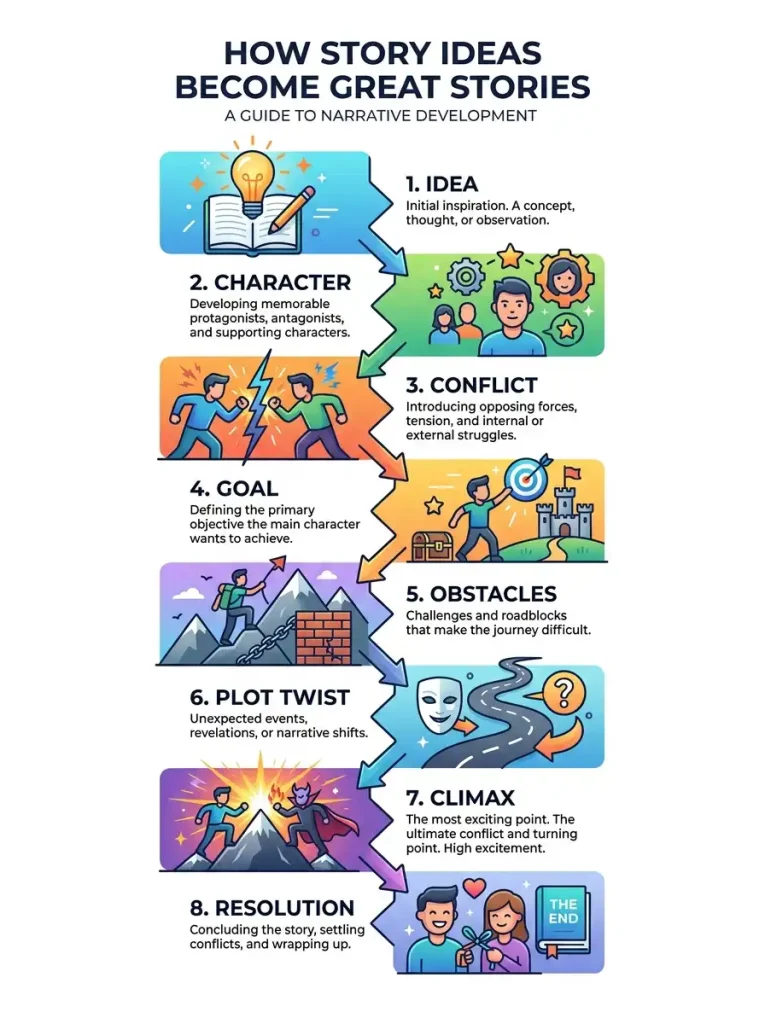
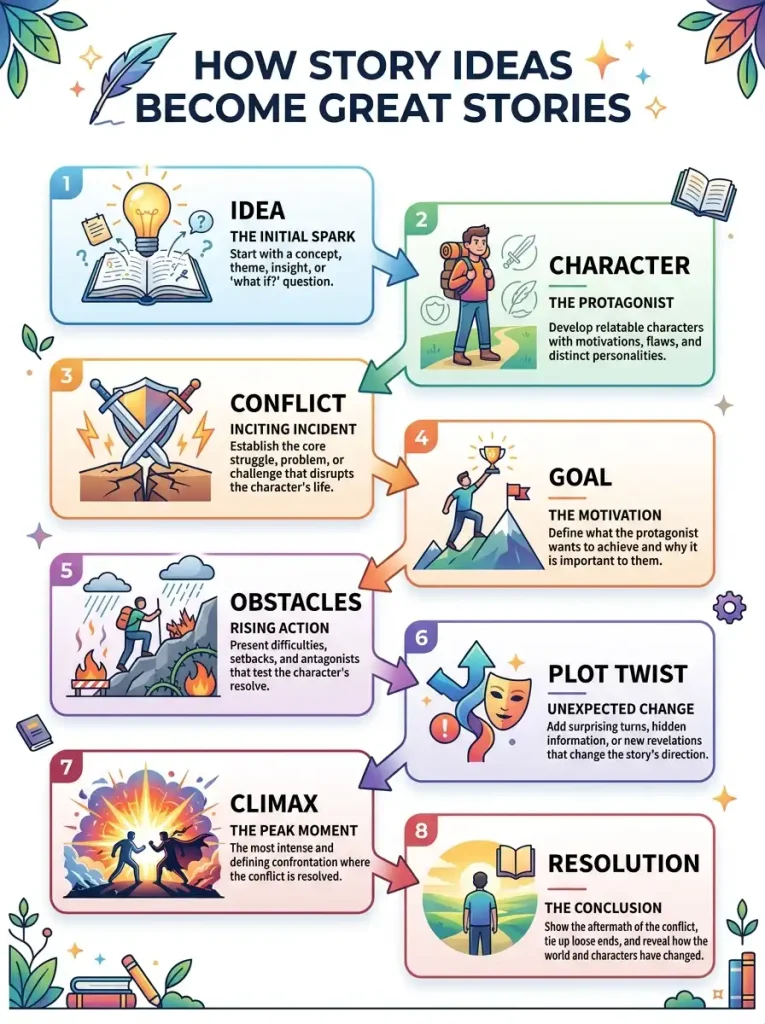
How to Turn Any Idea into a Great Story
A strong premise only gets you halfway there. Turning any of these into a finished story requires a few deliberate steps.
Start by finding conflict. Every compelling story needs something standing between your character and what they want. Without resistance, even a fascinating idea falls flat quickly.
Next, focus on raising stakes. Ask what your protagonist loses if they fail, whether that’s safety, love, identity, or something less obvious like trust in their own memory.
Building believable characters matters just as much as plot. Give your protagonist a clear desire and one internal contradiction, something they want that conflicts with something they fear.
Creating emotional arcs keeps readers invested beyond curiosity alone. Your character should end the story changed, even subtly, from where they started.
Adding suspense doesn’t require constant action. Sometimes, withholding information a scene longer builds far more tension than a dramatic reveal delivered too early.
Finally, building satisfying endings means resolving your central conflict in a way that feels earned, not convenient. Circle back to an image, object, or line from earlier in the story whenever possible.
“A story doesn’t need a perfect idea. It needs a character worth following through an imperfect one.”
Daily Exercises That Build Creativity
Consistent practice matters more than waiting for inspiration to strike. Try these exercises regularly to keep your creative instincts sharp.
- Random word challenge: Pick three unrelated words and build a short scene connecting them.
- Dialogue exercise: Write a conversation between two characters who each want something different from the exchange.
- Dream journal: Keep a notebook beside your bed, jotting down fragments immediately upon waking.
- Observation notebook: Spend ten minutes people-watching, recording small, specific details you notice.
- Photo inspiration: Choose a random photograph and write the backstory behind it.
- Writing from music: Play an instrumental track and write whatever scene it evokes.
- Reverse storytelling: Start with an ending, then work backward to figure out how your characters got there.
- Rewriting fairy tales: Take a familiar story and change one major element, the setting, the villain, or the outcome.
Writing Tip: Set a timer for ten minutes before starting any exercise. Time pressure quiets overthinking and keeps your instincts leading the way.
Common Mistakes Writers Make
Even strong ideas can produce weak stories if a few habits go unchecked. Here’s what to watch for.
Waiting for inspiration stalls more stories than any actual lack of ideas. Start writing before you feel ready; momentum creates its own motivation.
Copying famous stories too closely limits originality. Use familiar structures as inspiration, not templates to replicate exactly.
Weak characters happen when writers focus entirely on plot. Give every major character a contradiction, some tension between what they want and what they fear.
Predictable plots disappoint readers who’ve invested emotional energy. Brainstorm at least two alternate directions before committing to your final choice.
No conflict leaves stories feeling flat, regardless of how interesting the premise sounds. Make sure your character faces real resistance toward their goal.
Poor pacing often stems from uneven scene length. Vary your pacing deliberately, slowing for emotional beats, speeding through transitional moments.
Editing too early kills momentum before a draft has room to breathe. Finish a full draft first, then revise with fresh eyes.
Fear of failure quietly convinces many writers to abandon projects prematurely. Remind yourself that first drafts exist to discover the story, not perfect it.
Begin Your Story Today
Twelve ideas, and honestly, dozens more hiding inside each one once you start pulling at the threads. That’s the real gift of genuine inspiration: it rarely offers just one story. It opens a door, and what waits on the other side depends entirely on you.
Don’t wait for the perfect concept to appear out of nowhere. Choose whichever idea pulled at you the most while reading, sit down, and start writing today. Consistency beats waiting for perfect conditions every single time.
Great stories rarely begin with certainty. They begin with someone willing to write the first imperfect sentence anyway. That someone can be you, starting right now.