12 Bulletin Board Ideas for School That Actually Engage Students
Walking into a new classroom every August, most teachers face the same blank wall problem. You have a corkboard, a roll of butcher paper, and about an hour before open house starts. What goes up there actually matters more than it seems.
A great bulletin board does more than fill empty space. It sets the tone for your classroom, sparks curiosity, and gives students a reason to look up from their desks. Whether you’re decorating a kindergarten reading nook or a high school science lab, the right display can turn a plain wall into a teaching tool.
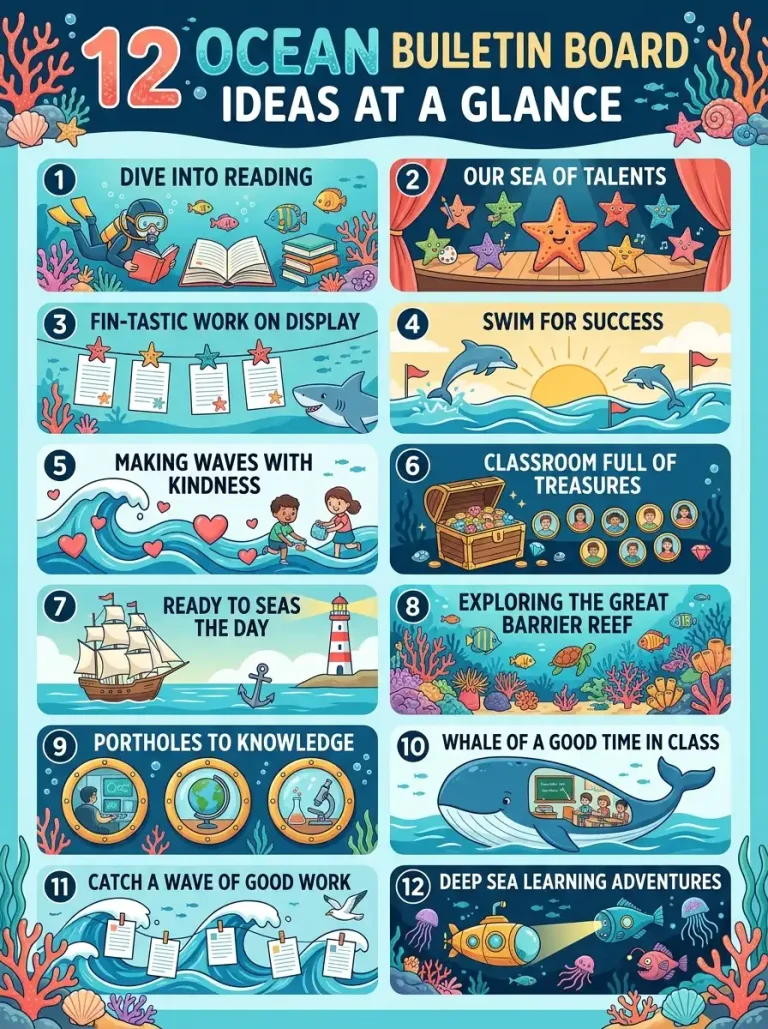
In this guide, you’ll find 12 school bulletin board ideas that go beyond generic decorations. Each one includes the materials you need, step-by-step instructions, ways students can get involved, and practical tips from teachers who’ve actually built these boards. By the end, you’ll have a full toolkit of classroom bulletin board ideas ready to use this year and beyond.
12 Bulletin Board Ideas for School
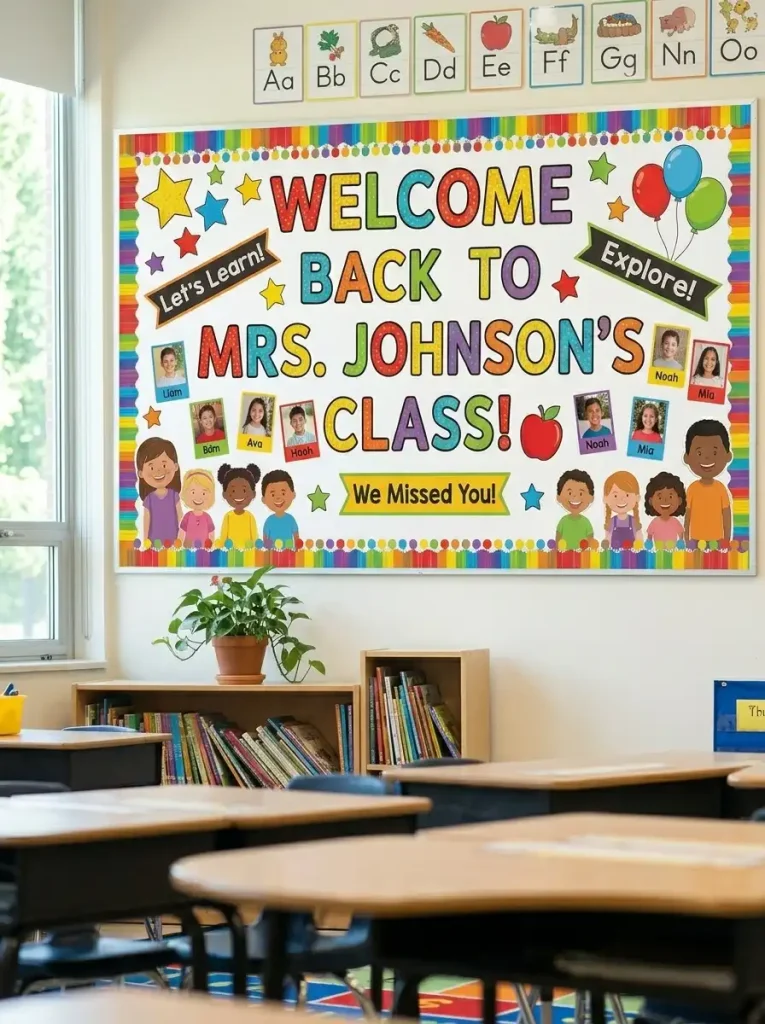
1. “Welcome to Our Learning Adventure” Back-to-School Board
Why It Works
First impressions shape how students feel about a new classroom. A warm, exciting welcome board reduces first-day anxiety and helps students feel like they belong immediately. It’s one of the most valuable back to school bulletin boards you can create.
Best For
Preschool through 5th grade, though the concept adapts easily for middle school with a more mature design.
Materials Needed
- Large bold letters for the headline
- Colorful border trim
- Cardstock in bright colors
- A world map or globe cutout
- Student photos (optional)
- Glue sticks and scissors
How to Create It
- Cover the board with bright background paper.
- Add a large headline like “Welcome Aboard!” using a travel or adventure theme.
- Cut out a simple vehicle shape, such as a hot air balloon or train.
- Attach individual student name tags along the vehicle.
- Frame the whole board with a colorful border.
Ways Students Can Participate
Ask students to decorate their own name tag on the first day. This gives them ownership immediately and helps you learn names faster.
Teacher Tips
Laminate the vehicle shape so you can reuse it every year. Just swap the name tags each fall.
Variations
Try an ocean theme with a ship, or a space theme with a rocket. Older students enjoy a “road trip” version showing a map with a route to their goals for the year.
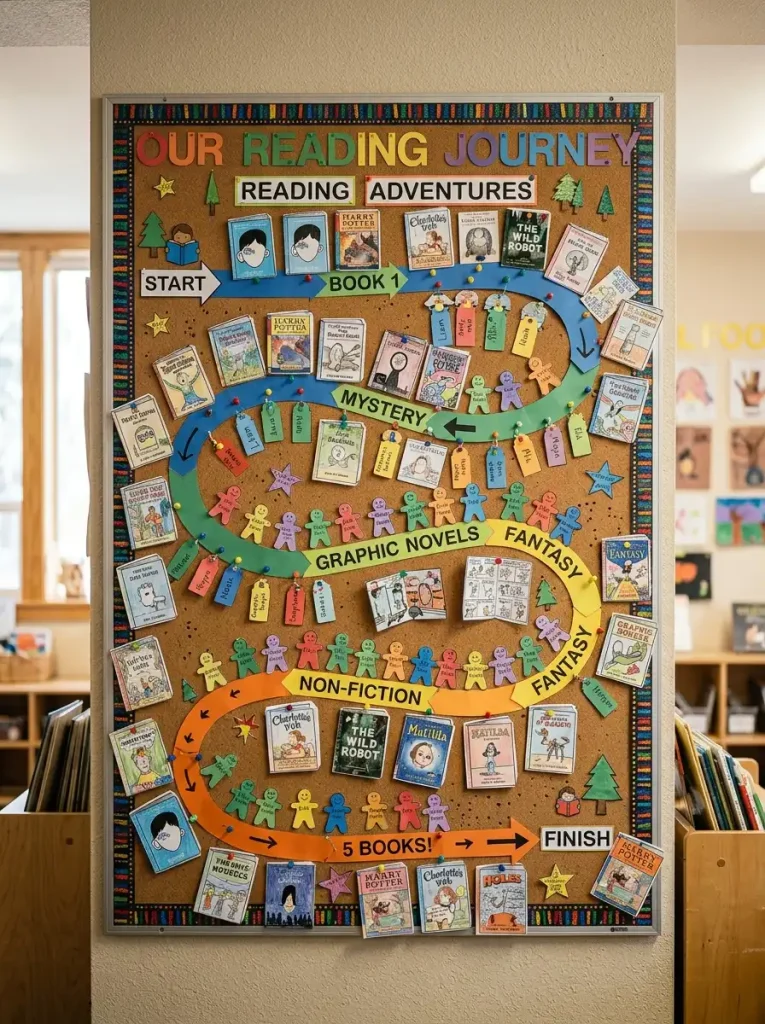
2. “Reading Takes You Places” Reading Corner Board
Why It Works
A reading bulletin board near your classroom library encourages students to see books as adventures rather than assignments. It also gives you a spot to highlight new titles and reading milestones.
Best For
Kindergarten through 6th grade, with a more independent version for middle school reading corners.
Materials Needed
- Cutout book shapes
- A path or road design (yarn or paper strips)
- Student name tags shaped like footprints or vehicles
- Book cover images
- Colorful backing paper
How to Create It
- Create a winding path across the board using paper or yarn.
- Place book-shaped markers along the path representing different reading levels or genres.
- Add a footprint or rocket for each student to move along the path as they finish books.
- Include a “Currently Reading” pocket chart for ongoing books.
Ways Students Can Participate
Let students move their marker forward every time they finish a book. They can also recommend a favorite title by writing a short note to pin nearby.
Teacher Tips
Update the path each quarter so the challenge feels fresh. Avoid turning it into a competition; frame movement as personal progress instead.
Variations
For older students, replace the path with a “map of genres” where markers move toward different literary destinations like mystery, fantasy, or biography.
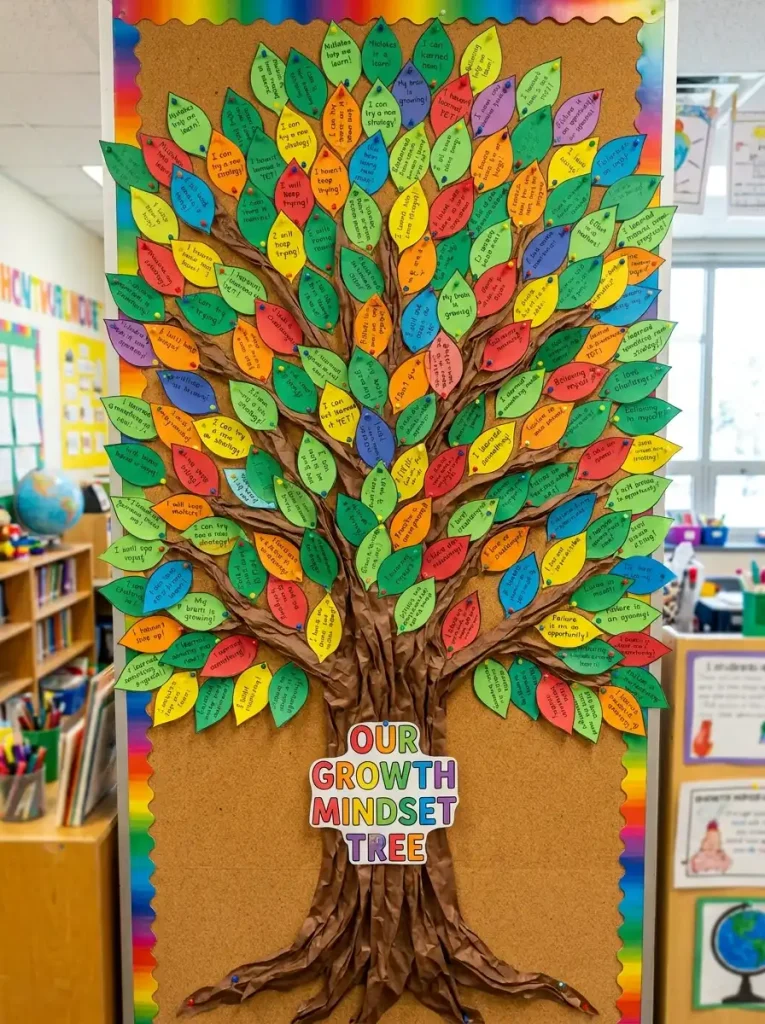
3. “Mistakes Help Us Grow” Growth Mindset Board
Why It Works
A growth mindset board reinforces the idea that effort and persistence matter more than instant success. Repeated exposure to these messages genuinely shifts how students respond to challenges over time.
Best For
All grade levels, with vocabulary adjusted for age.
Materials Needed
- Plant or tree cutouts (roots, trunk, leaves)
- Sticky notes
- Motivational phrase cards
- Green and brown paper
- Markers
How to Create It
- Build a large tree shape using brown and green paper.
- Label the roots with phrases like “effort,” “practice,” and “asking questions.”
- Leave the leaves blank so students can fill them in later.
- Add a headline such as “Our Growth Mindset Garden.”
Ways Students Can Participate
Invite students to write a challenge they overcame on a leaf and add it to the tree. Over time, the tree fills with real examples from your own classroom.
Teacher Tips
Model this yourself first by adding your own leaf about a mistake you learned from. Students respond well when they see adults embrace imperfection too.
Variations
Swap the tree for a mountain climbing theme, where each sticky note represents a step toward the summit.
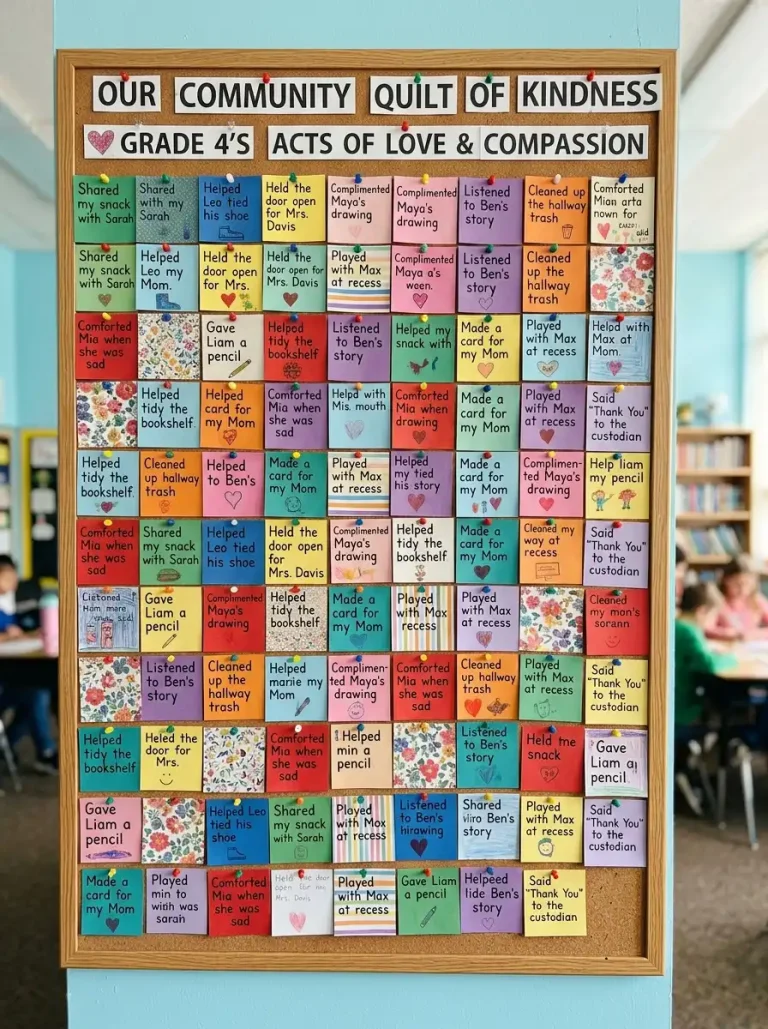
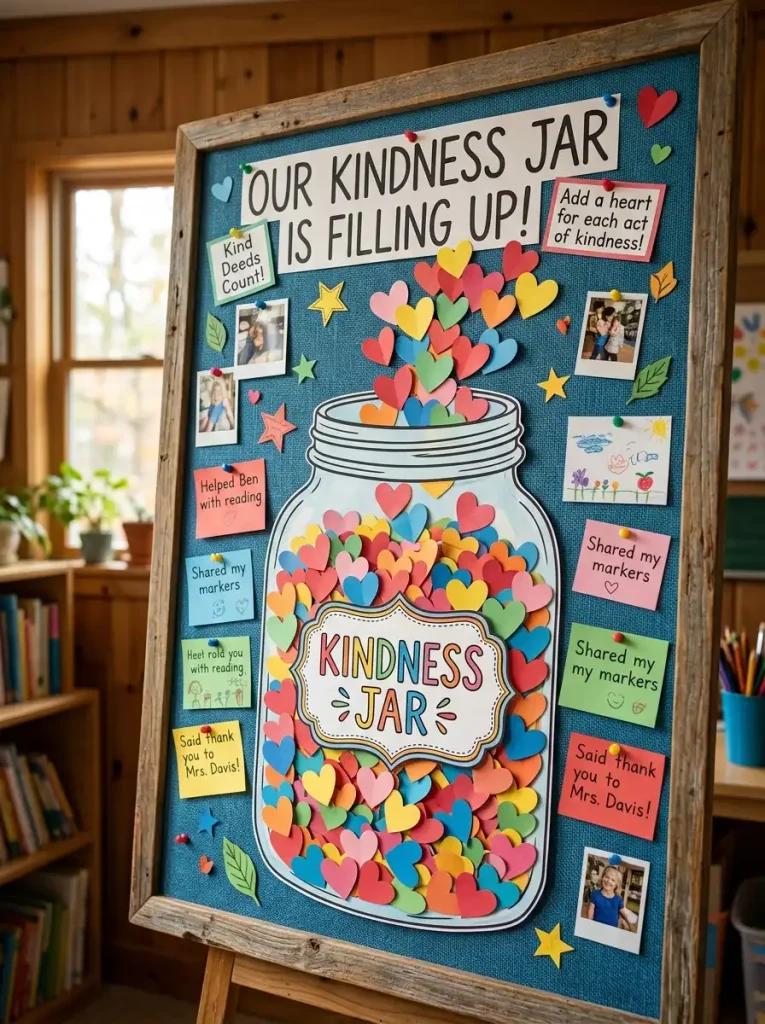
4. “Kindness Counts” Community Board
Why It Works
A kindness bulletin board makes generosity visible. When students see their kind acts recognized publicly, it reinforces positive behavior far more effectively than a quiet word alone.
Best For
Elementary and middle school classrooms.
Materials Needed
- Heart-shaped cutouts
- A large jar or thermometer design
- Colorful markers
- Bulletin board paper
- Push pins or tape
How to Create It
- Draw a large jar or container in the center of the board.
- Cut out small paper hearts to represent kind acts.
- Add a headline like “Filling Our Kindness Jar.”
- Leave space below for students to write examples.
Ways Students Can Participate
Whenever a student notices a classmate being kind, they write it on a heart and add it to the jar. Set a class goal, like filling the jar by the end of the month.
Teacher Tips
Read a few hearts aloud each week during morning meeting. This keeps the board active instead of becoming background noise.
Variations
Turn it into a schoolwide kindness bulletin board in the hallway, where any student or teacher can contribute a heart.
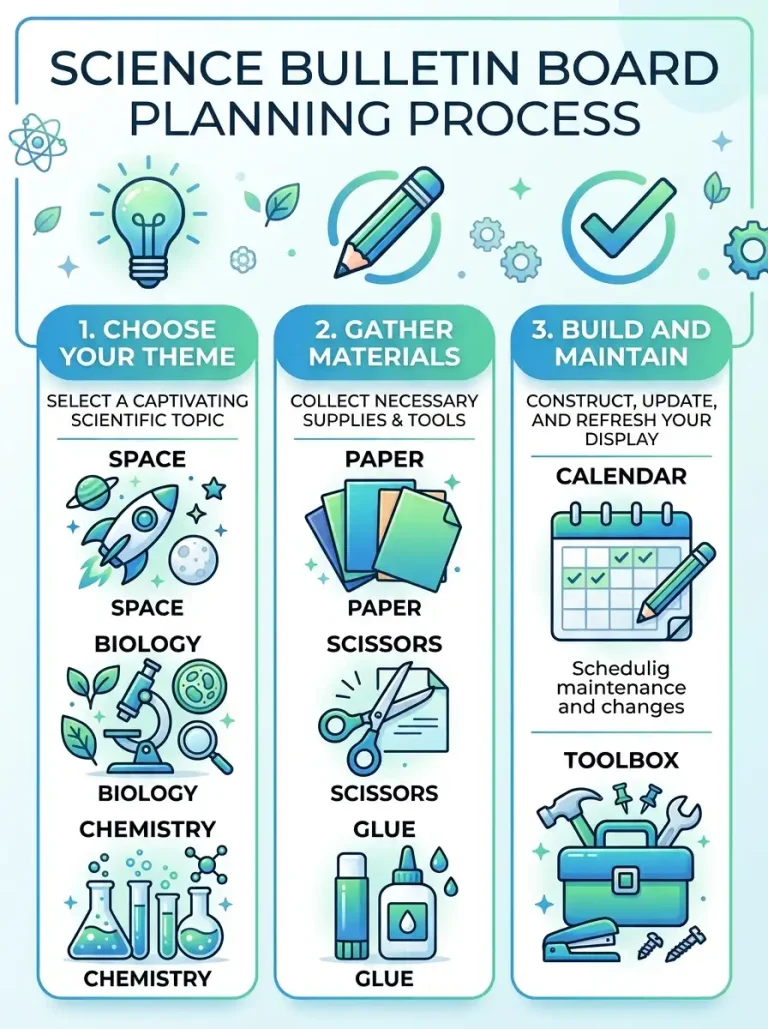
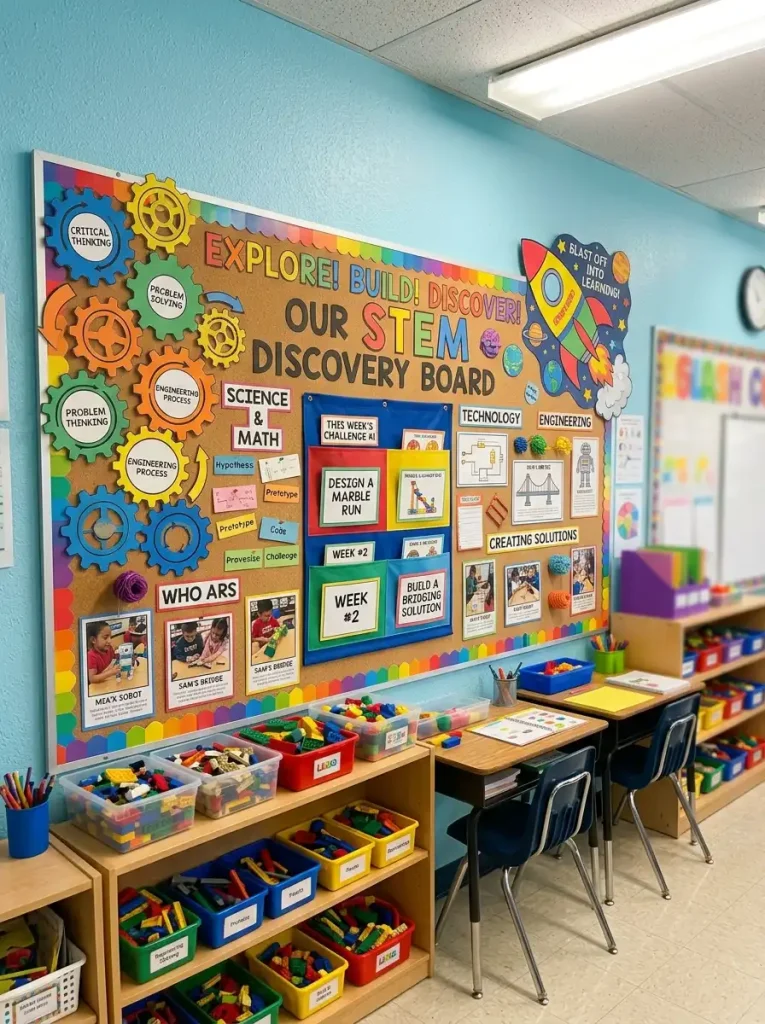
5. “STEM Explorers” Discovery Board
Why It Works
STEM discovery boards spark curiosity about science, technology, engineering, and math outside of formal lessons. They also give students a place to explore questions that don’t fit neatly into a single subject.
Best For
3rd through 8th grade.
Materials Needed
- Gear, rocket, or lightbulb cutouts
- A “Question of the Week” pocket
- Sticky notes for answers
- Bright primary colors
- Small facts or trivia cards
How to Create It
- Design a headline such as “STEM Explorers Wanted.”
- Add a pocket labeled “Challenge of the Week” where you post a new puzzle or question.
- Include a spot for students to submit written guesses or solutions.
- Rotate in fun facts about inventors, engineers, or scientists.
Ways Students Can Participate
Let students submit answers anonymously, then reveal the solution and a top answer each Friday. Rotate who picks the next challenge.
Teacher Tips
Keep challenges short enough to solve in five minutes so students engage without feeling overwhelmed.
Variations
Focus one month on engineering challenges and another on coding logic puzzles to keep the board dynamic.
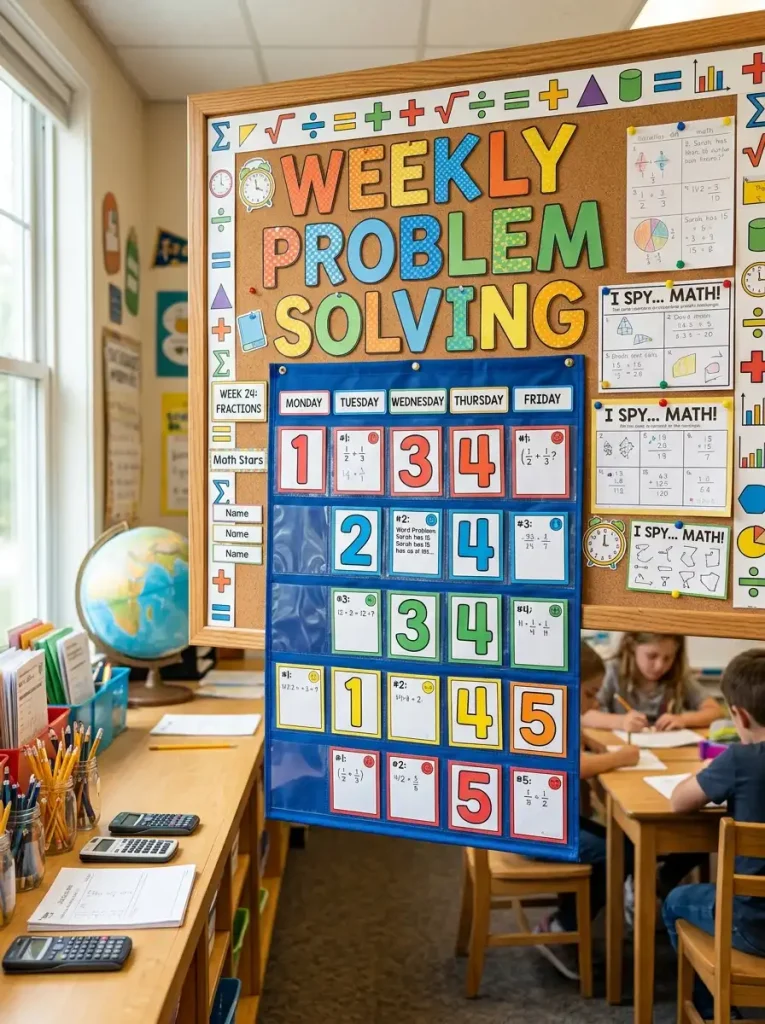
6. “Math in Action” Problem-Solving Board
Why It Works
A math bulletin board that changes weekly gives students low-pressure practice outside of graded work. It also shows that math shows up in daily life, not just textbooks.
Best For
2nd through 8th grade.
Materials Needed
- Numbered pocket chart
- Dry-erase pockets or laminated cards
- Colorful number cutouts
- Markers
- A “Math Challenge” headline
How to Create It
- Set up a pocket labeled “Problem of the Week.”
- Post a new question every Monday, ranging from logic puzzles to real-world word problems.
- Provide a submission pocket for written answers.
- Reveal the solution and celebrate correct answers on Friday.
Ways Students Can Participate
Rotate responsibility for writing the weekly problem among small groups. This builds ownership and lets students practice explaining math to peers.
Teacher Tips
Include problems with more than one valid approach so students can compare strategies rather than just checking a single answer.
Variations
For younger grades, turn it into a number-of-the-day board where students find creative ways to represent the same number.
7. “Wonders of Science” Explorer Board
Why It Works
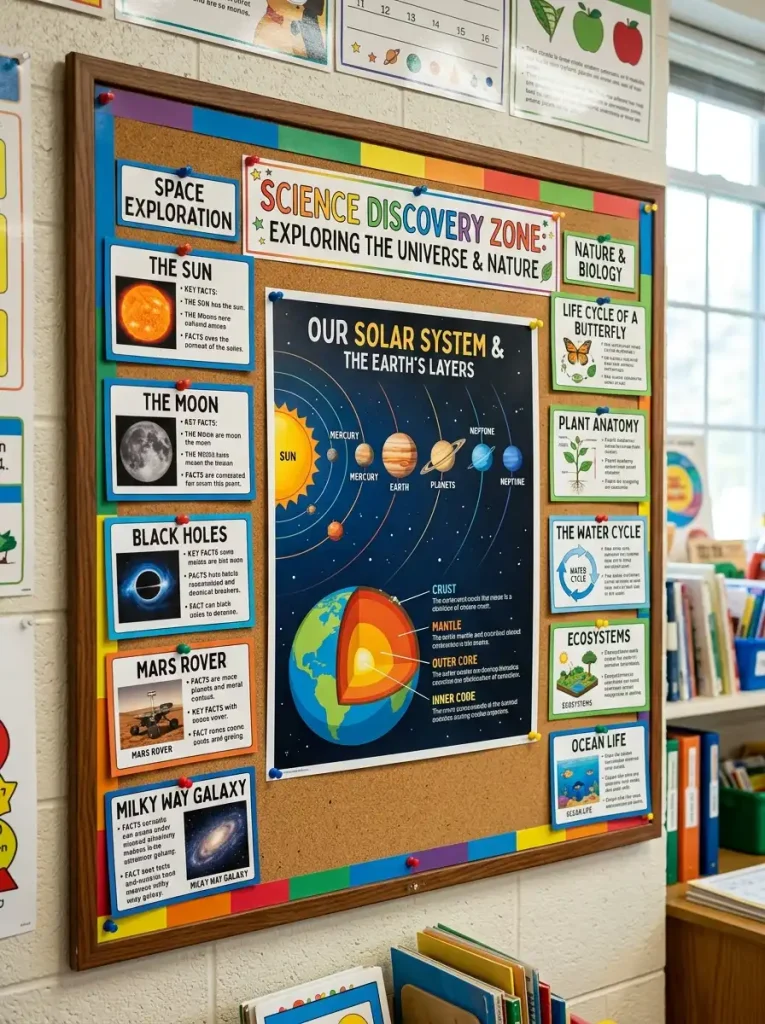
A science bulletin board connects classroom lessons to real-world discoveries. Highlighting current events in science, like a new space mission or a local nature phenomenon, keeps content relevant.
Best For
4th through 8th grade, adaptable for high school electives.
Materials Needed
- Space, nature, or lab-themed cutouts
- Fact cards
- Photos or diagrams
- Bright accent colors
- A “Did You Know?” header
How to Create It
- Choose a rotating focus, such as space, ecosystems, or the human body.
- Add a large diagram or labeled illustration as the centerpiece.
- Surround it with short fact cards students can read quickly.
- Update the centerpiece every few weeks to match your curriculum.
Ways Students Can Participate
Ask students to research and submit their own “Did You Know?” fact card related to the current unit.
Teacher Tips
Tie the board directly to whatever unit you’re teaching so it reinforces rather than distracts from your lessons.
Variations
Create a “Scientist Spotlight” section featuring a different researcher or field each month.
8. “Where in the World” Map Board
Why It Works
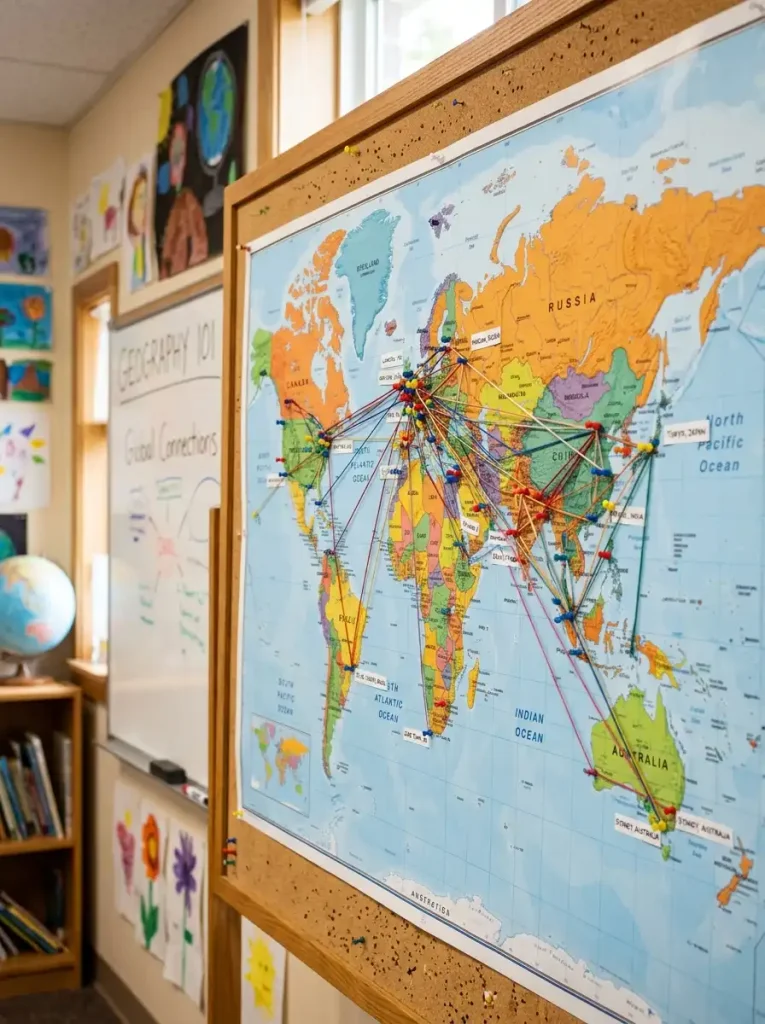
A world map board builds geography awareness naturally, without a dedicated lesson every time. It also works well for connecting literature, current events, or heritage months to specific locations.
Best For
Elementary through high school, depending on complexity.
Materials Needed
- A large world map (printed or hand-drawn)
- Pushpins or small flags
- String or yarn
- Labels for locations
- A headline banner
How to Create It
- Mount a large world map as the centerpiece.
- Add pins for places connected to your curriculum, like book settings or historical events.
- Use string to connect pins to short description cards around the border.
- Update pins as new topics come up throughout the year.
Ways Students Can Participate
Let students add a pin for their own family heritage or a place they’d like to visit, along with a short fact.
Teacher Tips
Keep a small basket of pins and labels nearby so updating the board takes minutes, not an entire prep period.
Variations
Turn it into a “Books Around the World” board where each pin marks the setting of a class novel.
9. “Star of the Week” Student Spotlight Board
Why It Works
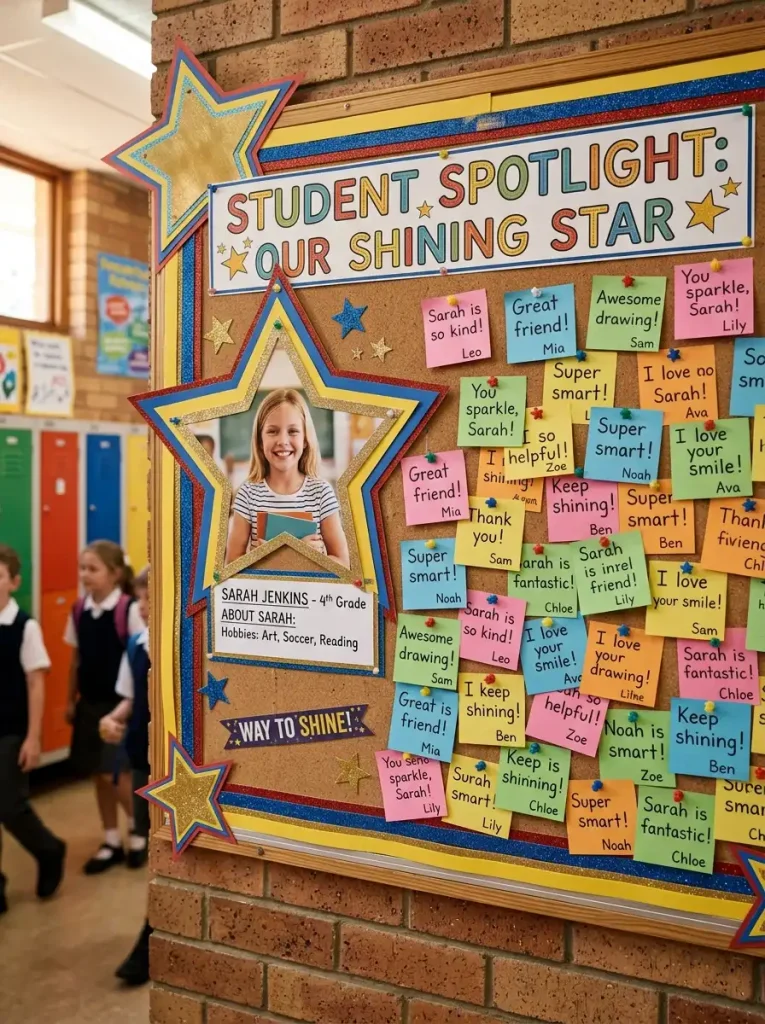
Every student wants to feel seen. A student spotlight board gives each child a moment of recognition, which builds confidence and strengthens classroom community.
Best For
Preschool through 6th grade.
Materials Needed
- A frame or star-shaped cutout
- A short questionnaire template
- Photo of the featured student
- Colorful border
- Push pins
How to Create It
- Create a frame labeled “Star of the Week” with space for a photo.
- Add a simple questionnaire, such as favorite color, hobby, or a fun fact.
- Rotate a new student into the spotlight each week.
- Let classmates add supportive notes around the frame.
Ways Students Can Participate
Ask classmates to write one kind comment or compliment for the featured student to take home at the end of the week.
Teacher Tips
Keep a rotation chart nearby so every student gets a turn, and no one feels skipped.
Variations
For older students, shift the focus to “Student Achievement Spotlight,” highlighting effort or improvement rather than just personal facts.
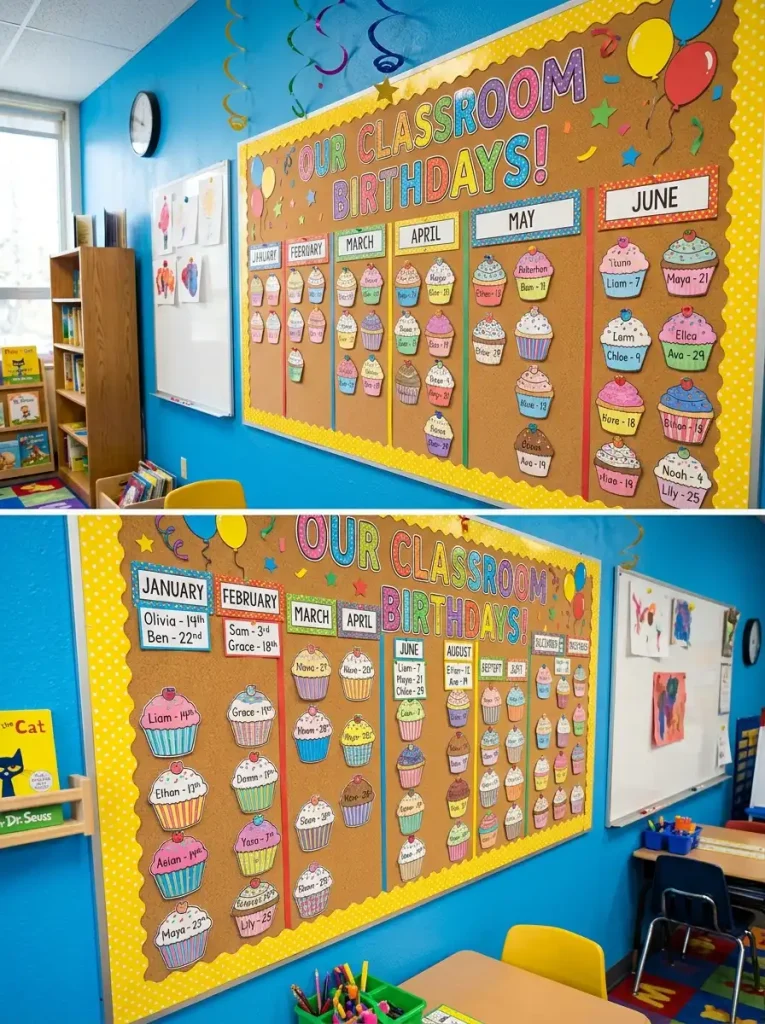
10. “Happy Birthday to You” Birthday Board
Why It Works
A birthday board is simple, but it matters more than it seems. Recognizing birthdays publicly makes students feel individually valued within a busy classroom routine.
Best For
Preschool through 5th grade.
Materials Needed
- Cupcake, balloon, or cake cutouts
- Monthly calendar grid
- Student names
- Bright, cheerful colors
- Glitter tape or stickers (optional)
How to Create It
- Create twelve small sections, one for each month.
- Add a cupcake or balloon cutout with each student’s name and birthday.
- Use a consistent color scheme so it stays easy to read.
- Update it at the start of the school year and leave it mostly static afterward.
Ways Students Can Participate
Let each student decorate their own cupcake or balloon cutout when they join the class.
Teacher Tips
Include a spot for “summer birthdays” so students with off-season birthdays still get recognized during the school year.
Variations
Combine it with a “half birthday” system for students whose birthdays fall during summer break.
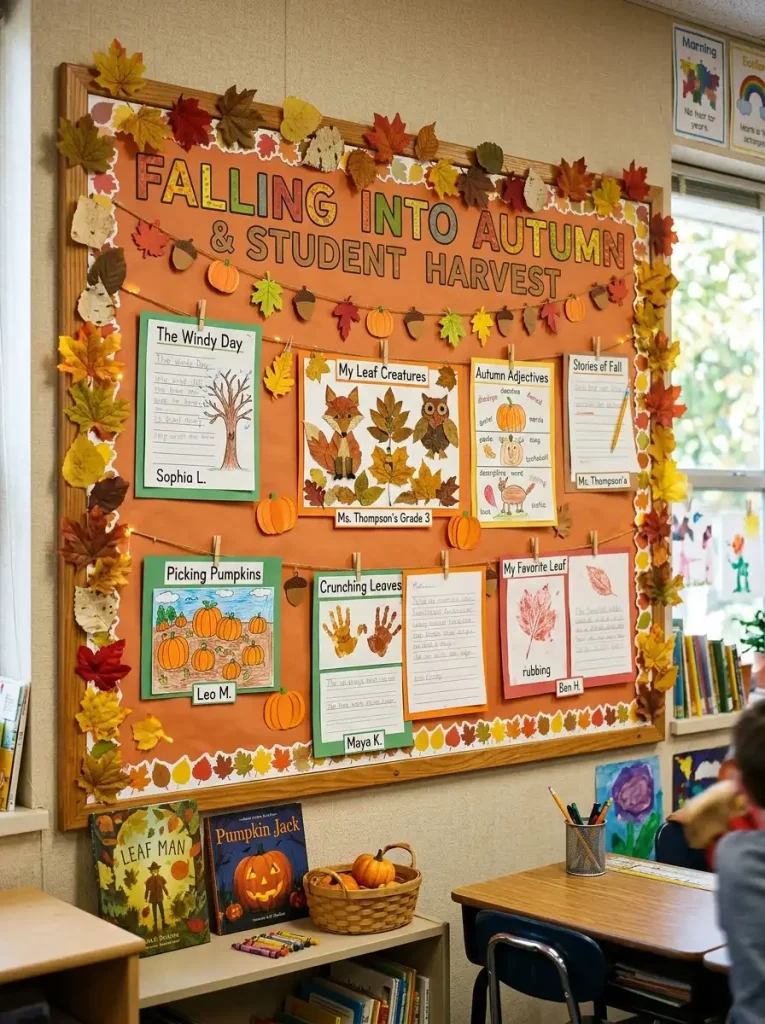
11. “Falling Into Learning” Seasonal Display
Why It Works
Seasonal bulletin boards keep your classroom feeling fresh and connected to the time of year. They also give you an easy way to showcase student work tied to seasonal writing or art projects.
Best For
All grade levels, with content adjusted by age.
Materials Needed
- Seasonal cutouts (leaves, snowflakes, flowers, sun shapes)
- Student work samples
- Colorful backing paper matching the season
- A rotating headline banner
How to Create It
- Choose a seasonal theme that matches the current month.
- Create a simple background using seasonal colors, like orange and red for fall.
- Add a display area for student work related to a seasonal writing prompt or art project.
- Swap decorations roughly every eight to ten weeks.
Ways Students Can Participate
Have students create a seasonal art piece or short reflection to display, rotating whose work is featured.
Teacher Tips
Keep a bin of reusable seasonal decorations labeled by season so setup takes less time each year.
Variations
Combine seasonal learning with academic content, like fall-themed math word problems or winter science facts about weather.
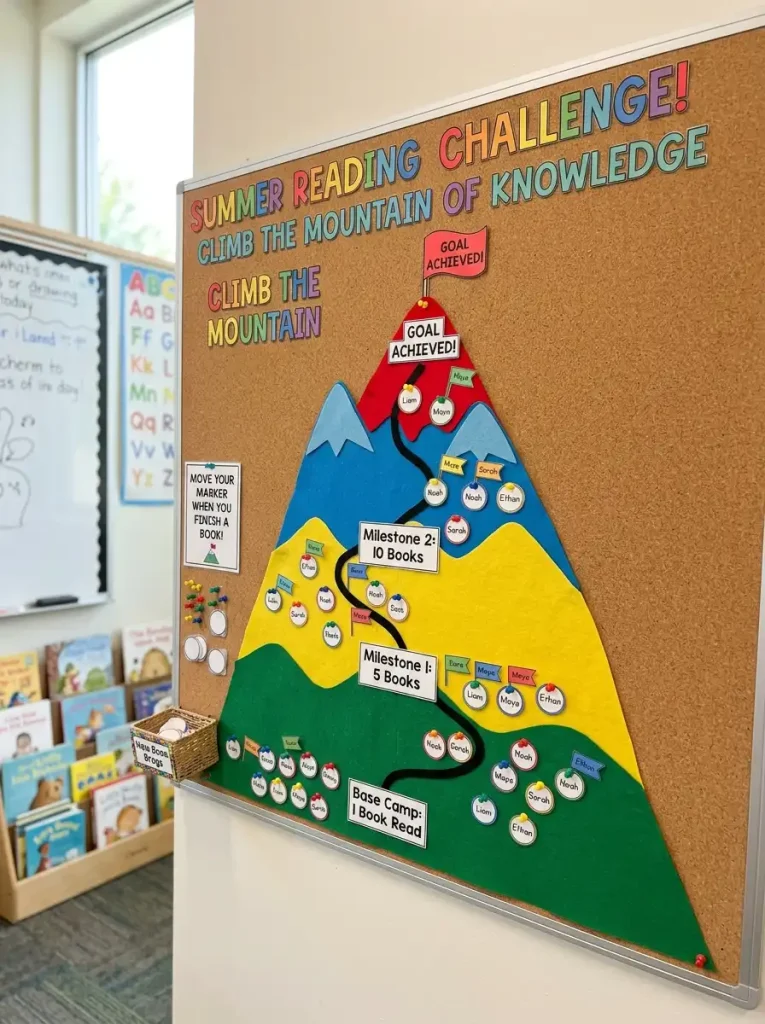
12. “Reaching for Our Goals” Goal Tracker Board
Why It Works
A goal tracker board makes progress visible, which keeps students motivated over the long term. It also teaches goal-setting as a habit rather than a one-time assignment.
Best For
3rd through 12th grade.
Materials Needed
- Ladder, rocket, or mountain design
- Small movable markers (clothespins or velcro tags)
- Index cards for goals
- Bright accent colors
- A headline banner
How to Create It
- Design a visual path, like a ladder or mountain, representing progress.
- Give each student a marker with their name that can move along the path.
- Have students write a personal or academic goal on an index card nearby.
- Check in weekly or monthly to move markers forward.
Ways Students Can Participate
Let students choose their own goals, whether academic, behavioral, or personal, and update their own marker during check-ins.
Teacher Tips
Keep goals private if needed by using initials instead of full names, especially in older grades where students may feel self-conscious.
Variations
Use it as a classwide goal tracker for a shared target, like a reading minutes challenge or a service project milestone.
Why Bulletin Boards Still Matter in Modern Classrooms
With smartboards, tablets, and digital slideshows everywhere, you might wonder if bulletin boards are outdated. They’re not. In fact, they serve purposes that screens simply can’t replace.
They Boost Engagement
A well-designed board catches a student’s eye the moment they walk in. Unlike a screen that turns off, a bulletin board stays visible all day, quietly reinforcing lessons. Students glance at it between tasks, during transitions, and while waiting for instructions.
They Shape Classroom Culture
Bulletin boards communicate values before you say a single word. A kindness bulletin board tells students that respect matters here. A growth mindset board signals that mistakes are part of learning. These messages sink in slowly, through repetition rather than lecture.
They Support Visual Learning
Many students process information better through images and color than through speech alone. Interactive bulletin boards turn abstract ideas, like fractions or the water cycle, into something students can see and touch. This is especially helpful for visual and kinesthetic learners.
They Help With Organization
Boards can double as a home for schedules, classroom jobs, or goal trackers. Instead of repeating instructions all day, you can simply point to the wall. This saves time and builds independence.
They Encourage Student Participation
The best educational bulletin boards aren’t static. They invite students to add their own work, vote on a question, or move a piece across a board. That participation turns a wall decoration into a shared classroom project.
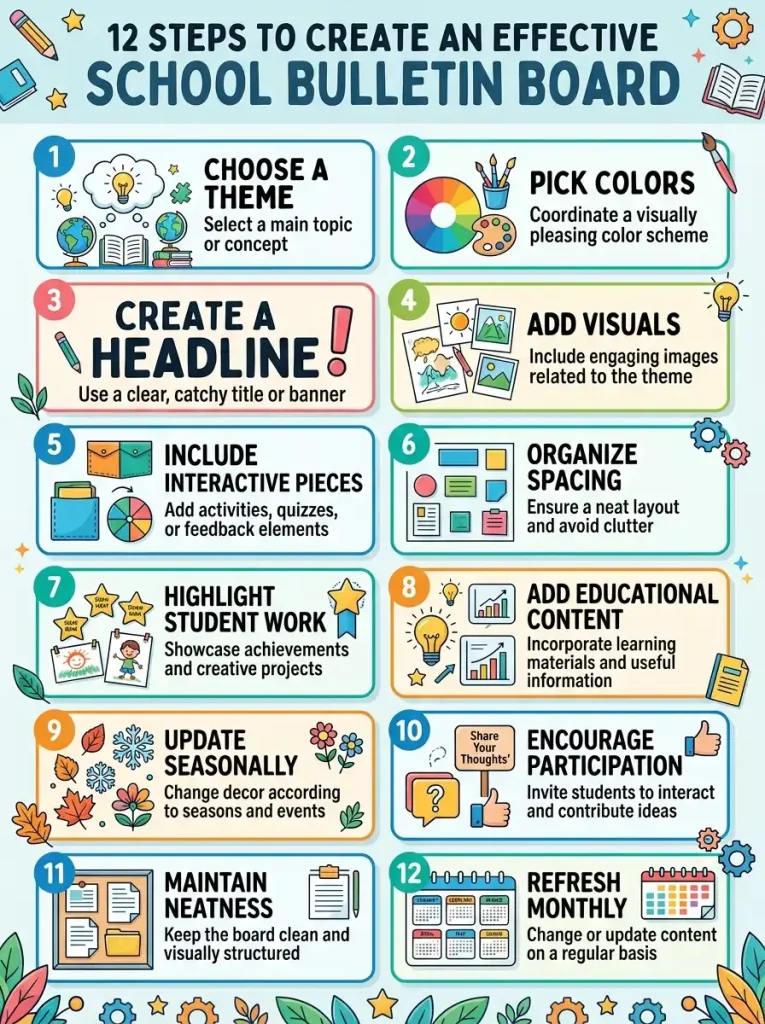
Tips for Creating Eye-Catching Bulletin Boards
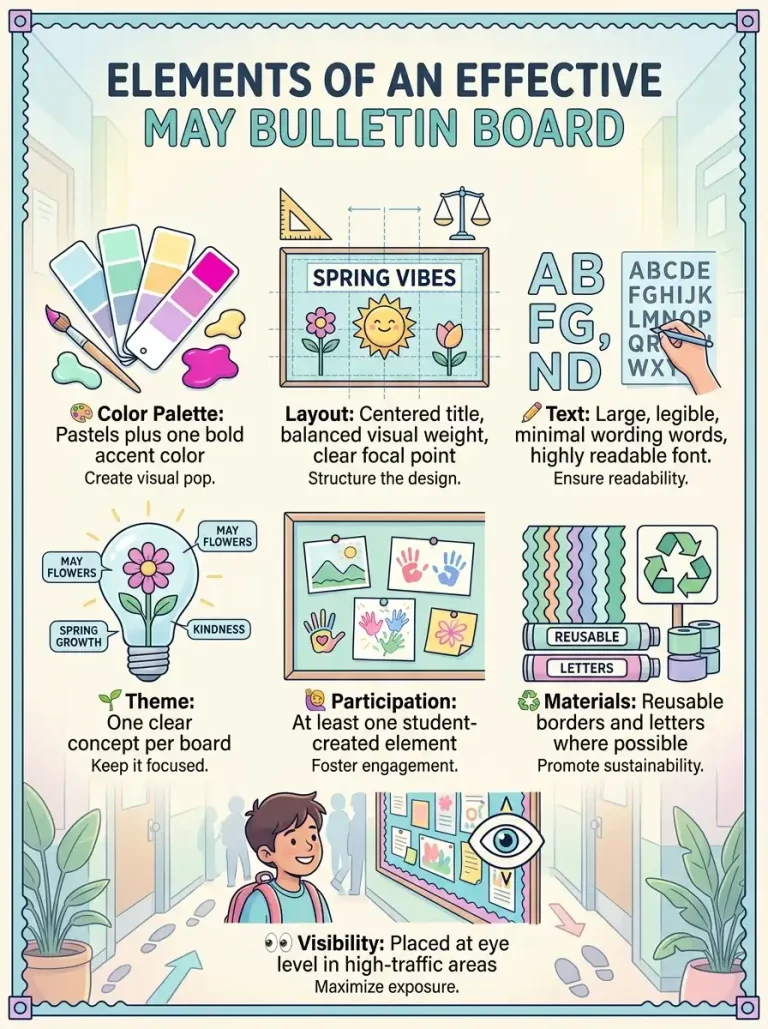
Before jumping into specific ideas, it helps to understand what separates a forgettable board from a memorable one. These fundamentals apply no matter which theme you choose.
Choose a Clear Theme
Every strong board starts with one clear idea. Trying to combine too many concepts on a single board usually creates visual clutter. Pick one theme, then let every element support it.
Use a Thoughtful Color Palette
Color affects mood more than most teachers realize. Warm colors like orange and yellow feel energetic and work well for welcome displays. Cooler tones like blue and green feel calm and suit reading corners or quiet spaces.
Stick to two or three main colors per board. This keeps things looking intentional instead of chaotic.
Pick Readable Fonts
Bubble letters and die-cut fonts look fun, but they need to stay legible from across the room. Avoid overly decorative script for large headlines. Save fancy fonts for short words only.
Balance Spacing
Empty space isn’t wasted space. Give your eyes room to rest between elements. Overcrowded boards are harder to read and feel overwhelming to young students.
Prioritize Durability
Paper fades and tears, especially in high-traffic hallways. Laminate key pieces, use bulletin board borders that can be reused, and choose sturdy backing paper when possible. This saves you money and time throughout the year.
Build In Interactive Elements
Static boards get ignored after the first week. Interactive bulletin boards, ones where students move a piece, answer a riddle, or add a sticky note, keep drawing attention.
Plan for Seasonal Updates
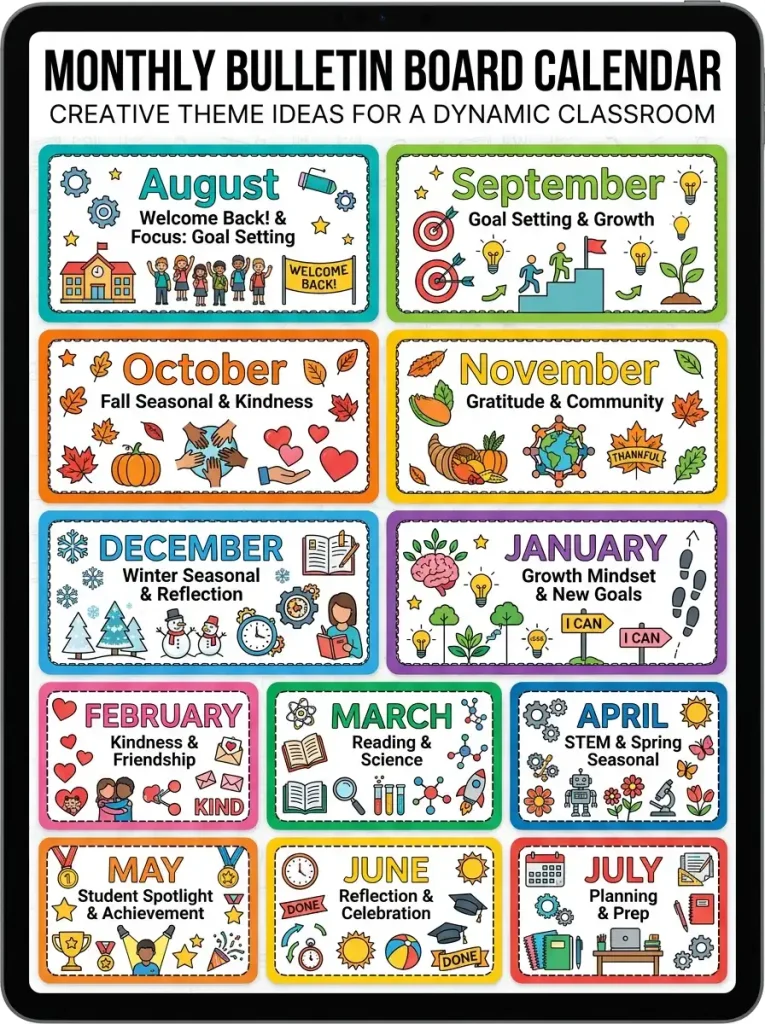
A board that never changes becomes invisible. Swap out headlines, borders, or student work every few weeks to keep things fresh without redoing the whole thing.
Now let’s get into the good stuff. Below you’ll find 12 bulletin board ideas that are practical, adaptable, and genuinely useful across grade levels.
Bulletin Board Design Mistakes to Avoid
Even experienced teachers fall into a few common traps. Here’s what to watch for as you plan your own classroom decorations.
Overcrowding the Board
Cramming too many elements into one space makes a board hard to read. Instead, pick fewer, larger elements and leave breathing room between them.
Using Too Many Fonts or Colors
Mixing five fonts and eight colors on one board creates visual noise. Stick to one or two fonts and a limited color palette for a cleaner look.
Making It Purely Decorative
A board with no educational value or interactive piece quickly becomes background noise. Even simple boards benefit from one small interactive element.
Forgetting to Update It
A board that stays up all year eventually gets ignored. Set a calendar reminder to refresh key elements every four to eight weeks.
Placing Small Text Too High
Text placed near the ceiling or in tiny fonts becomes unreadable from a normal viewing distance. Test readability by standing at the back of the room.
Skipping Student Involvement
Boards built entirely by the teacher miss a big opportunity. Student-created elements make displays more meaningful and reduce your own prep time.
Frequently Asked Questions
How often should I change my classroom bulletin boards?
Most teachers refresh interactive elements every two to four weeks and swap full themes every seasonal change, roughly every eight to ten weeks.
What materials last the longest on a bulletin board?
Laminated cardstock and reusable fabric borders tend to outlast plain paper, especially in high-traffic hallway displays.
Do bulletin boards actually improve learning?
Yes, when they include interactive or educational elements. Purely decorative boards offer less academic benefit than boards tied to current lessons.
What’s a good bulletin board idea for a small classroom?
Compact ideas like a goal tracker or student spotlight board work well in limited space since they don’t require large centerpieces.
How do I keep a bulletin board neat with young students helping?
Prepare pre-cut shapes and clear instructions so student contributions stay organized rather than scattered.
Are digital bulletin boards a good replacement for physical ones?
Digital displays work well as a supplement, but physical boards offer constant visibility without needing a screen to be turned on.
What’s the best bulletin board idea for middle school classrooms?
Middle school classroom ideas that emphasize independence, like a STEM challenge board or goal tracker, tend to resonate more than younger, cartoon-style themes.
How do I make a high school bulletin board feel age-appropriate?
High school bulletin board inspiration often leans toward minimalist design, real-world data, or college and career readiness themes rather than childlike decorations.
Can one bulletin board serve multiple subjects?
Yes, boards like a world map or goal tracker can connect to reading, math, and social studies content depending on how you frame the activity.
What should I do with old bulletin board materials?
Store reusable borders, letters, and cutouts in labeled bins by theme so you can reuse them in future years instead of buying new supplies each time.
Final Thoughts
Bulletin boards remain one of the simplest, most flexible tools in any classroom. They build community, reinforce lessons, and give students a sense of ownership over their space.
You don’t need to recreate all 12 of these ideas at once. Start with one or two that fit your grade level and curriculum, then build from there throughout the year.
As the seasons change and your curriculum shifts, let your boards shift with them. A little refresh every few weeks keeps your classroom feeling alive, and keeps students genuinely curious about what’s coming next.