7 Korean Study Planner Free Printable Templates PDF
You open your Korean textbook with big plans for the evening. Twenty minutes later, you’re scrolling your phone, the textbook untouched, and the guilt sets in. Sound familiar?
That gap between wanting to learn Korean and actually sitting down to study it isn’t about motivation. It’s about structure. Most learners don’t fail because they lack discipline. They fail because they never had a plan they could actually follow.
That’s exactly why a Korean study planner works so well. It turns a vague goal like “get better at Korean” into a series of small, doable tasks you can check off. And when that planner is a free printable PDF, you get something even better: a physical, distraction-free space to track your progress away from the same phone that keeps stealing your attention.
In this guide, you’ll get seven Korean study planner free printable templates PDF, each built for a different part of your learning journey. Whether you’re cramming vocabulary, prepping for TOPIK, or just trying to build a daily habit, there’s a printable sheet here for you.
Let’s talk about why planning matters so much for Korean specifically, then get into the templates themselves.
Why You Need a Korean Study Planner
Korean isn’t a language you can absorb passively. Between Hangul, grammar particles, honorifics, and constantly shifting sentence structures, your brain needs repeated, organized exposure. A planner gives you that structure without the mental overhead of deciding what to study every single day.
Consistency Beats Intensity
Studying for three hours once a week feels productive, but it isn’t. Your brain forgets new vocabulary within days unless you revisit it. A planner nudges you toward shorter, more frequent sessions, which is exactly what language acquisition research supports.
Habit Formation Happens Through Repetition
Every time you fill in a planner box, you reinforce the habit of studying. Over a few weeks, opening your planner becomes as automatic as checking your phone. That’s the real win here, because habits sustain progress long after motivation fades.
Vocabulary Retention Needs a System
Random flashcard sessions only go so far. A planner with a dedicated vocabulary section forces you to log new words, revisit older ones, and notice patterns in how Korean builds meaning. This kind of spaced repetition is one of the most effective tools for language retention.
Grammar Practice Needs Tracking
Korean grammar is layered. You’ll learn a pattern, move on, then realize weeks later that you never actually practiced it enough. Tracking grammar points on paper keeps you honest about what you’ve truly mastered versus what you’ve only seen once.
TOPIK Preparation Demands Structure
If you’re working toward the TOPIK exam, a planner isn’t optional. The test covers listening, reading, and writing separately, and each section needs its own practice rhythm. Without a plan, it’s easy to over-study one section and neglect another.
Balanced Study Sessions Prevent Gaps
Speaking, listening, reading, and writing all develop differently. A planner reminds you to rotate through all four skills instead of only doing the one that feels comfortable, like reading, while avoiding speaking practice.
Avoiding Burnout Matters More Than You Think
Burnout is the silent killer of language learning. A good planner includes rest days, realistic goals, and space for reflection, which keeps studying sustainable instead of overwhelming. Small, steady sessions protect your motivation far better than marathon cram sessions ever will.
How to Use These Printable Planners
Each planner in this collection is designed to print cleanly on standard A4 paper. Before you download, here’s how to get the most out of them.
Printing Tips
Print in grayscale to save ink, since every layout here is designed to look clean without color. Use a slightly heavier paper if you plan to write with a fountain pen or fine-tip marker, since regular printer paper can bleed through.
Consider printing a batch of each planner at once. Having ten daily planner sheets ready to go removes any excuse to skip a session because you “didn’t have a sheet.”
Daily Planning
Use the daily planner every morning or right before your study session. Fill in your main goal first, then work through the study blocks one at a time. This keeps each session focused instead of scattered.
Weekly Planning
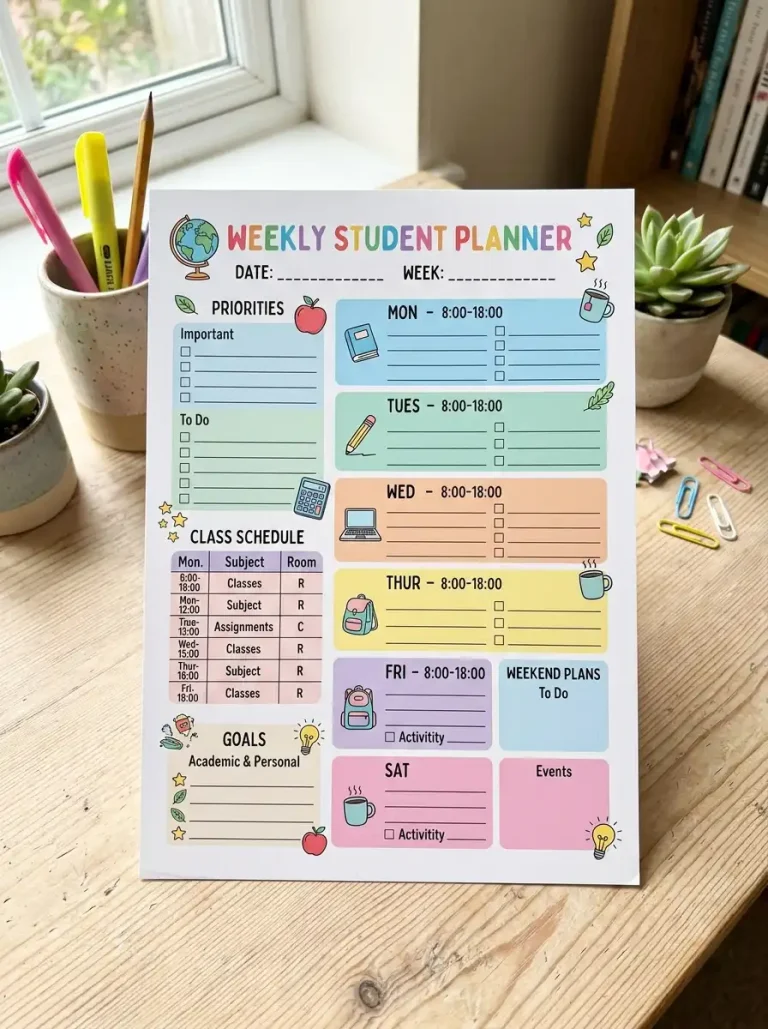
At the start of each week, sit down with the weekly planner and map out your priorities. Think about which days you have more time and which days need shorter sessions. Realistic planning beats ambitious planning that collapses by Wednesday.
Monthly Goals
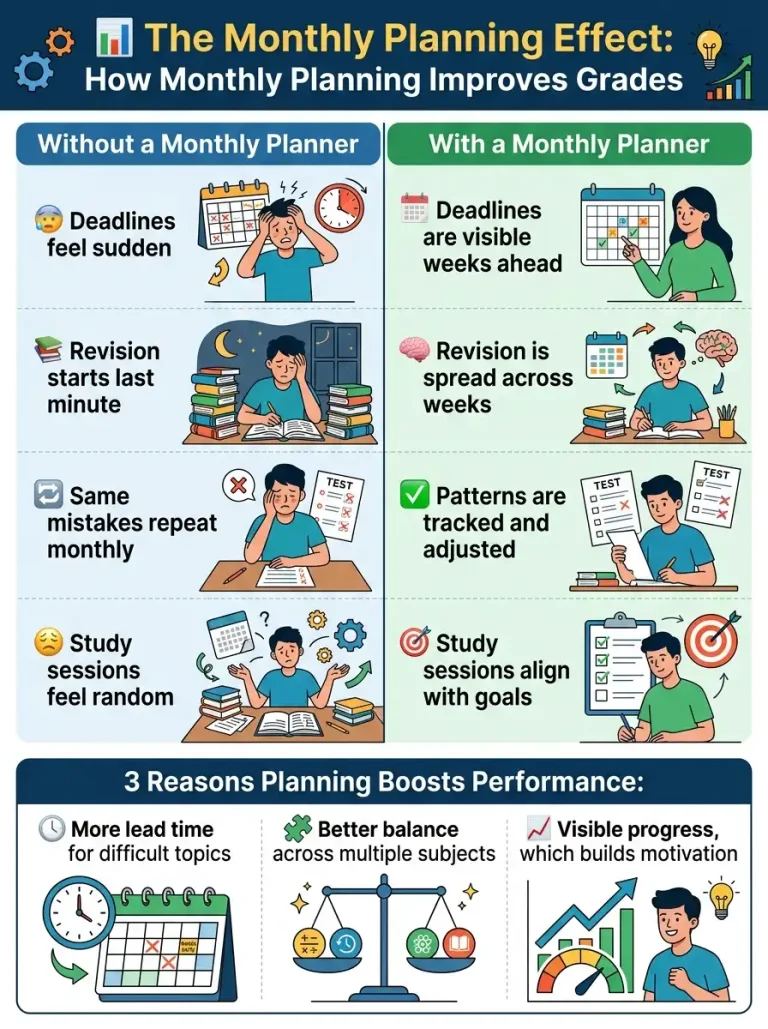
Monthly planning zooms out. Instead of daily tasks, you’re setting bigger targets, like finishing a textbook chapter or reaching a new TOPIK practice score. Revisit this sheet weekly to check whether you’re on track.
Vocabulary Review
Don’t just write new words down and forget them. Circle back to your vocabulary tracker every few days and quiz yourself on older entries. This single habit does more for retention than almost anything else on this list.
Grammar Tracking
Log every grammar point you study, along with example sentences. When you revisit a pattern weeks later, your own notes will remind you exactly how it works, which is far more useful than a generic textbook explanation.
Listening, Speaking, Reading, and Writing Practice
Rotate through these four skills deliberately. If your planner shows three days in a row of only reading, that’s a sign to switch things up. Balance is the entire point of a structured planner.
Revision Days
Build in at least one revision day per week. Use it to flip back through your vocabulary tracker, grammar planner, and notes from the week. Revision days are where real retention happens, not just first exposure.
The 7 Korean Study Planner Templates
Below are all seven planners included in this collection. Each one is included in the full downloadable PDF at the end of this article, formatted for clean A4 printing.
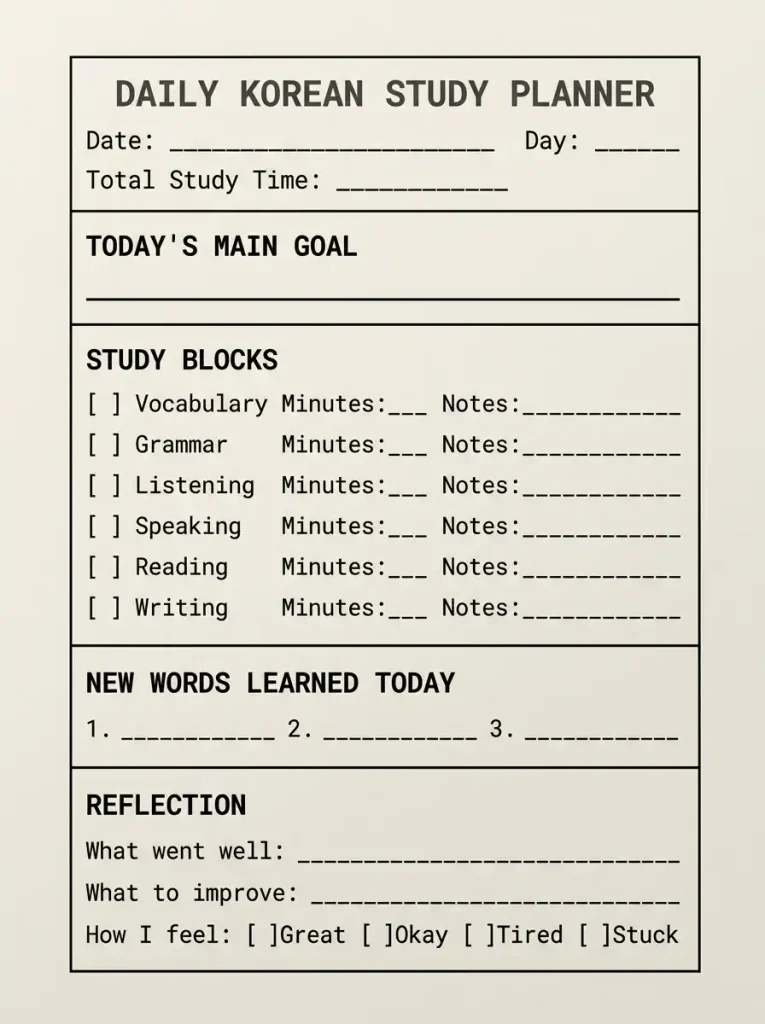
1. Daily Korean Study Planner
Purpose: Structure a single study session from start to finish.
Best for: Beginners building a daily habit, or anyone who studies in short, focused bursts.
Features: Date and total study time fields, six study-block checkboxes (vocabulary, grammar, listening, speaking, reading, writing), a new-words log, and a short reflection section with a mood tracker.
Study tips: Pick one main goal before you start. Trying to “study everything” in one sitting almost always backfires.
How it improves learning: By breaking a session into small blocks, this planner prevents you from spending the entire time on your favorite skill while ignoring the others.
2. Weekly Korean Learning Planner
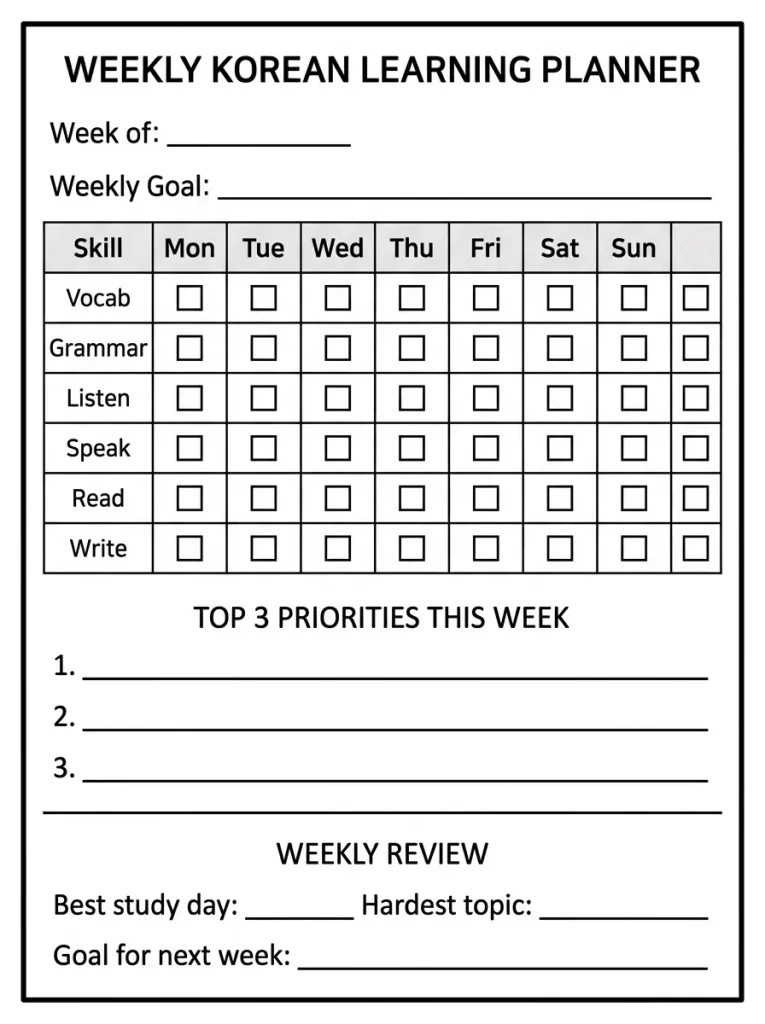
Purpose: Give you a bird’s-eye view of an entire week of study.
Best for: Learners juggling a busy schedule who need to see the whole week at a glance.
Features: A seven-day grid with checkboxes for each core skill, a weekly goal field, a top-three-priorities section, and a short weekly review.
Study tips: Fill this in on Sunday night or Monday morning, before the week gets busy and decisions get harder to make.
How it improves learning: Seeing the whole week laid out prevents the common trap of over-studying early in the week, then abandoning your plan by Thursday.
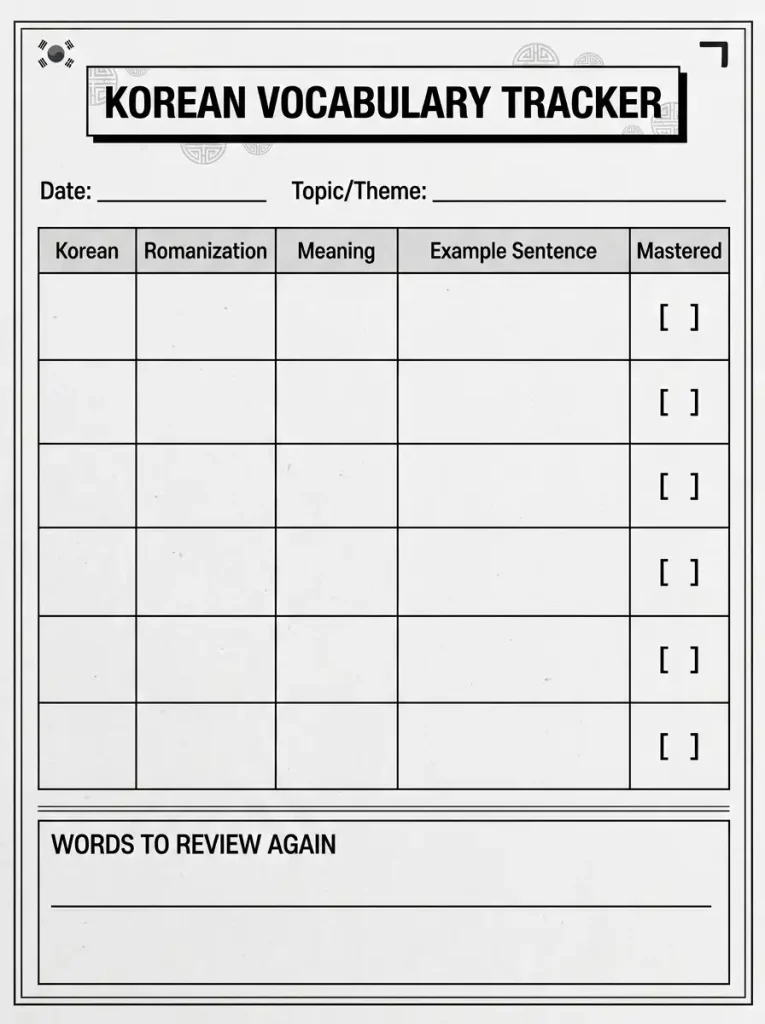
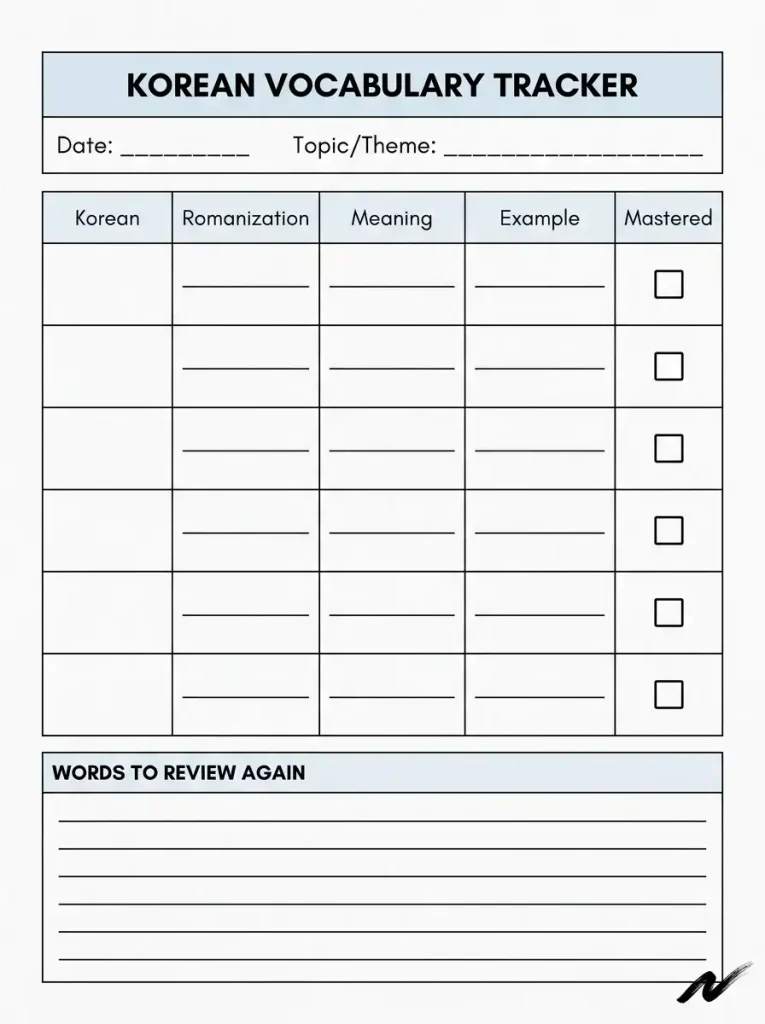
3. Korean Vocabulary Tracker
Purpose: Keep every new word you learn organized in one place instead of scattered across apps and sticky notes.
Best for: Anyone building vocabulary from a textbook, drama, podcast, or flashcard app.
Features: Columns for the Korean word, romanization, English meaning, an example sentence, and a mastered checkbox.
Study tips: Write your own example sentence for each word instead of copying one from a textbook. This forces active recall, which sticks far better than passive reading.
How it improves learning: Reviewing this sheet weekly turns vocabulary from something you “saw once” into something you actually own.
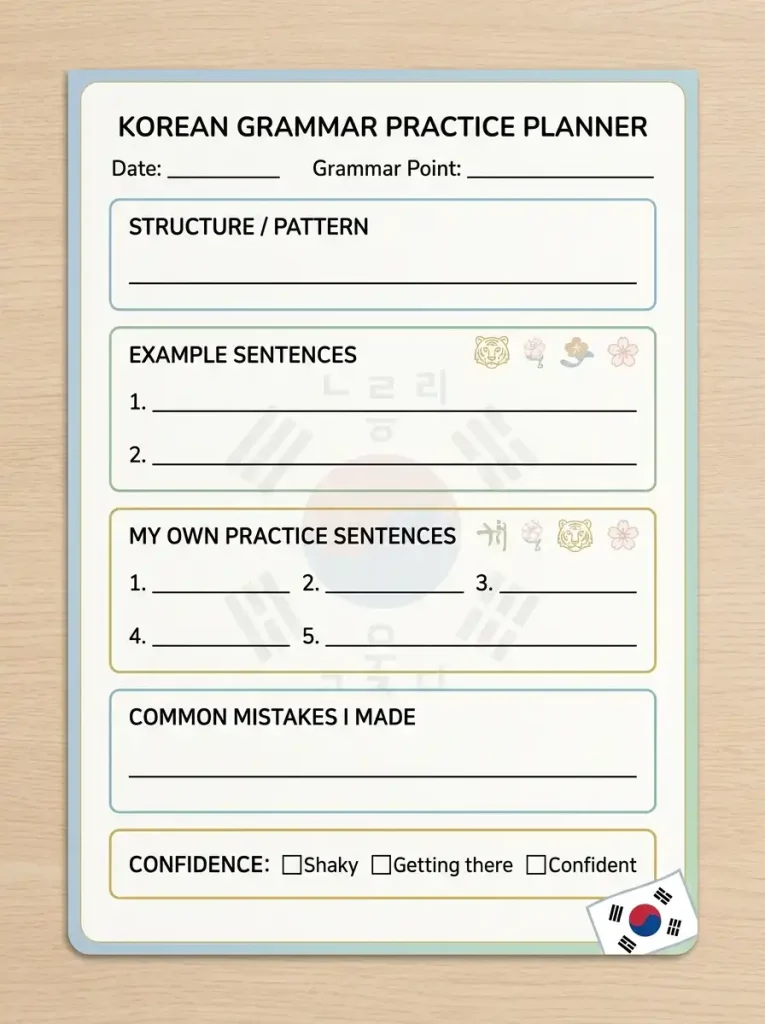
4. Grammar Practice Planner
Purpose: Turn a single grammar point into something you can actually use in a sentence, not just recognize on a page.
Best for: Intermediate learners tackling new grammar patterns week by week.
Features: Space for the structure or pattern, example sentences, your own practice sentences, common mistakes, and a confidence rating.
Study tips: Write at least five original sentences using the new grammar point. Recognizing a pattern in a textbook is very different from producing it yourself.
How it improves learning: The “common mistakes” section is the real value here. Writing down what you got wrong makes it far less likely you’ll repeat the same error.
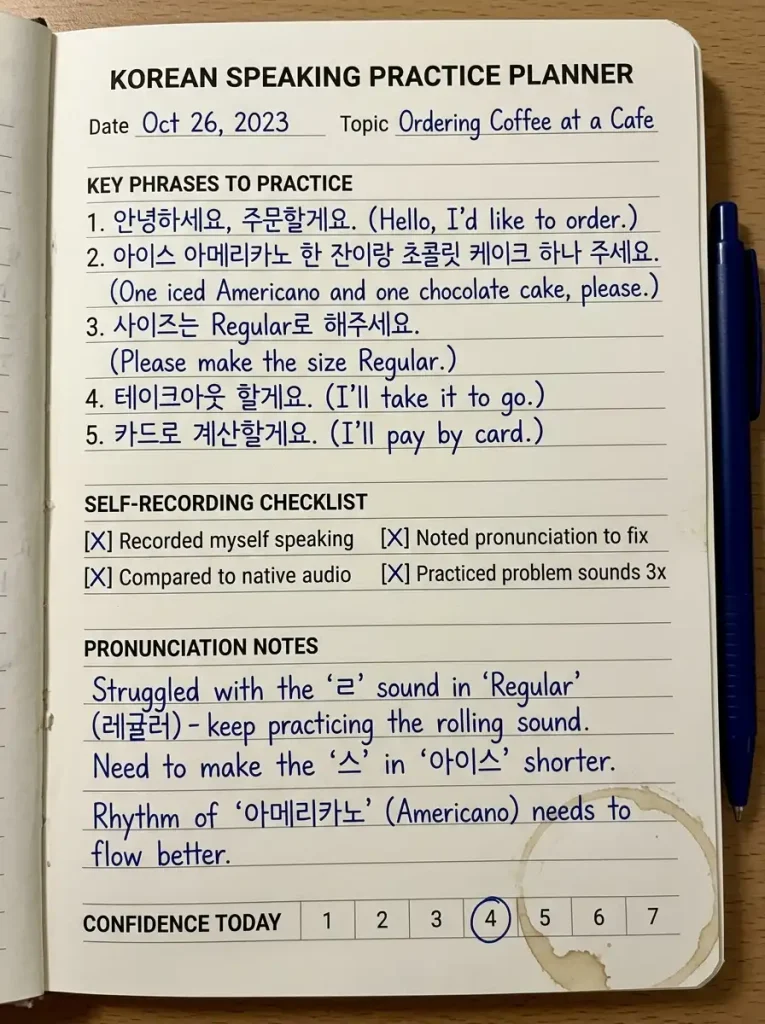
5. Korean Speaking Practice Planner
Purpose: Push you past silent studying and into actually producing spoken Korean.
Best for: Learners who read and understand well but freeze up when it’s time to talk.
Features: A key-phrases section, a self-recording checklist, pronunciation notes, and a confidence scale from one to five.
Study tips: Record yourself speaking, even for thirty seconds. Listening back is uncomfortable at first, but it’s one of the fastest ways to catch pronunciation habits you can’t hear in the moment.
How it improves learning: The self-recording checklist builds a habit of active output instead of passive listening, which is where most learners get stuck long-term.
6. TOPIK Exam Study Planner
Purpose: Organize exam prep around the three sections TOPIK actually tests.
Best for: Learners with an exam date on the calendar and a target score in mind.
Features: Exam date and countdown fields, a section-focus checklist for listening, reading, and writing, a practice test log, and a weak-areas tracker.
Study tips: Take one full practice test every one to two weeks and log your scores. Progress over time matters far more than any single test result.
How it improves learning: The practice test log turns vague exam anxiety into concrete data, so you always know exactly which section needs more attention.
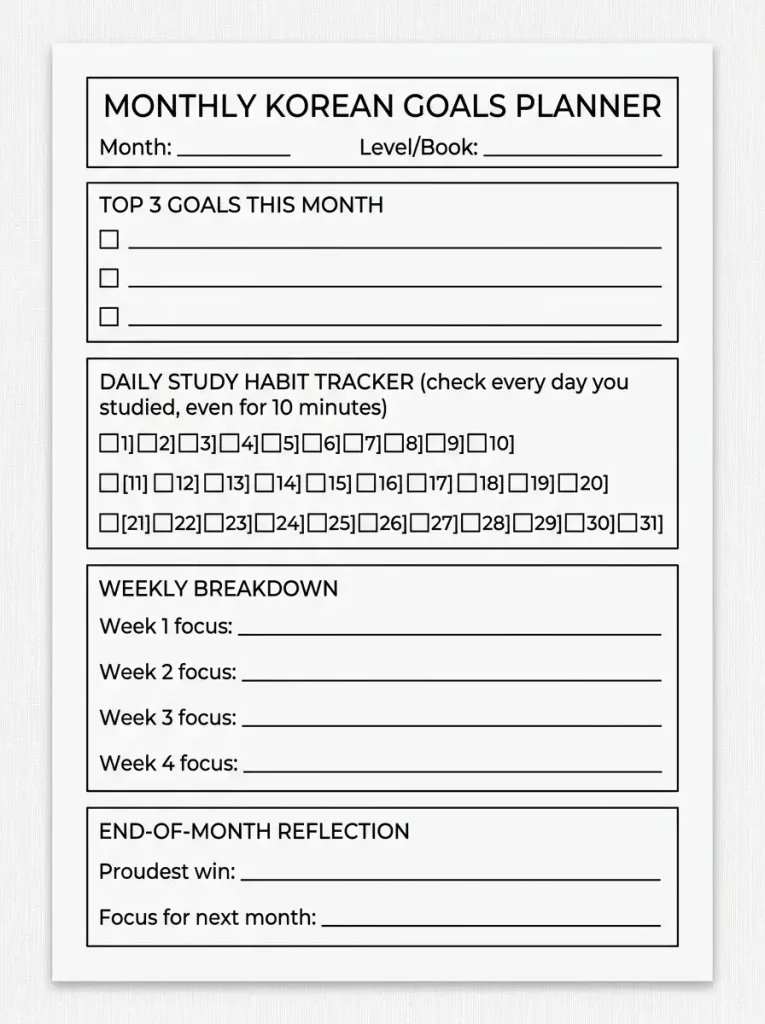
7. Monthly Korean Goals Planner
Purpose: Zoom out from daily and weekly tasks to track long-term progress.
Best for: Learners who want to see the bigger picture and stay motivated across weeks, not just days.
Features: Top three monthly goals, a 31-day habit tracker grid, a week-by-week breakdown, and an end-of-month reflection.
Study tips: Set goals that are specific and measurable, like “finish Chapter 5” instead of “get better at Korean.”
How it improves learning: The habit tracker grid is oddly motivating. Watching a row of checked boxes grow across the month makes consistency visible in a way daily planners can’t.
Printable PDF Version of All 7 Planners
Every planner above is included in one complete, printer-friendly PDF. Here’s what you’re getting:
- Clean, minimalist design that stays readable even in black and white
- Grayscale-friendly layout, so you don’t waste color ink
- Standard A4 page size for easy printing anywhere
- Generous writing space in every section
- Checkboxes throughout for quick daily tracking
- A notes section and date field on every planner
- A motivational quote footer on each page to keep you going
Each planner starts on its own page, so you can print only the ones you need or the full set at once.
Download Free Korean Study Planner PDF
You can download the complete set of seven planners as a single PDF, ready to print at home or at your local print shop. The file is named Korean-Study-Planner-Free-Printable-Templates.pdf and includes all seven layouts shown above, formatted cleanly for A4 paper.
Print the pages you need this week, keep the rest saved for later, and start filling in your first planner today.
Korean Study Routine in 30 Minutes a Day
Short on time? Here’s a simple 30-minute routine you can follow using the daily planner above.
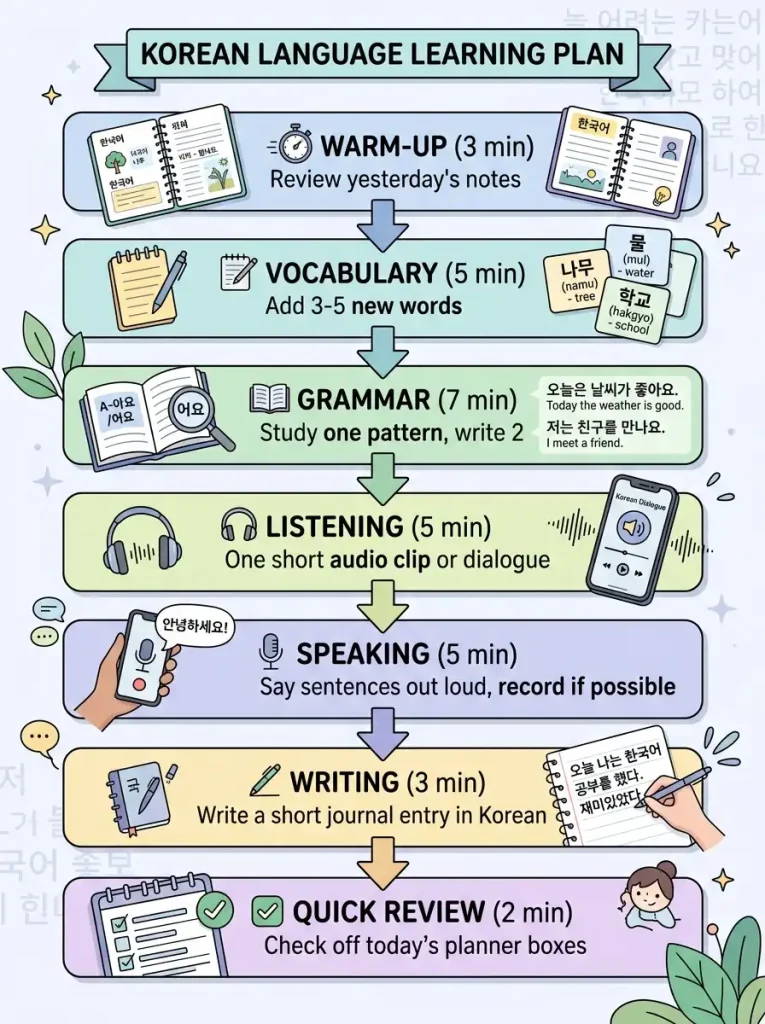
This routine fits into almost any schedule, and it touches all four core skills instead of just one. Even on busy days, thirty focused minutes beats an hour of distracted studying.
Daily vs Weekly vs Monthly Planners: Which One Works Best?
Not every learner needs all three planner types at once. Here’s how to think about when each one earns its place in your routine.
When a Daily Planner Works Best
A daily planner shines when you’re building a brand-new habit. It breaks studying into bite-sized blocks, which lowers the mental barrier to just getting started. If you’re in your first few months of learning Korean, lean heavily on daily planning until sitting down to study feels automatic.
Daily planners also help on days when motivation is low. Instead of facing an intimidating “study Korean” task, you’re just filling in small boxes one at a time.
When a Weekly Planner Works Best
Once your habit is established, a weekly planner gives you more flexibility. Life isn’t always predictable, and a weekly view lets you shift study time between days without losing sight of your overall goals.
Weekly planning also suits learners with irregular schedules, like students juggling exams or professionals with unpredictable workloads. You can front-load study time on lighter days and ease off during busier ones, while still hitting your weekly targets.
When a Monthly Planner Works Best
Monthly planners are less about day-to-day tasks and more about direction. They’re ideal for tracking bigger milestones, like finishing a textbook, reaching a new TOPIK level, or building a thirty-day streak.
Use a monthly planner alongside, not instead of, a daily or weekly one. Think of it as the map, while the daily and weekly sheets are your turn-by-turn directions.
10 Tips to Stay Consistent While Learning Korean
1. Study at the Same Time Every Day
Anchoring your study session to an existing habit, like right after breakfast, makes it far easier to remember and stick with.
2. Keep Sessions Short on Busy Days
A five-minute vocabulary review beats skipping entirely. Consistency matters more than session length.
3. Use Your Planner as a Visual Streak Tracker
Watching checked boxes pile up creates a small dopamine hit that keeps you coming back.
4. Pair Studying With Something You Enjoy
Listen to K-pop or watch a drama clip as your “listening practice” block. Enjoyment fuels consistency.
5. Set Realistic Weekly Goals
Overly ambitious goals lead to burnout fast. Aim for progress you can actually sustain long-term.
6. Review Before You Add New Material
Spend the first few minutes of each session reviewing old notes before diving into anything new.
7. Don’t Skip Speaking Practice
It’s tempting to stick with reading and listening since they feel easier. Speaking out loud, even alone, builds real fluency.
8. Track Your Mistakes, Not Just Your Wins
Mistakes show you exactly where to focus next. Your planner’s notes section is the perfect place for this.
9. Take One Rest Day Per Week
Rest prevents burnout and gives your brain time to consolidate what you’ve learned.
10. Celebrate Small Milestones
Finishing a chapter or hitting a two-week streak deserves recognition. Small wins keep long-term motivation alive.
7 Mistakes That Slow Down Korean Learning
1. Studying Without a Plan
Jumping randomly between apps and textbooks wastes time. A planner keeps every session focused and purposeful.
2. Ignoring Speaking Practice
Many learners avoid speaking because it feels uncomfortable. The speaking planner above builds this into your routine directly.
3. Cramming Vocabulary Without Review
New words fade fast without repetition. The vocabulary tracker forces regular revisits instead of one-time exposure.
4. Studying Only What Feels Easy
It’s natural to gravitate toward your strongest skill. A weekly planner’s skill grid keeps you balanced across all four areas.
5. Setting Vague, Unmeasurable Goals
“Get better at Korean” isn’t a goal you can track. Monthly and weekly planners push you toward specific, measurable targets instead.
6. Skipping Revision Days
Without dedicated revision time, older material quietly slips away. Building revision into your weekly planner protects your progress.
7. Not Tracking TOPIK Practice Scores
Studying for TOPIK without logging results means you’re guessing at your weak points. The TOPIK planner’s test log removes the guesswork entirely.
Frequently Asked Questions
1. Are these Korean study planners really free to download?
Yes, all seven planners are completely free to download as one PDF file. There’s no signup wall or hidden cost involved. Simply download the file, print the pages you need, and start using them right away. The templates are designed to be reusable, so you can print multiple copies of the daily or weekly planner whenever you run out.
2. What paper size do these planners use?
Every planner in this collection is formatted for A4 paper, which is the standard size used in most home and office printers worldwide. If you only have access to Letter-size paper, most printers will still handle the layout fine with a “fit to page” setting, though margins may shift slightly.
3. Can I print these planners in black and white?
Absolutely. Every layout was intentionally designed to be grayscale-friendly, meaning nothing depends on color to remain readable. This also saves you money on ink, since you can print the entire set using a standard black-and-white printer without losing any functionality.
4. How many planners should I print at once?
It depends on your habits, but a good starting point is ten daily planner sheets, four weekly planner sheets, and one monthly planner sheet per month. This gives you roughly a month’s worth of daily tracking and a full month of weekly check-ins without needing to reprint constantly.
5. Which planner is best for total beginners?
Start with the Daily Korean Study Planner. It breaks studying into small, manageable blocks, which makes it far less intimidating than open-ended study time. Once daily studying starts feeling automatic, usually after two to three weeks, you can add the weekly planner to get a broader view of your progress and priorities.
6. How do these planners help with TOPIK preparation specifically?
The TOPIK Exam Study Planner is built around the three sections the exam actually tests: listening, reading, and writing. It includes a countdown to your exam date and a practice test log, so you can track your scores over time. This turns exam prep from a vague worry into a measurable, trackable process.
7. Can I use these planners for other languages too?
While this set is built specifically for Korean, with sections for Hangul-based vocabulary and grammar patterns, the overall structure works for other languages too. You could adapt the vocabulary tracker or weekly planner for Japanese, Spanish, or any language, though the Korean-specific prompts and grammar sections were designed with Korean’s unique sentence structure in mind.
8. How often should I use the vocabulary tracker?
Ideally, use it every time you encounter new words, whether from a textbook, drama, or app. More importantly, revisit older entries at least twice a week to reinforce retention. The mastered checkbox helps you quickly spot which words still need review versus which ones you’ve fully internalized.
9. What if I miss a few days of studying?
Don’t try to “catch up” by cramming everything at once. Simply pick your planner back up where you left off and continue. The monthly habit tracker is especially helpful here, since a few missed boxes won’t derail your overall progress or motivation the way a broken daily streak might feel like it does.
10. Do I need special printing equipment for these planners?
No special equipment is needed. Any standard home printer or local print shop can handle these files, since they were designed with clean lines and no heavy graphics that would require premium printing. A regular inkjet or laser printer using A4 paper will produce clear, usable results every time.
Conclusion
Learning Korean is a long game, and long games need structure to stay enjoyable. These seven printable planners give you exactly that: a daily rhythm, a weekly overview, a monthly direction, and dedicated tools for vocabulary, grammar, speaking, and TOPIK prep.
None of these planners will study Korean for you. But they will remove the guesswork, the decision fatigue, and the scattered notes that make so many learners give up too early. Print the ones that fit where you are right now, fill in that first box, and let the habit build from there.
Your Korean study journey doesn’t need to be complicated. It just needs a plan you’ll actually stick to, one page at a time.