12 Book Story Ideas For Creative Writing
Somewhere between “I want to write a book” and actually writing one sits a gap most of us know too well. You want the idea, the one that grabs you by the collar and won’t let go. Yet most days, the page just stares back, blank and a little smug about it.
That’s exactly the gap this collection fills. These twelve book story ideas creative writing enthusiasts can genuinely build careers on come with full premises, protagonists, conflicts, twists, and themes already sketched out. Nothing here is a one-line prompt you’ll forget by lunchtime.
Each idea spans a different genre, from fantasy to literary fiction, so whatever pulls at your imagination has a home here. You’ll also find practical tips for expanding any concept into a full novel, plus answers to the questions writers ask most often about developing original stories.
Grab your notebook. Let’s find the idea that keeps you up writing past midnight.
How to Use This List
Each idea below includes everything you need to start drafting today: a premise, a protagonist, a conflict, a twist, themes, and tips for turning a short concept into an entire novel. Read through all twelve, or jump straight to your favorite genre.
Either way works. Inspiration doesn’t care about order.
1. The Cartographer’s Debt
Genre: Fantasy
Core Premise: A gifted mapmaker discovers that every map she draws slowly reshapes the actual landscape to match it, a power passed down through generations of her family, always at a steep personal cost.
Main Protagonist: Iris Vellum, disciplined and secretly terrified of her own gift, having watched it consume her mother years earlier.
Central Conflict: A warlord discovers Iris’s ability and threatens her family unless she redraws the borders of an entire kingdom in his favor.
Major Plot Twist: The cost of her magic isn’t measured in years of her life, as she believed, but in the memories of everyone who lives within the land she reshapes.
Possible Ending: Iris sacrifices her own memories of her family to redraw the kingdom’s borders one final time, freeing everyone else from the cost.
Themes Explored: Sacrifice, inherited burden, the price of power.
Why Readers Would Love It: Fantasy readers crave inventive magic systems with real consequences, and this one ties cost directly to identity, raising the emotional stakes with every chapter.
Tips for Expanding It Into a Novel: Build out the political landscape of the kingdom early, since the maps themselves should reflect real, escalating stakes. Consider a dual timeline showing Iris’s mother’s downfall alongside Iris’s present struggle.
Quick dialogue snippet: “Every line I draw costs someone something,” Iris said. “I just never used to know whose.”
2. The Last Case of Inspector Reyes
Genre: Mystery
Core Premise: A retired detective, weeks from a quiet life, gets pulled back into an unsolved case from decades earlier when the exact same murder method resurfaces in a brand-new crime.
Main Protagonist: Inspector Marisol Reyes, sharp and stubborn, haunted by the one case she never closed.
Central Conflict: Reyes must determine whether a copycat is responsible, or whether she arrested the wrong person all those years ago.
Major Plot Twist: The original suspect, long imprisoned, is innocent, and the real killer has been hiding in plain sight within Reyes’s own department.
Possible Ending: Reyes exposes the true killer, though doing so costs her the department’s trust and forces her into a genuinely uncertain retirement.
Themes Explored: Justice, guilt, the weight of unfinished business.
Why Readers Would Love It: Mystery readers love a detective with something personal at stake, and this premise ties a cold case directly to the protagonist’s own credibility and conscience.
Tips for Expanding It Into a Novel: Alternate chapters between the original investigation and the present-day case, letting readers piece together the truth alongside Reyes.
3. The Debt Collector of Willowmere
Genre: Historical Fiction
Core Premise: Set in a small industrial town during the 1920s, a young debt collector working for a ruthless factory owner begins secretly forgiving debts for families she deems too desperate to pay, risking everything to protect her double life.
Main Protagonist: Clara Whitfield, resourceful and quietly rebellious against the economic system she’s forced to enforce.
Central Conflict: Clara must keep her secret from her employer while the town’s growing unrest threatens to expose everyone involved.
Major Plot Twist: Clara’s employer has known about her forgiven debts for months, using her secretly as leverage against rival factory owners.
Possible Ending: Clara exposes the factory owner’s broader corruption, sparking genuine reform within the town’s economic structure.
Themes Explored: Class struggle, quiet rebellion, moral compromise.
Why Readers Would Love It: Historical fiction fans appreciate grounded, morally complex characters navigating real economic and social pressures of their era.
Tips for Expanding It Into a Novel: Research actual labor conditions from the period to ground Clara’s world in authentic, specific detail rather than generic historical atmosphere.
After Story Idea #4
4. The Signal From Nowhere
Genre: Science Fiction
Core Premise: A radio astronomer detects a repeating signal that, once decoded, turns out to be a warning, not from deep space, but from a research station humanity built decades in the future and somehow lost.
Main Protagonist: Dr. Aris Kade, brilliant but professionally sidelined after a previous discovery was dismissed by his peers.
Central Conflict: Aris must convince a skeptical scientific community that the warning is real before whatever caused the station’s disappearance happens again.
Major Plot Twist: The signal isn’t warning against a future threat; it’s warning against a decision Aris himself is about to make.
Possible Ending: Aris changes course based on the warning, preventing the very future that generated the signal in the first place, creating a satisfying causal loop.
Themes Explored: Fate versus free will, scientific responsibility, isolation.
Why Readers Would Love It: Science fiction readers love a well-constructed time paradox, especially one grounded in believable science and personal stakes rather than pure spectacle.
Tips for Expanding It Into a Novel: Keep the science internally consistent throughout. Readers will forgive speculative leaps if the story’s own rules never contradict themselves.
5. Letters to a Stranger’s Wife
Genre: Romance
Core Premise: A woman finds a box of unsent love letters in a house she just bought, written decades ago by a man to a woman who wasn’t yet his wife when he wrote them, and sets out to track down the intended recipient.
Main Protagonist: Naomi Fairweather, recently divorced and quietly cynical about romance, though the letters slowly soften that cynicism.
Central Conflict: Naomi’s search leads her to the letter-writer’s grandson, and their growing connection complicates her original, simple mission.
Major Plot Twist: The letters were never sent because the writer’s love was unrequited; the recipient married someone else entirely, a detail that reframes everything Naomi assumed about the romance.
Possible Ending: Naomi delivers the letters to the recipient’s now-elderly daughter, finding her own unexpected happy ending with the grandson along the way.
Themes Explored: Second chances, the difference between longing and love, healing after heartbreak.
Why Readers Would Love It: Romance readers adore a dual-timeline structure that pairs a decades-old love story with a fresh, present-day connection.
Tips for Expanding It Into a Novel: Excerpt the actual letters throughout the book, letting their voice contrast with Naomi’s present-day narration.
Quick scene snippet: Naomi unfolded the last letter carefully. “I hope, wherever you are,” it read, “that someone finally tells you the things I couldn’t.”
6. The Hollow Choir
Genre: Horror
Core Premise: A small church choir starts losing members one by one, each disappearance preceded by the same haunting melody appearing in their dreams, a song none of them can identify or explain.
Main Protagonist: Reverend Talia Moss, pragmatic and increasingly desperate as her congregation dwindles under mysterious circumstances.
Central Conflict: Talia must uncover the song’s origin before it claims the rest of her choir, including her own daughter.
Major Plot Twist: The melody belongs to a choir member who died in the church decades ago, still trying to complete a song interrupted by her own death.
Possible Ending: Talia helps the spirit finish the song, releasing her and ending the disappearances, though at a personal cost that lingers.
Themes Explored: Grief, unfinished business, faith under pressure.
Why Readers Would Love It: Horror readers respond strongly to slow-building dread paired with genuine emotional stakes, rather than shock value alone.
Tips for Expanding It Into a Novel: Build the melody itself as a recurring motif, described through sound and sensation rather than literal musical notation.
7. The Republic of Ash
Genre: Dystopian
Core Premise: In a society where emotional expression is strictly regulated to maintain “productivity,” a low-level government auditor discovers evidence that the ruling council secretly experiences the very emotions they’ve outlawed for everyone else.
Main Protagonist: Corin Vale, meticulous and initially loyal to the system, until personal loss forces genuine emotion to the surface.
Central Conflict: Corin must decide whether exposing the council’s hypocrisy is worth the certain punishment, both for himself and everyone he loves.
Major Plot Twist: The emotional regulation isn’t protecting society from chaos, as claimed; it’s protecting the council from a population capable of recognizing their corruption.
Possible Ending: Corin leaks the evidence anonymously, sparking a slow-building resistance movement rather than an immediate, dramatic revolution.
Themes Explored: Authoritarian control, suppressed identity, the cost of conformity.
Why Readers Would Love It: Dystopian fans appreciate a fresh angle on control and rebellion, especially one built around something as universal as emotional suppression.
Tips for Expanding It Into a Novel: Show the regulated society’s rules through small, specific daily rituals rather than lengthy exposition about the system itself.
8. The Girl Who Painted Weather
Genre: Magical Realism
Core Premise: In a quiet coastal village, a young painter discovers that whatever weather she paints appears exactly as depicted the following day, a gift that becomes a burden once the village starts depending on her art for survival.
Main Protagonist: Solenne, gentle and increasingly overwhelmed by a responsibility she never asked for.
Central Conflict: Solenne must balance her village’s growing demands against her own need for artistic freedom and personal identity beyond her gift.
Major Plot Twist: Solenne’s paintings don’t create the weather; they reveal weather that’s already coming, meaning she’s been given credit, and blame, for forces entirely beyond her control.
Possible Ending: Solenne reveals the truth to the village, redefining her role from weather-maker to weather-reader, freeing herself from impossible expectations.
Themes Explored: Creative burden, community expectation, authentic identity.
Why Readers Would Love It: Magical realism readers love subtle, lyrical magic woven into ordinary life, and this premise blends folklore-style wonder with genuine emotional weight.
Tips for Expanding It Into a Novel: Lean into sensory, painterly language throughout, matching the story’s prose style to Solenne’s own artistic perspective.
9. The Vanishing Hour
Genre: Thriller
Core Premise: Every year, on the same night, one resident of a small town disappears without a trace, and this year, the protagonist’s own name has appeared on a list she was never supposed to find.
Main Protagonist: Nadia Okonkwo, a local journalist who’s spent years investigating the disappearances without ever expecting to become a target herself.
Central Conflict: Nadia has less than twenty-four hours to uncover who’s behind the disappearances before the pattern claims her too.
Major Plot Twist: The disappearances aren’t random or supernatural; they’re orchestrated by a hidden town council protecting a decades-old secret through calculated sacrifice.
Possible Ending: Nadia exposes the council publicly at the exact moment she was meant to disappear, breaking the cycle permanently.
Themes Explored: Small-town secrecy, institutional complicity, survival under pressure.
Why Readers Would Love It: Thriller readers crave a ticking clock, and this premise delivers escalating tension with a satisfying, logical resolution.
Tips for Expanding It Into a Novel: Structure chapters around the countdown itself, using time stamps to heighten urgency throughout the narrative.
10. The Boy Who Collected Endings
Genre: Young Adult
Core Premise: A teenager with an unusual habit of writing alternate endings for real events in his life, breakups, arguments, missed opportunities, starts noticing that some of his written endings are actually coming true.
Main Protagonist: Theo Reyes, witty and quietly lonely, using writing as a coping mechanism before realizing its strange power.
Central Conflict: Theo must decide how far he’s willing to rewrite his own life, especially once he realizes changing one ending disrupts something else entirely.
Major Plot Twist: Theo’s best friend has been secretly aware of his ability for months, quietly benefiting from small changes Theo never noticed he made.
Possible Ending: Theo confronts his friend, choosing honesty over convenient rewrites, and accepts his real story instead of a constantly edited one.
Themes Explored: Coming of age, authenticity, the temptation of control.
Why Readers Would Love It: Young adult readers connect deeply with themes of identity and control, especially wrapped in a premise that feels both relatable and genuinely magical.
Tips for Expanding It Into a Novel: Include excerpts of Theo’s actual written endings throughout the book, contrasting his imagined outcomes with reality.
11. The Salt Road
Genre: Adventure
Core Premise: A disgraced former merchant sets out to rediscover a legendary desert trade route, rumored to lead to a lost city, using a map fragment that’s already gotten two previous expeditions killed.
Main Protagonist: Kessa Dunmoor, resourceful and driven by the need to restore her family’s reputation more than any interest in treasure itself.
Central Conflict: Kessa must navigate treacherous terrain, rival treasure hunters, and her own crew’s growing distrust as the journey grows more dangerous than promised.
Major Plot Twist: The lost city isn’t abandoned; its inhabitants have been deliberately erasing the route for generations to protect themselves from outside exploitation.
Possible Ending: Kessa chooses to protect the city’s secret rather than exploit it, restoring her reputation through integrity instead of treasure.
Themes Explored: Redemption, exploration versus exploitation, chosen family.
Why Readers Would Love It: Adventure readers love high stakes, vivid settings, and a protagonist whose external journey mirrors genuine internal growth.
Tips for Expanding It Into a Novel: Map out the physical journey in detail before drafting, ensuring each leg of the trip introduces a new obstacle or revelation.
12. The Weight of Ordinary Days
Genre: Literary Fiction
Core Premise: Over the course of one quiet year, a middle-aged woman cares for her dying father while slowly reconnecting with a sister she hasn’t spoken to in over a decade, forcing both women to confront old wounds neither ever fully processed.
Main Protagonist: Helen Marsh, dutiful and emotionally guarded, having spent years avoiding unresolved family conflict.
Central Conflict: Helen must navigate grief, sibling resentment, and her own buried regrets as her father’s condition worsens.
Major Plot Twist: Helen discovers her father kept a journal revealing he always favored her sister, a truth that reframes decades of Helen’s own self-perception.
Possible Ending: Helen and her sister reconcile imperfectly but genuinely, choosing honest, ongoing effort over a tidy, complete resolution.
Themes Explored: Family, grief, the complexity of forgiveness.
Why Readers Would Love It: Literary fiction readers value emotional honesty and nuanced character work over plot mechanics, and this story delivers both in a quiet, powerful way.
Tips for Expanding It Into a Novel: Resist the urge to resolve every conflict neatly. Literary fiction often earns its power through unresolved, believable complexity.

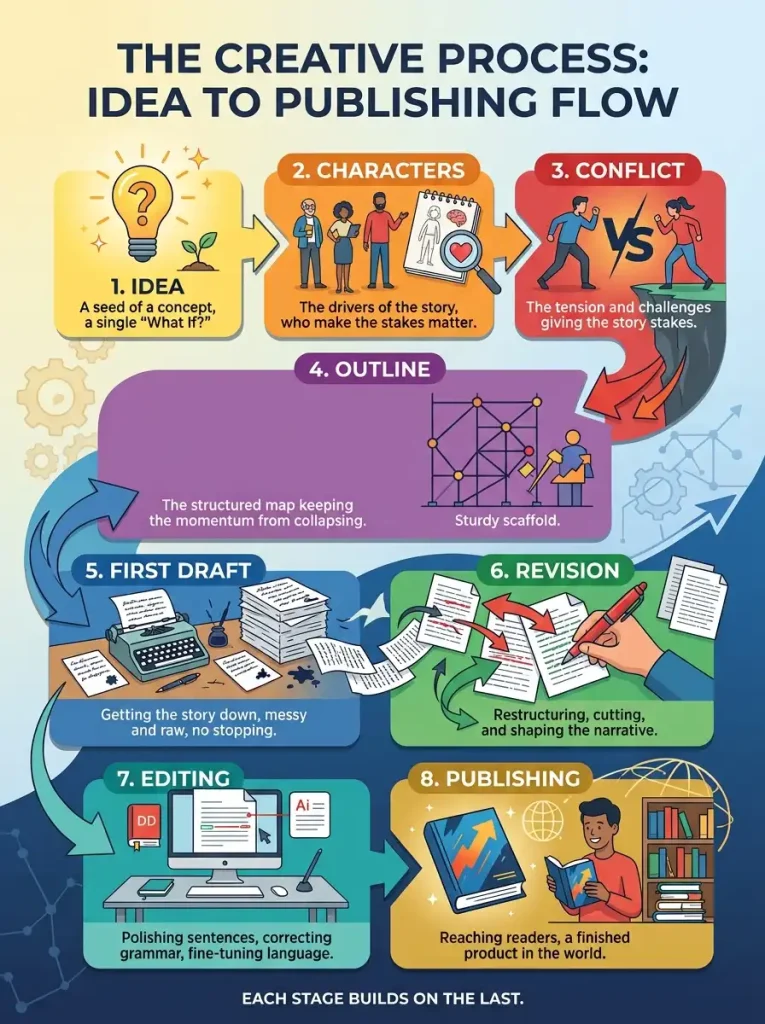
Infographic: From Idea to Published Novel
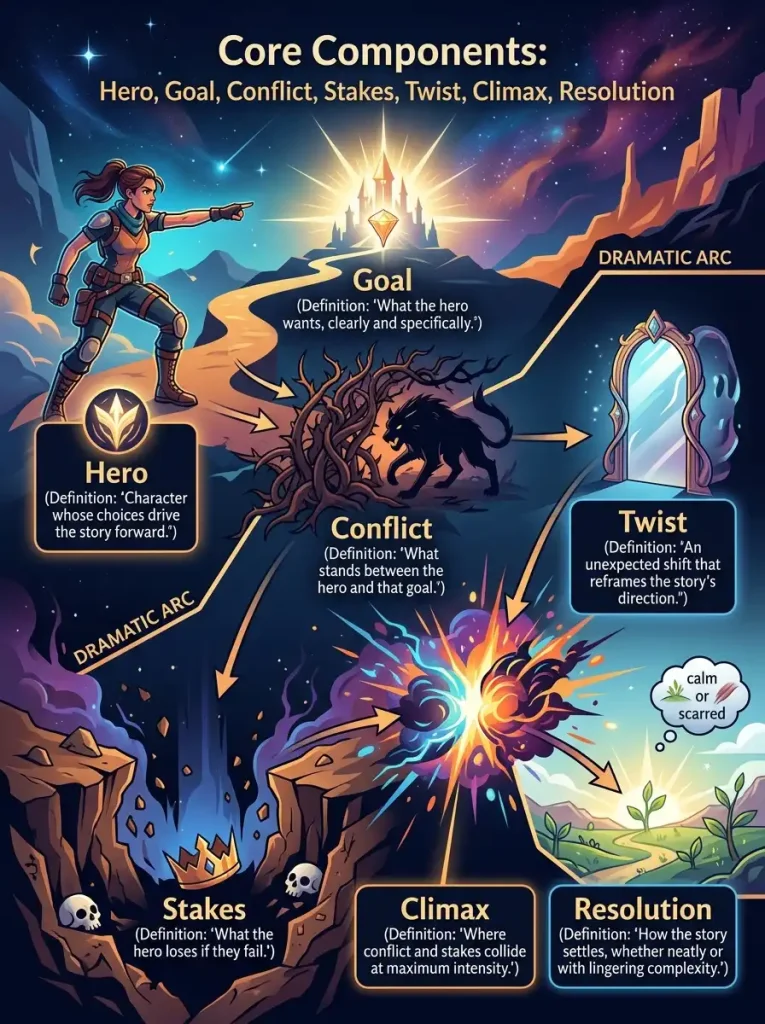
Infographic: The Anatomy of a Great Story
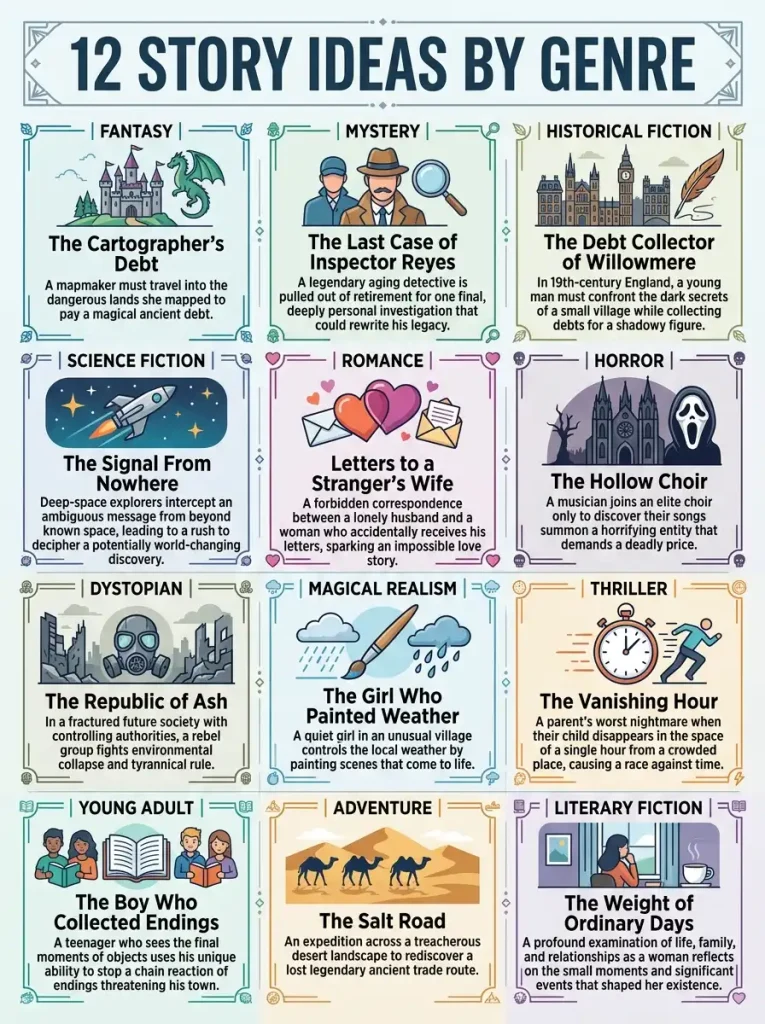
Infographic: 12 Story Ideas by Genre
Frequently Asked Questions
How do you come up with book story ideas? Most reliable ideas come from combining two unrelated concepts, a strange setting with a personal fear, or an ordinary job with an impossible power. Pay attention to real conversations, dreams, and “what if” questions, since they often reveal ideas already forming in your subconscious.
How do you avoid cliché plots? Identify the most predictable direction your premise could take, then deliberately choose something else. Cliché usually comes from following the first idea that comes to mind rather than pushing past it toward something more specific and personal.
Can one story idea become a series? Absolutely. Ideas with rich worldbuilding, like The Republic of Ash or The Salt Road, naturally support multiple books, especially if you leave certain conflicts unresolved by design rather than accident.
How detailed should a book idea be before writing? At minimum, know your protagonist’s goal, the central conflict, and roughly how the story ends. Beyond that, some writers outline extensively, while others discover details through drafting itself.
How do authors develop original characters? Give characters contradictions, someone brave who’s secretly terrified of abandonment, or someone kind who struggles with quiet resentment. Contradiction creates depth far more effectively than a simple list of traits.
Should I write in the genre I read most, or experiment? Writing what you love reading often produces the most authentic voice, though experimenting occasionally can reveal unexpected strengths you wouldn’t discover otherwise.
What’s the difference between a plot twist and a gimmick? A genuine twist reframes earlier events logically, rewarding attentive readers. A gimmick exists purely for shock value without meaningful connection to the story’s themes or character arcs.
How long should I develop an idea before starting to write? There’s no universal answer, though most writers benefit from at least knowing their ending before starting. That said, don’t let planning become a permanent substitute for actually drafting.
Related Creative Writing Guides
- Character Development Tips
- How to Outline a Novel
- Worldbuilding for Beginners
- Writing Better Dialogue
- Plot Twist Ideas
- Show Don’t Tell Guide
Start Writing Your Story Today
Twelve ideas, twelve genres, and honestly, countless more stories hiding inside each one once you start pulling at the threads. That’s the real value of strong book story ideas creative writing thrives on: they never hand you a finished novel, just an open door.
Pick the one that wouldn’t leave you alone while reading. Sit down, and write the very first sentence, even if it’s imperfect.
Every novel you’ve ever loved started exactly there, one imperfect sentence, written by someone willing to keep going anyway.