7 Daily Study Planner Free Printable Templates PDF
You wake up with good intentions. Today’s the day you finally catch up. Then somehow, by 3 p.m., you’ve reorganized your desk twice, checked your phone forty times, and barely opened a textbook.
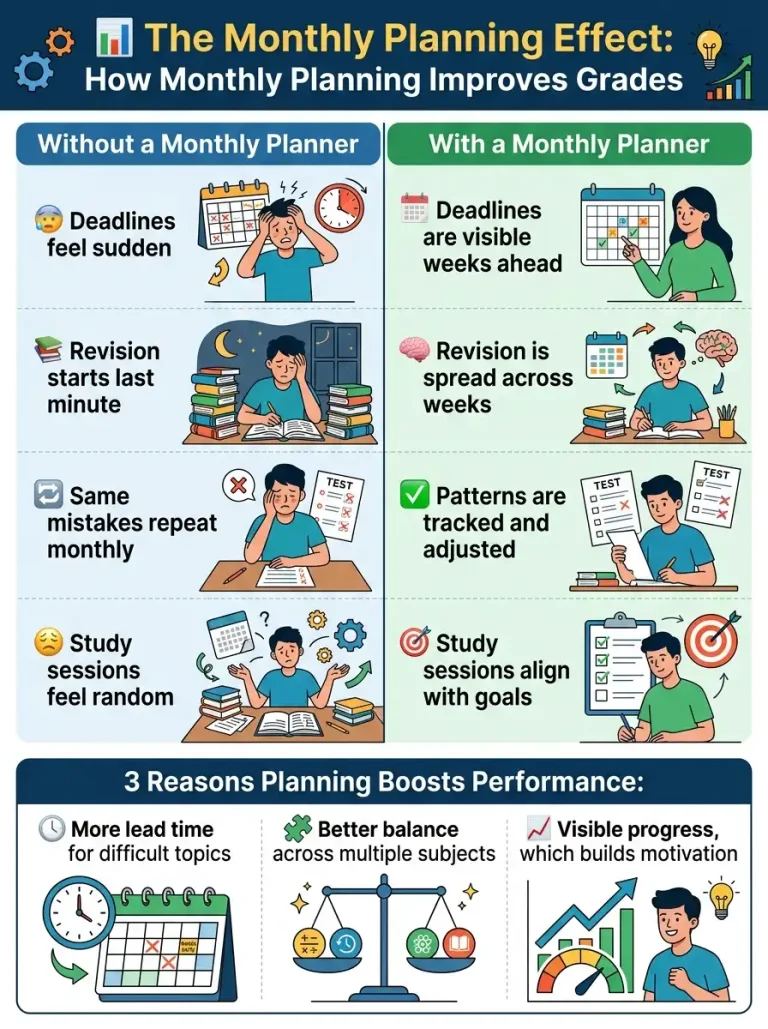
A daily study planner fixes that specific problem. Research on study habits consistently shows that students who plan their sessions in advance retain more information and report lower stress than those who study reactively, jumping from task to task without structure. A written plan turns “I should probably study today” into a specific, scheduled block of time you can actually follow.
This collection gives you seven daily study planner free printable templates PDF options, each built around a different study style. Whether you thrive with hour-by-hour structure or prefer a loose, priority-based approach, you’ll find a format that fits. Every template below links to its own instant PDF download, plus a combined bundle at the end containing all seven in one file.
Quick Answer
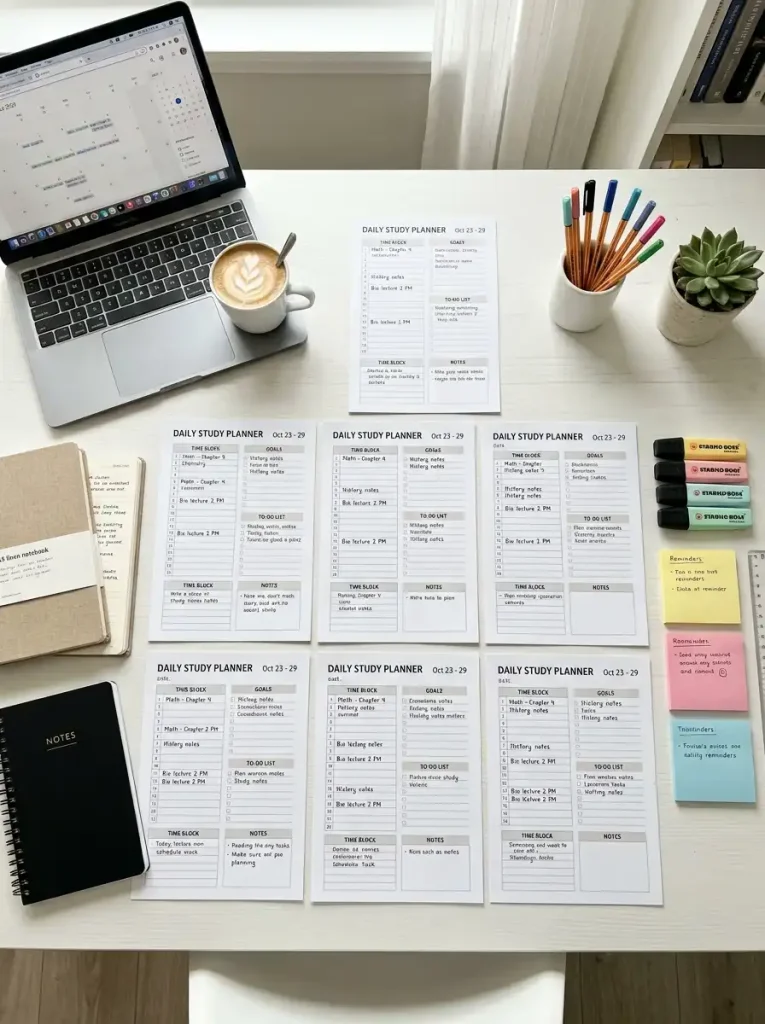
A daily study planner printable PDF is a one-page template you print out and fill in by hand each day to organize your study tasks, time blocks, and priorities. Students, homeschoolers, and anyone preparing for exams use these templates because writing plans by hand improves focus and follow-through more reliably than relying on memory or scattered digital reminders. Printable planners remain effective because they’re distraction-free, fully customizable, and require zero setup beyond a printer and a pen.
Why Every Student Needs a Daily Study Planner
A daily planner does more than organize your to-do list. It changes how your brain approaches the entire day.
Better focus comes from removing decision fatigue. Instead of constantly asking “what should I study now?” you simply follow the plan you already made. Additionally, time management improves naturally once tasks have specific time slots instead of floating vaguely in your head.
Reduced procrastination follows almost automatically. A task written down with a specific time attached feels far more real than a vague intention, which makes it harder to keep pushing aside. Meanwhile, improved memory results from the structure itself, since spaced, planned study sessions consistently outperform last-minute cramming according to cognitive psychology research on spaced repetition.
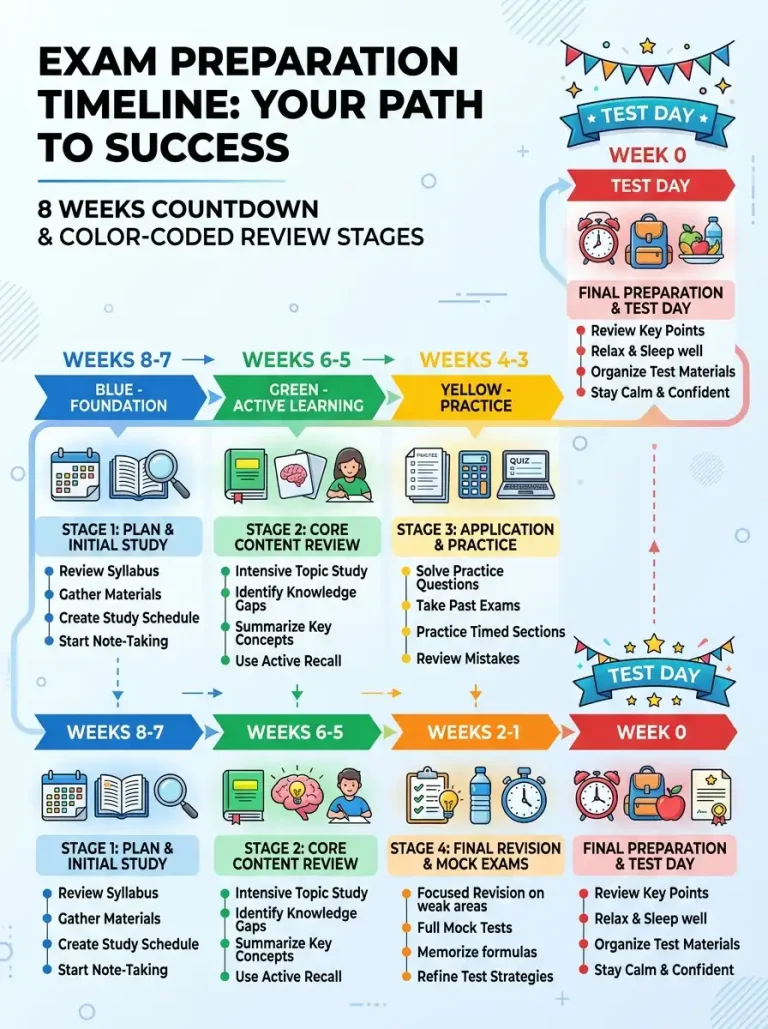
A solid daily plan also supports exam preparation by ensuring consistent review instead of last-minute panic. It helps balance your workload across multiple subjects so no single class gets neglected. Finally, seeing your day mapped out reduces the overwhelmed feeling that drives so much academic stress, since everything has a place instead of competing for attention all at once.
7 Free Printable Daily Study Planner Templates
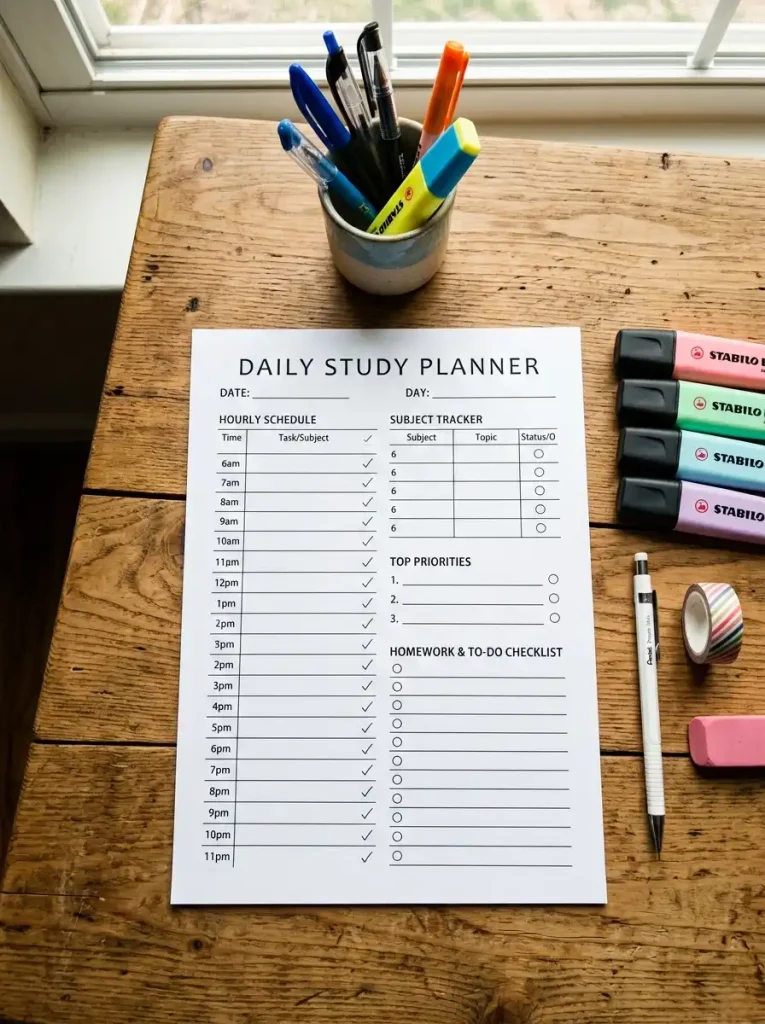
Each template below solves a slightly different planning problem. Skim through all seven, or jump straight to whichever style matches how you actually work.
1. Classic Hourly Daily Planner
Best for: Students who concentrate best with detailed, hour-by-hour structure, especially during intensive study periods.
Key features: A full 6 a.m. to 9 p.m. hourly grid, a top-3-priorities checklist, and an end-of-day notes box.
Layout description: Clean blue-accented rows alternate shading for easy scanning, with hour labels running down the left margin.
Advantages: Removing the guesswork from your day reduces decision fatigue. You simply follow the schedule you already committed to that morning.
Customization ideas: Extend the hourly range if you study late into the evening, or color-code blocks by subject using highlighters after printing.
Printing recommendations: Print several copies at once so a fresh sheet is always ready, or laminate one copy for daily dry-erase reuse.
Ideal users: High school and college students managing multiple classes who want maximum structure.
Download PDF: daily-study-planner-template-page-1.pdf
2. Priority-Focused Daily Planner
Best for: Students who feel overwhelmed by hourly grids and need a simpler, priority-driven approach instead.
Key features: One large “#1 Focus” box, three supporting priority cards, four subject time blocks, and an end-of-day reflection section.
Layout description: A bold purple header leads into spacious priority boxes designed to draw your eye to what matters most.
Advantages: Focusing on a single main priority first prevents the common trap of a long to-do list where nothing actually gets finished.
Customization ideas: Use the three supporting priority boxes for secondary goals, personal errands, or smaller assignments unrelated to your main focus.
Printing recommendations: Standard printer paper works fine here, since the layout relies more on open space than fine grid lines.
Ideal users: Students juggling coursework alongside jobs, sports, or other commitments who need to protect their top priority each day.
Download PDF: daily-study-planner-template-2.pdf
3. Subject Tracker Daily Planner
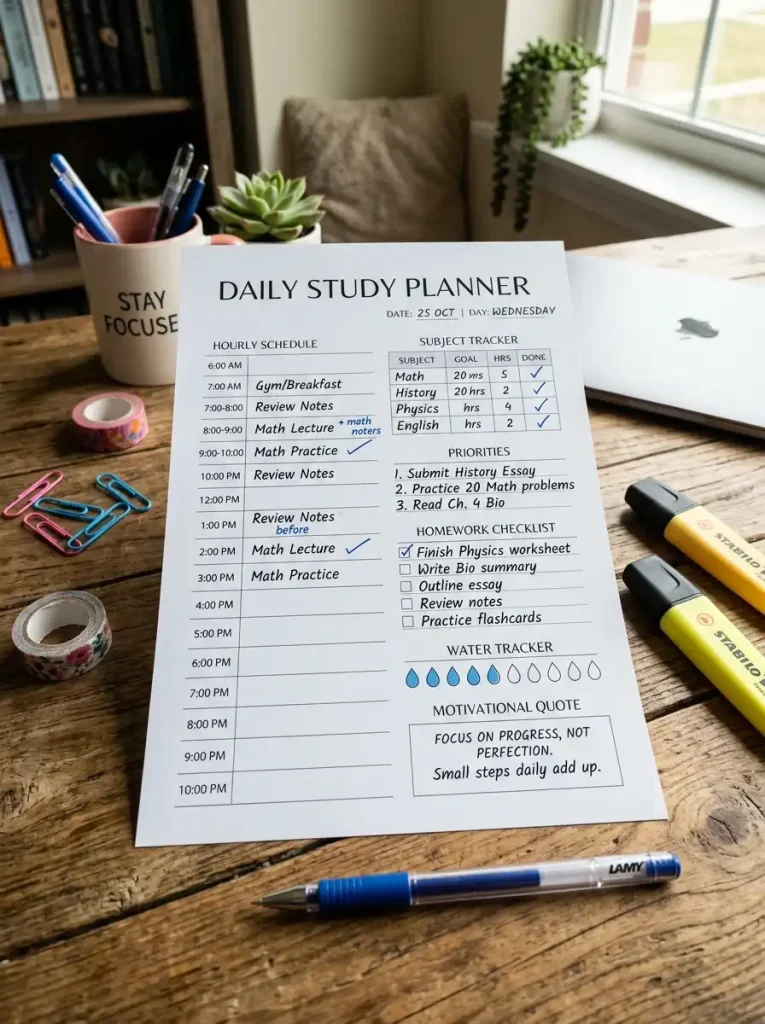
Best for: Students taking several classes who tend to favor certain subjects while neglecting others.
Key features: A table tracking subject, minutes studied, notes, and a three-item checklist (notes reviewed, practice done, questions asked) per subject.
Layout description: A green-accented table with alternating row shading, spacious enough to log detailed notes per class.
Advantages: Visualizing time distribution across subjects highlights imbalances immediately, making it easy to correct course before a subject falls too far behind.
Customization ideas: Add a color-coded dot next to each subject row matching your notebook or folder colors for that class.
Printing recommendations: Print in black and white for daily use, then fill in details with colored pens for quick visual scanning.
Ideal users: Students balancing four or more subjects who need built-in accountability for each one.
Download PDF: daily-study-planner-template-3.pdf
4. Time-Blocking Sprint Planner
Best for: Students who struggle with sustained focus and do better with short, timed bursts of work.
Key features: Eight 25-minute sprint rows, a subject/task column, notes space, and tally circles for tracking completed sprints, plus an end-of-day sprint review box.
Layout description: A warm orange design with clearly numbered sprint rows and small circles to mark progress.
Advantages: Short, structured sprints reduce burnout while still maintaining steady academic progress, especially for students who find long study blocks exhausting.
Customization ideas: Adjust the sprint length to 20 or 30 minutes if 25 doesn’t match your natural focus span.
Printing recommendations: Print several sheets at once, ideally a week’s worth, so a fresh one is always within reach.
Ideal users: Students with shorter attention spans, or anyone easily distracted by long, unbroken study sessions.
Download PDF: daily-study-planner-template-4.pdf
5. Wellness-Balanced Daily Planner
Best for: Students who tend to sacrifice basic self-care, water, sleep, breaks, while chasing academic goals.
Key features: A study task checklist, an eight-circle water tracker, mood and energy sliders, a gratitude line, a motivational quote box, and a sleep and bedtime tracker.
Layout description: A calming teal and pink palette softens the page, keeping the tone encouraging rather than purely task-driven.
Advantages: Balancing study demands with basic wellness habits supports better focus and prevents the burnout that derails long-term academic performance.
Customization ideas: Swap the included motivational quote for one of your own, or adjust the water tracker circles to match your personal hydration goal.
Printing recommendations: This one works especially well laminated, since daily wellness tracking benefits from long-term reuse.
Ideal users: Students prone to burnout, or anyone who wants their planner to support their whole day, not just their study tasks.
Download PDF: daily-study-planner-template-5.pdf
6. Minimalist Daily To-Do Planner
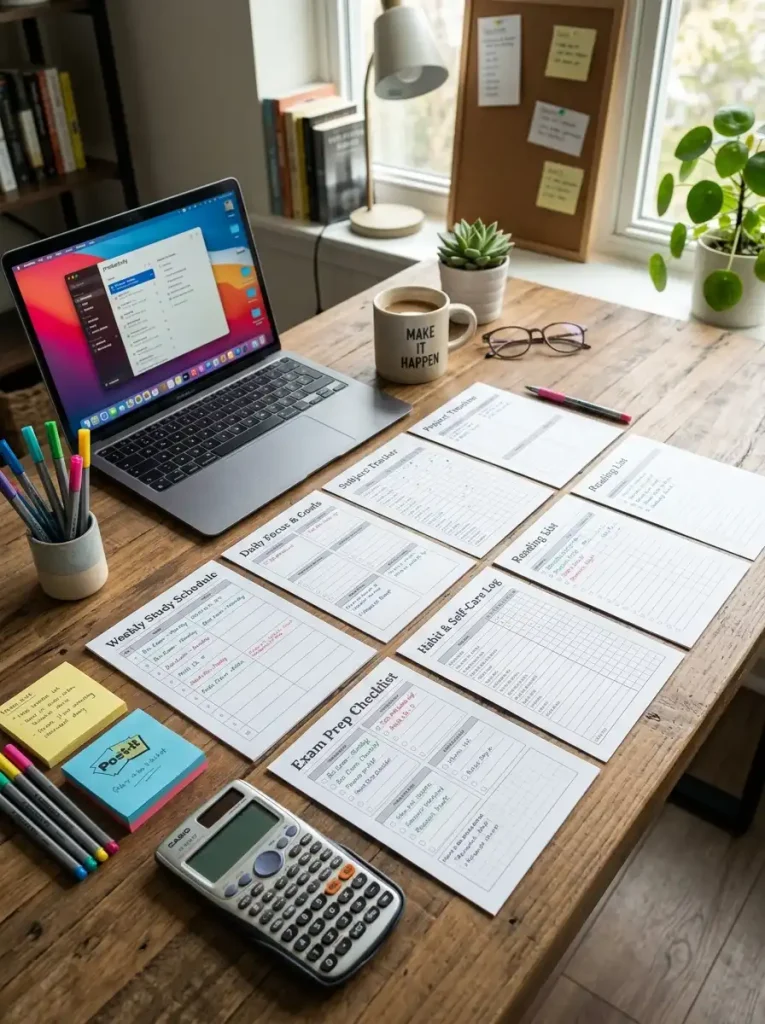
Best for: Students who find detailed templates overwhelming and just want a clean, simple checklist.
Key features: A ten-item to-do list, two quick-priority fields (must finish today, can wait until tomorrow), and an open notes section.
Layout description: A sleek charcoal header sits above generous white space, keeping the design distraction-free.
Advantages: Simplicity removes friction. Students who abandon complex planners often stick with this one specifically because it takes seconds to fill out.
Customization ideas: Number your list by priority order instead of checkboxes if you prefer working strictly top to bottom.
Printing recommendations: Print in bulk, since this simple format works well as a daily habit sheet you’ll use constantly.
Ideal users: Students who’ve tried complicated planners before and abandoned them, or anyone who values speed and simplicity above detailed tracking.
Download PDF: daily-study-planner-template-6.pdf
7. Exam-Day Focused Daily Planner
Best for: The specific day of a major exam, when your only job is final review and staying calm.
Key features: A time-blocked review table with a confidence rating column, a five-item exam day checklist, a calming quote box, and space for final formulas or facts to remember.
Layout description: A bold red header signals urgency, while the checklist and calming quote balance the page with reassurance.
Advantages: Structuring exam morning around light, confidence-rated review rather than frantic last-minute cramming supports calmer, more effective performance.
Customization ideas: Fill the “final facts” box the night before so it’s ready to glance at during breakfast on exam morning.
Printing recommendations: Print this one the week of your exam and keep it in your bag, not just at your desk.
Ideal users: Any student with a major test, final, or standardized exam on the calendar.
Download PDF: daily-study-planner-template-7.pdf
Get All 7 Templates in One PDF
Prefer one file instead of seven separate downloads? The combined bundle includes a clean cover page followed by all seven daily study planner templates, ready to print as a complete set.
📥 Download: 7-daily-study-planner-free-printable-templates.pdf — all seven templates plus a cover page, formatted for both Letter and A4 paper.
No email signup, no watermark, just eight ready-to-print pages.
Printable Planner Tips
A few small adjustments make printed planners far more usable day to day.
Paper size matters less than you’d think, since every template here fits both Letter (8.5 x 11 inches) and A4 paper without cutting off content. For printing options, always choose 100% scale rather than “fit to page,” which can shrink grid lines and cramp your handwriting space.
Color vs. black and white comes down to preference. Color headers help templates feel more inviting, though black-and-white printing saves ink for daily use.
For binding, a simple three-ring binder keeps a semester’s worth of daily sheets organized chronologically. Laminating your favorite template turns a one-time printable into a reusable planner you can fill with dry-erase markers for months. Finally, hole punching printed sheets before binding prevents the frustration of misaligned holes later.
How to Use Your Daily Study Planner Effectively
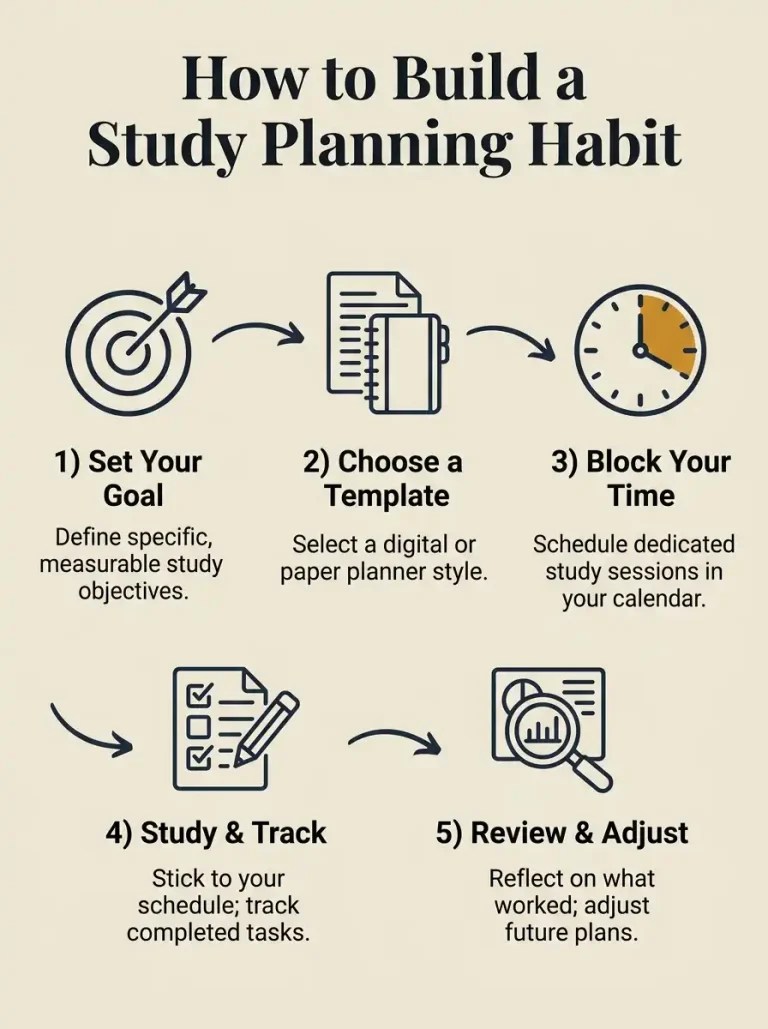
Owning a planner and actually using it well are two different skills. Follow these steps to build a routine that sticks.
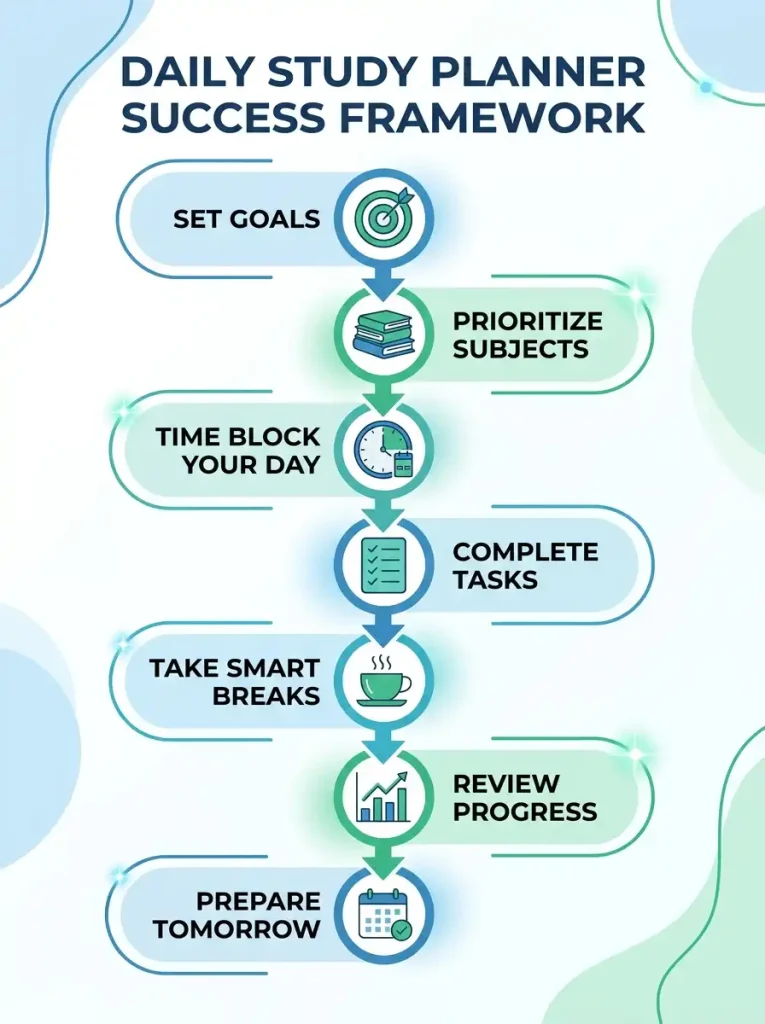
- Fill it out the night before or first thing in the morning, before distractions have a chance to take over your day.
- Prioritize your hardest subject during your highest-energy hours, rather than saving difficult material for when you’re already tired.
- Use time blocking deliberately, assigning specific tasks to specific chunks of time instead of working from an open-ended list.
- Schedule breaks intentionally, not just when you happen to feel tired, since planned breaks prevent burnout more reliably than reactive ones.
- Review your progress at the end of each day, noting what worked and what didn’t.
- Set one clear, specific goal for tomorrow before closing out today’s sheet.
- Avoid burnout by respecting your own limits, even when a plan feels incomplete at day’s end.
Common Mistakes Students Make
Even a great planner can underperform if a few habits go unchecked.
- Overscheduling every minute. Leave buffer time; an overpacked day causes more stress than the disorganization it’s meant to solve.
- Writing vague tasks. “Study math” accomplishes less than “review chapter 6 practice problems 1 through 15.”
- Skipping the reflection step. Without reviewing what worked, your planning never actually improves over time.
- Ignoring realistic time estimates. Tasks almost always take longer than expected, so build in extra room.
- Abandoning the planner after one rough day. Consistency matters more than any single day’s perfection.
- Forgetting to schedule breaks. Continuous studying without rest reduces both focus and retention.

Daily Study Routine Example
Here’s a sample day using several of the templates above together.
Morning (7–9 a.m.): Review yesterday’s notes and tackle your hardest subject while your energy is highest.
Afternoon (12–3 p.m.): Attend classes, then use two or three sprint blocks for focused homework between commitments.
Evening (6–8 p.m.): Work through your subject tracker, splitting time across remaining classes based on upcoming deadlines.
Review session (8:30 p.m.): Spend fifteen minutes checking off completed tasks and rating your confidence in tomorrow’s material.
Relaxation (9 p.m. onward): Close your planner fully. Protect this time as genuinely off-limits from schoolwork to support both rest and next-day focus.
Benefits of Printable PDFs Compared to Apps
Both formats work, and honestly, the right choice depends more on your habits than any objective superiority.
Printable planners offer real advantages. Handwriting tasks strengthens memory more effectively than typing them, according to research comparing handwritten and digital note-taking. There’s also no notification pulling your attention away mid-task, since paper simply can’t buzz.
That said, apps have genuine strengths too. They’re easier to edit when plans change suddenly, and they travel with you automatically since your phone is always nearby. Digital reminders also work well for time-sensitive alerts that a paper planner can’t provide on its own.
Many students find a hybrid approach works best: print a physical planner for the actual study session, then use a phone calendar only for appointment reminders and deadline alerts.
Frequently Asked Questions
What is the best daily study planner template for beginners?
The Minimalist Daily To-Do Planner works well for beginners, since its simple checklist format requires almost no setup while still providing clear daily structure.
How many templates are included in the free download?
Seven individual daily study planner templates are available, plus a combined PDF bundle containing all seven together with a cover page.
Can I print these templates on A4 paper?
Yes, every template uses generous margins designed to fit cleanly on both Letter (8.5 x 11 inches) and A4 paper without cutting off any content.
Which template works best for exam preparation?
The Exam-Day Focused Daily Planner is built specifically for exam mornings, with a confidence-rated review table and a calming checklist.
How do I stay consistent with a printable planner?
Fill it out at the same time each day, ideally the night before or first thing in the morning, and review your progress briefly each evening to build the habit.
Should I choose an hourly or priority-based planner?
It depends on your personality. Choose the Classic Hourly Planner if vague plans tend to fall apart, or the Priority-Focused Planner if hourly grids feel overwhelming.
Can teachers or parents use these planners with students?
Yes, all seven templates are free to print and share for classroom or homeschool use, making them useful tools for teaching organizational skills.
What’s the difference between the Subject Tracker and the Sprint Planner?
The Subject Tracker organizes your day around balancing multiple classes, while the Sprint Planner focuses on short, timed bursts of focused work regardless of subject.
Do I need color ink to print these templates?
No, every template prints clearly in black and white, though the color headers do help distinguish templates visually if color printing is available.
How is a printable planner better than a to-do list app?
Handwriting tasks tends to improve memory and follow-through more than typing them, and a paper planner offers zero notifications to distract you mid-task.
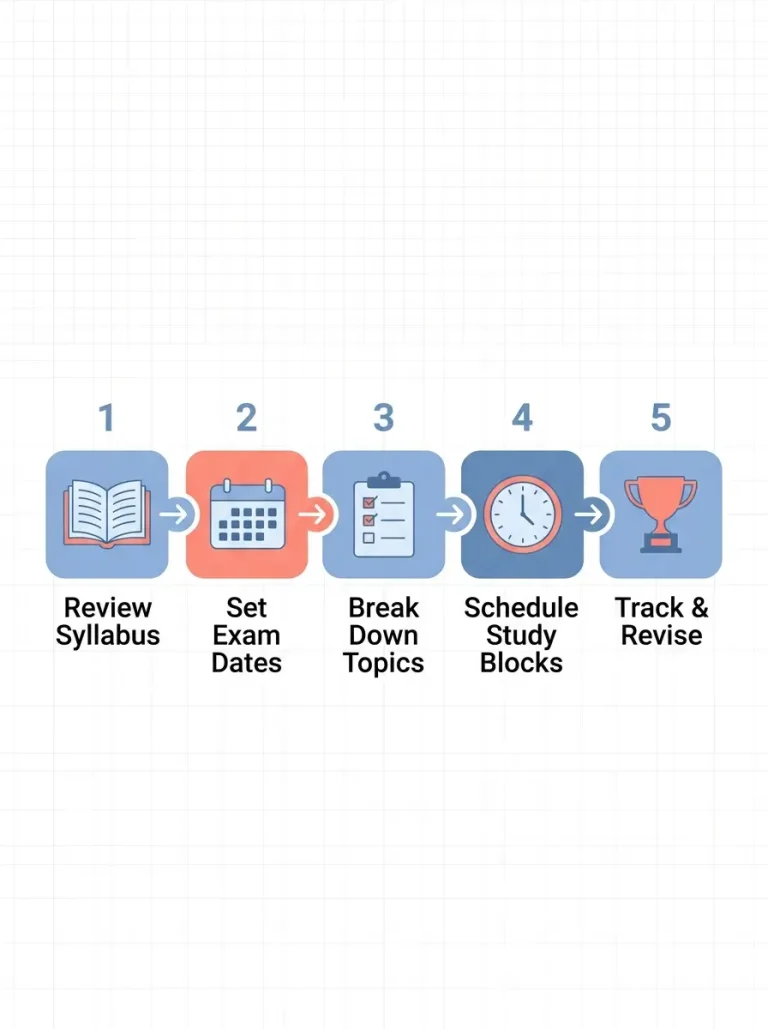
Infographic: Daily Study Planner Success Framework
Final Thoughts
A daily study planner won’t do the studying for you, but it will make sure your time actually goes where you intend it to go. That shift alone changes how manageable each day feels.
Try one template this week, whether that’s the Classic Hourly Planner for structure or the Minimalist To-Do for simplicity. Print it, use it honestly for seven days, and adjust based on what actually works for you.
Your next productive day starts with a single filled-in page. Download your favorite template above, print it out, and get started today.